

A catastrophic landslide swept through a sleeping village in eastern Democratic Republic of Congo early Tuesday, killing at least 13 people and leaving more than 30 unaccounted for in a disaster that underscores how natural catastrophes amplify suffering in regions already devastated by armed conflict.
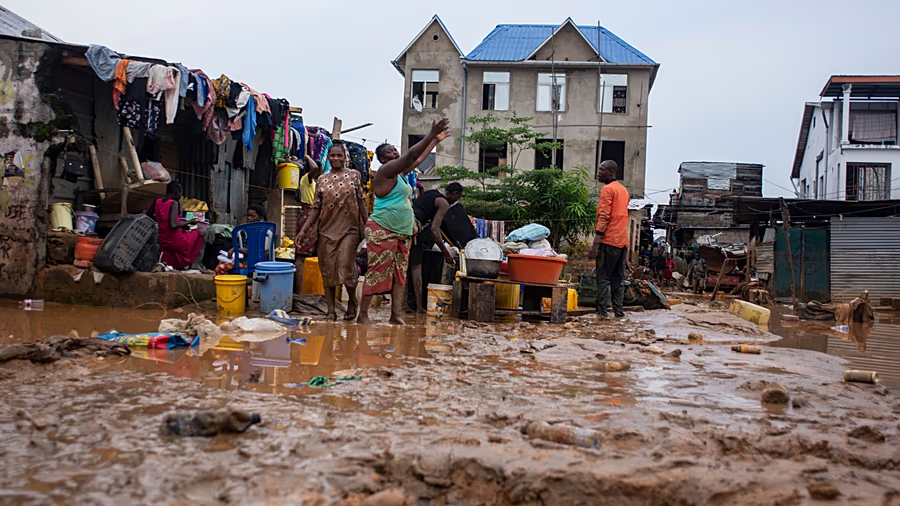
The hillside collapsed around 1 a.m. in Burutsi village, located in North Kivu province, burying homes and severing the primary transportation artery connecting the major city of Goma to Walikale, the provincial capital. The destruction followed several hours of intense rainfall that destabilized the terrain above the community.
“Nature acted terribly, and the entire hillside collapsed into the village of Burutsi while people were asleep,” Descarte Akilimali, the sector chief of the Burutsi area, told The Associated Press.
Witnesses described a scene of sudden devastation as torrents of mud, rock and debris cascaded down the slope, engulfing structures and trapping residents who had no warning of the impending disaster. The timing of the collapse, occurring during nighttime hours when most villagers were in their homes, maximized casualties and complicated immediate rescue attempts.
Local authorities have requested government assistance, but the severed road to Goma presents formidable logistical obstacles for emergency responders attempting to reach the disaster site. The infrastructure damage transforms what would ordinarily be a challenging rescue operation into a significantly more complex undertaking, potentially delaying the arrival of equipment and personnel critical to locating survivors trapped beneath debris.
The landslide adds another layer of tragedy to a region that has endured decades of violent conflict involving government forces and numerous armed groups. Eastern Congo’s ongoing security crisis creates conditions that magnify the impact of natural disasters, as weakened governance structures, damaged infrastructure and displaced populations reduce communities’ resilience when catastrophes strike.
North Kivu province has become the epicenter of violence linked to the Rwanda-backed M23 rebel movement, whose recent resurgence has intensified fighting and deepened an already acute humanitarian emergency. Walikale itself fell to M23 forces during an offensive last year, and the territory continues experiencing sporadic violence that disrupts daily life and undermines recovery efforts.
The convergence of natural disaster and armed conflict presents unique challenges that distinguish emergency response in eastern Congo from similar situations in more stable regions. Rescue teams must navigate not only physical obstacles created by the landslide but also security concerns related to ongoing hostilities that can restrict movement and access to affected areas.
More than 100 armed groups compete for control of mineral-rich territories in eastern Congo near the Rwandan border, creating a fragmented security landscape where violence remains endemic. This prolonged conflict has generated one of the world’s most severe humanitarian crises, with displacement figures exceeding 7 million people, humanitarian officials report.
The staggering displacement numbers reflect how sustained violence forces communities to abandon homes repeatedly as fighting shifts across territories. Internally displaced persons often settle in temporary camps lacking adequate shelter, sanitation or medical services, creating populations exceptionally vulnerable to additional shocks like natural disasters.
Earlier this year, M23 forces seized Goma and Bukavu, two strategically critical cities in eastern Congo, marking a major escalation in the conflict. The capture of these urban centers demonstrated the rebel movement’s growing capabilities and raised international alarm about the trajectory of violence in the region.
The fall of Goma proved particularly significant given the city’s role as a humanitarian hub and provincial capital. Its occupation by rebel forces disrupted aid operations, displaced hundreds of thousands of additional residents and severed supply chains that communities throughout the region depend upon for essential goods and services.
This context transforms the Burutsi landslide from an isolated natural disaster into a symptom of broader systemic failures affecting eastern Congo. Deforestation driven by conflict-related population displacement and resource extraction destabilizes hillsides, increasing landslide vulnerability during heavy rainfall. Weakened local governance reduces capacity for early warning systems, land use planning and emergency preparedness measures that might mitigate disaster impacts.
The region’s topography makes it inherently susceptible to landslides, with steep terrain and intense rainfall patterns creating conditions where soil saturation can trigger slope failures. Climate patterns potentially influenced by broader environmental changes may be intensifying rainfall events, though establishing direct causation requires more comprehensive meteorological data than conflict zones typically generate.
Communities in eastern Congo face impossible choices about where to settle, balancing landslide risks against security threats, agricultural viability and access to services. Conflict often forces populations onto marginal lands where natural hazard exposure increases, creating a vicious cycle where violence and environmental vulnerability reinforce each other.
The road closure between Goma and Walikale illustrates how infrastructure damage from natural disasters intersects with conflict dynamics. In stable regions, emergency road repairs would commence immediately. In eastern Congo, security considerations, resource constraints and competing priorities may delay restoration, prolonging isolation for affected communities.
Search and rescue operations in the coming days will determine whether additional survivors can be extracted from the debris field. The 30-plus missing persons represent families waiting for information about loved ones’ fates, a familiar agony for communities that have experienced repeated displacement and loss through years of violence.
Local authorities’ appeal for government assistance highlights the resource limitations that constrain response capabilities in provincial areas. National government attention often focuses on urban centers and politically strategic locations, leaving rural communities to manage crises with inadequate support.
International humanitarian organizations operating in eastern Congo will likely redirect resources toward landslide response, though ongoing conflict demands mean assistance for disaster victims competes with needs of displaced populations, malnourished children and communities affected by recent fighting.
The Burutsi landslide serves as a grim reminder that populations enduring armed conflict face compounded vulnerabilities extending beyond direct violence. Natural disasters, disease outbreaks, food insecurity and other challenges become more lethal in contexts where governance collapses, infrastructure deteriorates and social safety nets disintegrate.
For the 13 confirmed dead and their bereaved families, the landslide represents a tragedy compounded by the region’s broader crisis. For the missing, each passing hour reduces survival prospects as rescue efforts contend with obstacles ranging from unstable debris piles to the damaged road network that isolates Burutsi from outside assistance.
Eastern Congo’s overlapping emergencies demand integrated responses addressing both immediate humanitarian needs and underlying drivers of vulnerability. Yet the political complexities surrounding the conflict, competing international interests in the region’s mineral wealth and limited resources available for crisis response suggest that meaningful progress toward stability and resilience remains distant for communities like Burutsi.
The Associated Press




