

Cristiano Ronaldo’s absence from Al-Nassr’s upcoming Saudi Pro League fixture has intensified scrutiny around the internal dynamics of one of the kingdom’s most prominent football clubs, as fresh details point to mounting frustration by the Portuguese star over transfer policy, governance and competitive balance within the league.
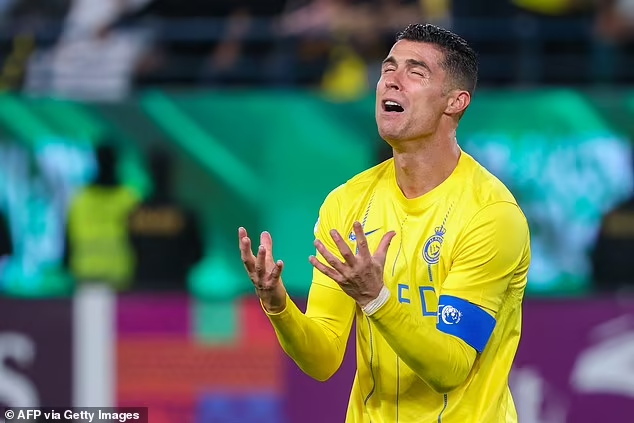
Ronaldo, the most decorated scorer in modern football and the highest-paid player in the sport’s history, will not feature in Al-Nassr’s next league match against Al-Riyadh. Initial explanations circulating in Saudi media suggested the 41-year-old was dealing with a minor physical concern. However, reporting by Portuguese outlet A Bola indicates the decision is rooted in dissatisfaction rather than fitness.
According to A Bola, Ronaldo has grown increasingly disillusioned with the role played by Saudi Arabia’s Public Investment Fund, which holds a controlling stake in Al-Nassr and three other Saudi Pro League clubs. The outlet attributes the forward’s frustration to what he perceives as preferential treatment toward rival sides, particularly league leaders Al-Hilal, during the most recent transfer window.
Ronaldo, who joined Al-Nassr in December 2022, has remained prolific on the pitch. He has scored 18 goals in 22 appearances across all competitions this season and has delivered 117 goals in 133 matches since arriving in Saudi Arabia. His contributions helped secure the Arab Club Champions Cup in 2023, one of the club’s most notable achievements in recent years.
Despite that output, A Bola reports that Ronaldo has privately voiced concerns that Al-Nassr failed to provide head coach Jorge Jesus with the reinforcements requested during the January transfer window. The club’s sole incoming addition was 21-year-old Iraqi midfielder Haydeer Abdulkareem, a signing that has done little to alter perceptions of competitive imbalance within the league.
In contrast, Al-Hilal bolstered their squad significantly, completing deals for former Arsenal defender Pablo Marí from Fiorentina and French forward Kader Meïté from Rennes in a transfer valued at approximately £26 million. The club has also been linked with a further £26 million move for Neom winger Saimon Bouabre, underlining the disparity in spending power between league rivals operating under the same ownership umbrella.
Last month, Jorge Jesus publicly acknowledged that imbalance, remarking that Al-Nassr “doesn’t have the political power of Al-Hilal.” The comments, delivered during a media appearance, prompted Al-Hilal to formally request a lengthy suspension for the coach, citing reputational harm. While no such sanction has been announced, the episode exposed tensions simmering beneath the league’s rapid expansion.
Further complicating matters for Al-Nassr is an internal restructuring that has reduced the influence of two figures close to Ronaldo. Sporting director Simão Coutinho and chief executive José Semedo, both long-time associates of the forward, had their authority curtailed earlier this month following a board-level decision. That move, as outlined by A Bola, has contributed to Ronaldo’s growing sense of marginalization within the club’s hierarchy.
The Public Investment Fund owns 75 percent stakes in Al-Nassr, Al-Hilal, Al-Ittihad and Al-Ahli and has been instrumental in transforming the Saudi Pro League into a global talking point. Its investment strategy has attracted elite players such as Karim Benzema, Riyad Mahrez and Kalidou Koulibaly, reshaping perceptions of Middle Eastern football and accelerating the league’s commercial profile.
Ronaldo’s situation, however, underscores the challenges of managing competitive integrity within a multi-club ownership model. While PIF has emphasized that each club operates independently, the uneven allocation of resources has fueled debate among players, coaches and supporters about fairness and long-term sustainability.
From a broader perspective, Ronaldo’s reported refusal to play marks a rare public rupture between the superstar and an employer that has built much of its global identity around his presence. Since arriving in Riyadh, Ronaldo has served as both a sporting talisman and a commercial ambassador, drawing unprecedented international attention to Saudi football.
His dissatisfaction carries implications beyond Al-Nassr. As the league continues to court elite talent, player confidence in governance structures may prove as important as financial incentives. High-profile figures expect not only lucrative contracts but also a clear commitment to competitiveness and sporting ambition.
Analysts note that Ronaldo’s stature amplifies the issue. When one of football’s most influential figures expresses discontent, it resonates across dressing rooms and boardrooms alike. The episode may prompt PIF and league officials to reassess how transfer strategies are communicated and how perceptions of favoritism are addressed.
At 41, Ronaldo remains driven by competition and legacy. While his scoring record in Saudi Arabia remains formidable, his ambitions extend beyond personal milestones. For Al-Nassr, resolving the standoff may require more than assurances; it may demand tangible evidence that the club intends to compete on equal footing with its rivals.
Whether Ronaldo’s absence represents a brief protest or a deeper fracture remains unclear. What is evident is that the Saudi Pro League’s rapid ascent now brings scrutiny that mirrors Europe’s elite competitions, where governance, transparency and sporting balance are increasingly central to the game’s credibility.




