

Tropical Cyclone Gezani tore across Madagascar’s eastern coastline, collapsing homes and crippling infrastructure in the country’s principal port city, leaving at least 31 people dead and thousands displaced, authorities confirmed Wednesday.
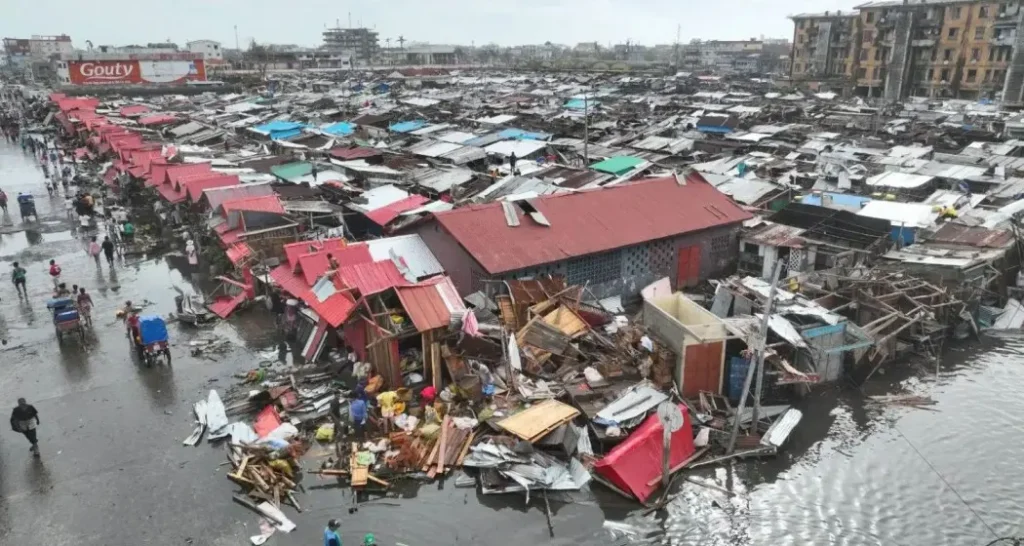
Madagascar’s National Office for Risk and Disaster Management attributed many of the fatalities to building collapses as the powerful storm made landfall late Tuesday in Toamasina, a coastal city of roughly 300,000 residents. At least 36 people sustained serious injuries, and four others were reported missing. More than 6,000 residents have been forced from their homes.
The national weather service placed multiple regions under red alert ahead of the cyclone’s arrival, cautioning that torrential rain and high winds could trigger flooding and landslides. Gezani struck the island with sustained winds exceeding 195 kilometers per hour (121 miles per hour), sweeping inland across a nation of about 31 million people, many of whom live in vulnerable housing structures ill-equipped to withstand severe storms.
Officials said the majority of the deaths occurred in and around Toamasina, where widespread destruction was visible across neighborhoods. Power outages have persisted in the city since Tuesday, compounding the challenges for emergency responders and residents attempting to assess the damage.
President Michael Randrianirina, who assumed office following a military takeover in October, traveled to Toamasina to inspect affected areas and meet with displaced families. Footage released on his office’s Facebook page showed inundated streets, homes with torn-off roofs, shattered storefronts and debris strewn across major thoroughfares. Uprooted trees and downed utility poles lined sections of the city, underscoring the scale of the destruction.
In a statement, the president’s office indicated that approximately 75% of Toamasina’s infrastructure had sustained damage or been destroyed.
“It’s devastation,” said a resident identified only as Michel, speaking by telephone. “Roofs have been blown away, walls have collapsed, power poles are down, trees have been uprooted. It looks like a catastrophic landscape.”
Gezani weakened to a tropical storm as it moved westward across Madagascar on Wednesday, passing roughly 100 kilometers (62 miles) north of the capital, Antananarivo. The capital remained under a red alert due to the risk of flooding as heavy rainfall continued.
Forecast models issued by the national weather service indicated that the system was expected to move into the Mozambique Channel between Madagascar and Africa’s east coast on Thursday. Meteorologists cautioned that Gezani could regain strength over warm ocean waters and potentially redevelop into a tropical cyclone before curving back toward Madagascar’s southwestern coastline next week.
Regional authorities are closely monitoring the storm’s path. In Mozambique, where severe flooding last month affected more than 700,000 people, officials issued precautionary weather advisories for three coastal provinces that could feel Gezani’s impact if the storm intensifies again.
Madagascar remains acutely vulnerable to tropical systems forming over the Indian Ocean. Less than two weeks ago, Tropical Cyclone Fytia struck the island on Jan. 31, killing 14 people and displacing more than 85,000 residents, according to the country’s disaster management agency. The back-to-back storms have strained already limited resources and deepened humanitarian concerns.
The United Nations earlier this week released $3 million from its emergency response fund to support preparedness and relief efforts ahead of Gezani’s landfall. U.N. spokesperson Stéphane Dujarric confirmed Monday that the funding was intended to help authorities reinforce response capacity in anticipation of the cyclone’s impact.
Madagascar’s cyclone season, which typically runs from November through March, regularly subjects the island to destructive weather systems. As the world’s fourth-largest island, Madagascar sits directly in the path of storms that gather strength over the warm waters of the Indian Ocean. Since 2020, more than a dozen tropical storms and cyclones have struck the country.
The United Nations Office for Disaster Risk Reduction estimates that such storms cause roughly $85 million in infrastructure damage annually, undermining development in one of the world’s poorest nations. Repeated destruction of roads, bridges, schools and hospitals hampers recovery efforts and leaves communities exposed when the next storm arrives.
Analysts note that Madagascar’s vulnerability stems not only from its geographic position but also from chronic underinvestment in resilient infrastructure. Rapid urban growth in coastal cities such as Toamasina has led to the expansion of informal settlements where housing is often constructed from lightweight materials unable to withstand hurricane-force winds. In rural areas, deforestation has exacerbated the risk of landslides during heavy rainfall, increasing the human toll of cyclones.
Climate scientists have also warned that warming ocean temperatures can intensify tropical systems, raising concerns that storms striking the southwest Indian Ocean basin may become more destructive over time. While no single cyclone can be directly attributed to climate change, experts say the trend toward heavier rainfall and stronger winds aligns with broader global patterns observed in other cyclone-prone regions.
For Madagascar, the immediate priority remains emergency relief and restoring essential services. Aid organizations are coordinating with local authorities to provide temporary shelter, clean water and medical assistance to displaced families. Restoring electricity and clearing blocked roads will be critical to reopening supply lines to affected communities.
As residents begin to sift through debris and account for losses, the rising death toll underscores the fragile balance between survival and vulnerability in a country repeatedly battered by extreme weather. With cyclone season still underway and forecasts suggesting Gezani could re-intensify, Madagascar faces the prospect of continued uncertainty in the days ahead.




