

Indiana, PA (BN24) – Former Vice President Dick Cheney, one of the most powerful and controversial figures in modern American politics, has died at the age of 84, his family confirmed in a statement released Saturday.
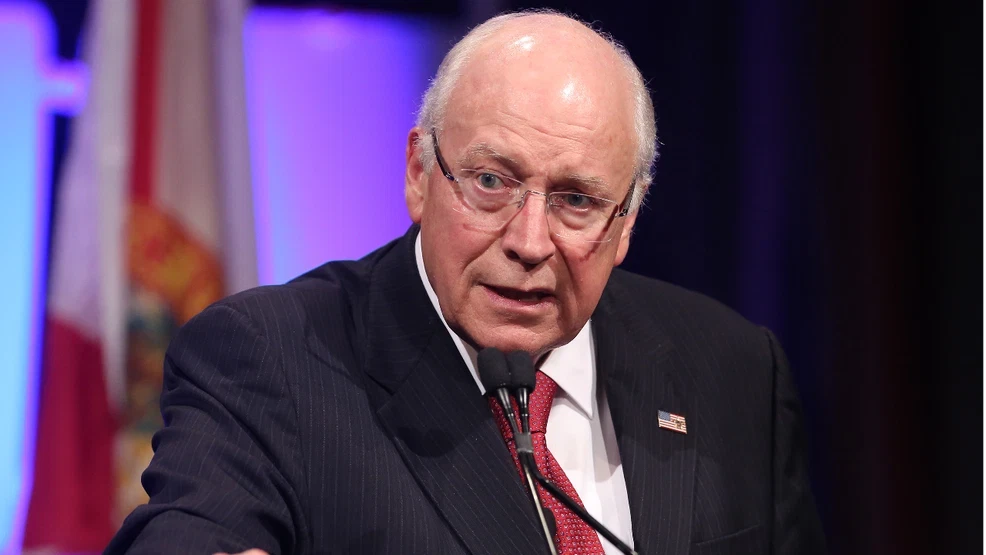
Cheney, who served as vice president under President George W. Bush from 2001 to 2009, passed away on November 3 after suffering from pneumonia and long-term cardiac and vascular disease.
“Dick Cheney was a great and good man who taught his children and grandchildren to love our country, and to live lives of courage, honor, love, kindness, and fly fishing,” his family’s statement read. “We are grateful beyond measure for all Dick Cheney did for our country. And we are blessed beyond measure to have loved and been loved by this noble giant of a man.”
Cheney’s health had been fragile for decades. He suffered multiple heart attacks over his lifetime and underwent a heart transplant in 2012, which he later described as “the gift of life itself.”
A Wyoming native, Cheney’s public service career spanned five decades. Before becoming vice president, he served as White House Chief of Staff under President Gerald Ford and later as Secretary of Defense under President George H.W. Bush, overseeing the U.S.-led coalition victory in the 1991 Gulf War.
But it was his tenure as vice president that cemented Cheney’s reputation as one of the most influential — and divisive — figures in American history.
When terrorists struck the United States on September 11, 2001, Cheney was in the White House bunker coordinating the nation’s immediate response. “At that moment, you knew this was a deliberate act,” he later told CNN. “This was a terrorist act.”
In the years that followed, Cheney became the chief architect of the U.S. invasion of Iraq in 2003, asserting that Saddam Hussein’s regime possessed weapons of mass destruction and maintained ties with al-Qaeda — claims that were later discredited. His advocacy for the war and for the use of “enhanced interrogation techniques” made him a lightning rod for criticism both domestically and abroad.
Despite widespread backlash, Cheney never wavered in his defense of those decisions. In a 2014 interview, he told the Senate Intelligence Committee, “I would do it again in a minute.”
Cheney’s influence during the Bush administration earned him the label of “the most powerful vice president in U.S. history.” Yet, it also left him one of the most polarizing — leaving office in 2009 with an approval rating of just 31 percent, according to the Pew Research Center.
In his later years, Cheney became increasingly outspoken against Donald Trump, appearing in a 2022 campaign ad for his daughter, Liz Cheney, in which he declared, “In our nation’s 246-year history, there has never been an individual who is a greater threat to our republic than Donald Trump.”
“He is a coward,” Cheney said in the ad. “A real man wouldn’t lie to his supporters. He lost his election, and he lost big.”
His daughter, Liz Cheney, a Republican congresswoman from Wyoming, confirmed that her father had planned to vote for Vice President Kamala Harris in the 2024 presidential election, marking a rare public break from the GOP.
Cheney is survived by his wife Lynne Cheney, and daughters Liz and Mary Cheney, both of whom have followed him into politics. Mary Cheney, who is openly gay, has been an advocate for LGBTQ+ rights within the Republican Party.
Cheney’s legacy was dramatized in the 2018 biographical film Vice, in which Christian Bale portrayed him. The film — a dark political satire directed by Adam McKay — received critical acclaim for Bale’s performance but was considered a modest commercial success, grossing $76 million worldwide against a $60 million budget.
As tributes pour in from political allies and rivals alike, Cheney’s passing marks the end of an era for a man whose tenure reshaped American foreign policy — and whose influence on Washington politics will be debated for generations.




