

Former CNN anchor Don Lemon entered a not guilty plea Friday to federal civil rights violations connected to a January church demonstration in Minnesota, maintaining he attended as a working journalist documenting civil unrest rather than as an active participant in the disruption.
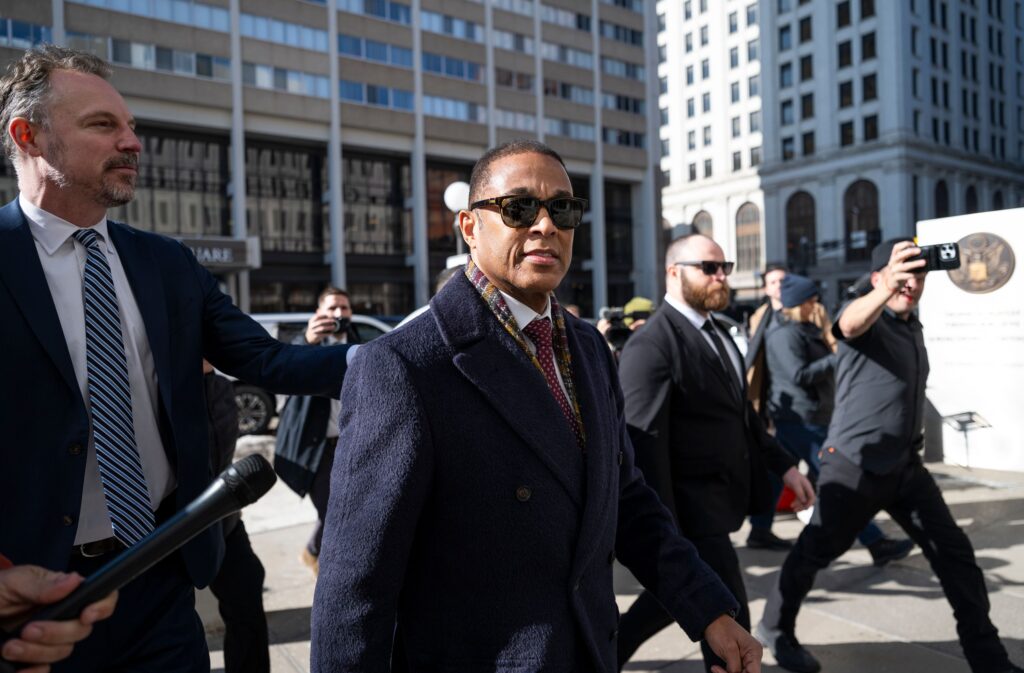
The high-profile case has ignited fierce debate over press freedoms, prosecutorial discretion, and the boundaries between journalistic observation and protest participation. Lemon now operates as an independent journalist following his departure from CNN, producing content for his livestream program that focuses on political and social justice issues.
Approximately two dozen demonstrators gathered outside the federal courthouse during Lemon’s arraignment, directing their ire at Attorney General Pam Bondi with rhythmic chants demanding her removal from office. The crowd simultaneously voiced support for press protections, creating a raucous backdrop to the legal proceedings unfolding inside.
“For more than 30 years, I’ve been a journalist, and the power and protection of the First Amendment has been the underpinning of my work,” Lemon declared outside the courthouse following his appearance before a federal magistrate. “The First Amendment, the freedom of the press, are the bedrock of our democracy.”
The charges against Lemon and eight co-defendants stem from a January 18 incident at Cities Church, a Southern Baptist congregation in St. Paul. Demonstrators interrupted worship services by chanting “ICE out” and “Justice for Renee Good,” referencing a 37-year-old mother of three fatally shot by an Immigration and Customs Enforcement officer in Minneapolis last month during the Trump administration’s intensified immigration enforcement operations.
Federal prosecutors invoked the 1994 Freedom of Access to Clinic Entrances Act to charge the nine individuals. The statute prohibits interference with or intimidation of any person through force, threatened force, or physical obstruction while they exercise religious freedom rights at houses of worship. Those convicted face maximum penalties of one year imprisonment and fines reaching $10,000.
The law’s application to this case represents an unusual expansion of legislation originally designed to protect abortion clinic access from blockades and harassment. Legal scholars note the statute’s language extends beyond reproductive health facilities to encompass all religious worship locations, though prosecutions for church disruptions remain comparatively rare.
During Friday’s hearing, Lemon’s attorney Abbe David Lowell requested the return of his client’s mobile phone, which law enforcement officials confiscated during Lemon’s arrest in Los Angeles. Prosecutors revealed the device remains in Department of Homeland Security custody, with the search warrant authorizing its examination still under court seal. The phone cannot be returned until forensic analysis concludes, government lawyers told the court.
The seizure and ongoing search of a journalist’s phone raises significant constitutional questions about press freedom and government overreach. Press advocacy organizations have historically challenged such actions as potential violations of reporter privilege and threats to source confidentiality, though courts have sometimes permitted such searches when journalists face criminal charges.
Four additional defendants entered not guilty pleas Friday, including Nekima Levy Armstrong, a prominent civil rights attorney and local activist who became an unwitting subject of digital manipulation by the White House. Armstrong appeared in a doctored photograph distributed through official White House social media channels that falsely depicted her crying during her arrest—an image that never actually occurred.
The fabricated image forms part of a broader pattern of artificially altered photographs circulating since federal officers fatally shot Renee Good and Alex Pretti in Minneapolis. The deployment of AI-generated misinformation by official government accounts represents an unprecedented development in American political communications, raising alarm among digital rights advocates and misinformation researchers.
Two more defendants connected to the Cities Church incident face arraignment next week, including Georgia Fort, another independent journalist whose presence at the demonstration similarly raises questions about distinguishing journalistic coverage from protest participation. The government’s decision to prosecute two individuals claiming journalistic status has generated particular controversy.
Lemon has consistently maintained his journalistic independence from the protest organizers. “I have spent my entire career covering the news. I will not stop now. In fact, there is no more important time than right now, this very moment for a free and independent media that shines a light on the truth and holds those in power accountable,” he told journalists following his initial arrest.
The church disruption provoked sharp condemnation from conservative religious and political figures. White House press secretary Karoline Leavitt issued a warning via social media: “President Trump will not tolerate the intimidation and harassment of Christians in their sacred places of worship.” The administration’s response reflects its cultivation of evangelical Christian support and positioning as a defender of religious liberty.
Interestingly, even clergy members who oppose the administration’s immigration enforcement approach expressed discomfort with the protest tactics. The disruption of worship services—regardless of the demonstrators’ motivations—violated widely shared norms about the sanctity of religious spaces and the appropriateness of political action during sacred observances.
Lemon’s legal team includes Joe Thompson, one of several former prosecutors who recently resigned from the Minnesota U.S. Attorney’s Office citing disagreements with the Trump administration’s immigration enforcement priorities and the Justice Department’s handling of the Good and Pretti shooting investigations. Thompson previously directed the office’s sprawling investigation into major public program fraud cases before departing last month.
The fraud cases Thompson supervised disproportionately affected Minnesota’s substantial Somali community, with most defendants coming from that population. The Trump administration has repeatedly cited these prosecutions as justification for heightened immigration enforcement in Minnesota, though critics argue the connection conflates criminal fraud with immigration status in misleading ways.
Thompson’s transition from federal prosecutor to defense attorney representing a defendant charged by his former office creates an unusual dynamic. His insider knowledge of Justice Department operations and prosecutorial strategies could prove valuable to Lemon’s defense, though it also highlights the significant turnover and internal dissent within federal law enforcement agencies over current administration policies.
The case raises fundamental questions about how courts should differentiate between journalists documenting civil disobedience and activists participating in it. Traditional distinctions relied on factors like press credentials, employment by established news organizations, and physical positioning relative to protesters. However, the proliferation of independent journalism, citizen reporting, and livestream documentation has blurred these once-clear boundaries.
Lemon’s transition from mainstream media employee to independent content creator places him in an increasingly common category that challenges conventional frameworks. While major news organizations provide institutional credibility and legal resources to shield their journalists, independent reporters often operate without such protections, making them potentially more vulnerable to prosecution when covering controversial events.
The prosecution’s decision to charge Lemon and Fort—both claiming journalistic roles—sends a chilling signal to reporters covering protest movements and civil unrest. Press freedom organizations worry that aggressive prosecution of journalists at demonstrations could deter coverage of dissent and government accountability, particularly among independent reporters lacking corporate legal departments.
First Amendment scholars will watch this case closely as courts balance competing constitutional values: religious freedom to worship without disruption versus press freedom to document events of public concern. The outcome could establish important precedents for how authorities treat journalists present at protests that cross legal boundaries.
Beyond its immediate legal significance, the case reflects broader tensions surrounding immigration enforcement, religious liberty, press freedom, and political dissent in contemporary America. The convergence of these issues in a single prosecution illustrates how deeply polarized the nation has become over fundamental questions of rights, responsibilities, and the proper exercise of governmental power.
As the case proceeds toward trial, both legal arguments and public opinion will shape its trajectory. Whether Lemon ultimately prevails may depend less on the specific facts of January 18 than on how courts and jurors perceive the essential nature of journalism in an era when anyone with a smartphone can claim to be documenting history.




