

GOMA, Democratic Republic of Congo (BN24) — A drone strike by Congolese armed forces near the strategic Rubaya mining site in eastern Democratic Republic of Congo killed the military spokesperson of the M23 rebel group and at least nine other people, according to multiple sources cited by international media.
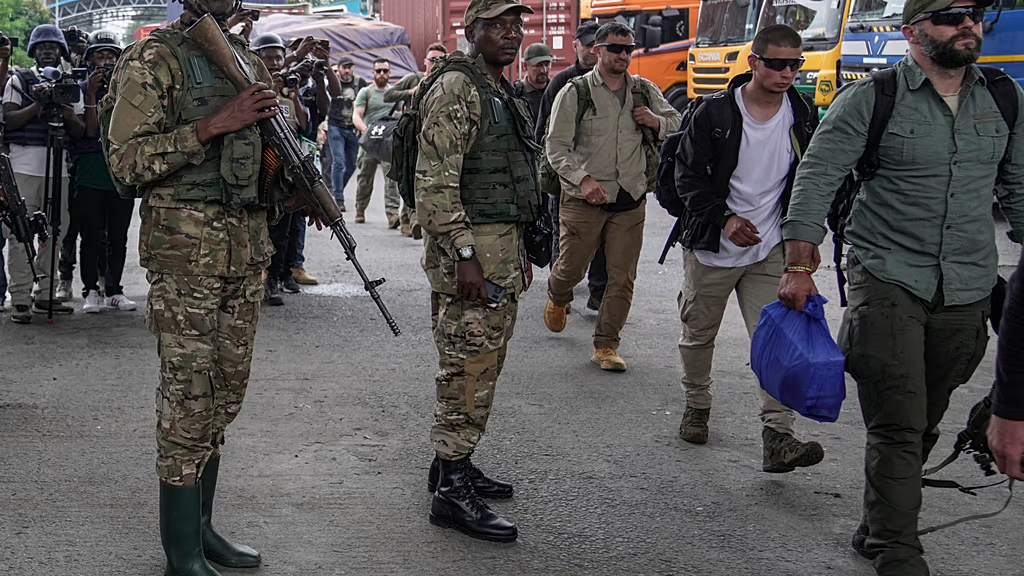
The strike, carried out on Feb. 24, targeted positions linked to the M23/AFC rebel movement near Rubaya, a mining hub that accounts for a significant share of the world’s coltan supply. Among those killed was Willy Ngoma, who served as the movement’s military spokesperson. The group’s overall military commander was not harmed in the operation.
Individuals familiar with the aftermath told several press agencies that nine additional people died in the strike. Reuters, citing its own information channels, indicated that as many as seven more fatalities could be connected to the attack, although no further remains had been recovered from the site at the time of its dispatch.
The M23 movement has not publicly addressed the strike or confirmed the casualty figures.
The Rubaya mining complex occupies a pivotal role in the global supply chain for coltan, a mineral used in the production of electronic components for smartphones, computers, and other consumer technologies. Industry estimates indicate the site accounts for between 15% and 30% of worldwide coltan output, making it one of the most strategically significant mineral assets in the region.
The M23 rebel group seized control of Rubaya during a rapid military advance last year that saw it capture extensive territory across eastern Congo. Since then, the area has remained under rebel administration, with the Congolese government vowing to reclaim it.
The Feb. 24 strike marks a notable escalation in Kinshasa’s campaign to dislodge M23 from resource-rich zones. The Congolese armed forces have increasingly relied on aerial surveillance and unmanned aerial vehicles to monitor and strike rebel positions in North Kivu province, where fighting has displaced hundreds of thousands of civilians over the past two years.
Willy Ngoma had been one of the most visible figures within M23, frequently appearing in public communications and media engagements to articulate the group’s position. His death could represent a significant symbolic blow to the movement, even as its core military leadership remains intact.
While the Congolese government has not issued a detailed public account of the operation, the targeting of a high-profile spokesperson suggests that the operation was intelligence-driven. At the same time, reports of additional civilian or non-combatant casualties raise concerns about the human toll in densely populated or economically active areas such as Rubaya.
Eastern Congo has endured decades of armed conflict involving government forces, local militias, and foreign-backed insurgent groups. The resurgence of M23 in recent years has further destabilized the region, prompting diplomatic tensions between Congo and neighboring Rwanda, which Kinshasa accuses of backing the rebels — an allegation Rwanda denies.
The capture of Rubaya amplified M23’s leverage, both economically and strategically. Control over coltan mines provides not only financial resources but also bargaining power in any potential negotiations. The mineral’s centrality to global electronics manufacturing has drawn international scrutiny to the conflict, with advocacy groups warning of the risk that supply chains could be tainted by the involvement of armed groups.
Reuters’ reporting on the strike underscores the uncertainty surrounding the full casualty count. The agency noted the possibility of additional deaths beyond the nine initially confirmed, though recovery efforts at the site had not yielded more bodies at the time of publication.
The absence of an official response from M23 leaves unanswered questions about the group’s next move. In past confrontations, rebel factions have responded to targeted killings with retaliatory offensives or intensified recruitment campaigns.
The drone strike near Rubaya reflects a broader evolution in the Congolese military’s operational approach. By deploying unmanned systems to strike high-value targets, Kinshasa signals an attempt to project precision and deterrence without engaging in prolonged ground battles that can expose troops to ambushes.
However, such tactics carry political and humanitarian risks. If reports of additional fatalities prove accurate, scrutiny over proportionality and civilian harm could intensify, particularly given Rubaya’s economic importance and the presence of miners and traders in the area.
The elimination of a spokesperson like Willy Ngoma may disrupt M23’s communications apparatus, but it is unlikely on its own to dismantle the group’s command structure. Rebel movements often anticipate leadership losses and maintain layered hierarchies to ensure continuity. The survival of the military commander suggests operational cohesion may remain largely intact.
Moreover, Rubaya’s significance extends beyond immediate battlefield calculations. With up to nearly a third of global coltan supply linked to the site, instability there has implications for international markets. Technology manufacturers, already under pressure to certify conflict-free sourcing, may face renewed scrutiny if violence escalates.
Diplomatically, the strike could complicate ongoing regional mediation efforts aimed at de-escalating tensions between Congo and its neighbors. A targeted killing in a contested economic zone risks hardening positions on both sides, especially if civilian casualties are substantiated.
For residents of eastern Congo, the episode underscores the precarious balance between military action and civilian safety. Communities in North Kivu have endured repeated cycles of displacement, and renewed aerial strikes could trigger further movement if residents fear additional attacks.
Ultimately, the Feb. 24 operation illustrates the high stakes surrounding control of mineral wealth in conflict zones. As Kinshasa seeks to reassert sovereignty over Rubaya and other strategic sites, the interplay between security operations, rebel resilience, and global economic interests will continue to shape the trajectory of violence in eastern Democratic Republic of Congo.





