

At least five migrants, including two women, were found dead along Libya’s coastline east of the capital, Tripoli, on Saturday, a local police official said, in the latest grim reminder of the dangers facing those attempting the Mediterranean crossing to Europe.
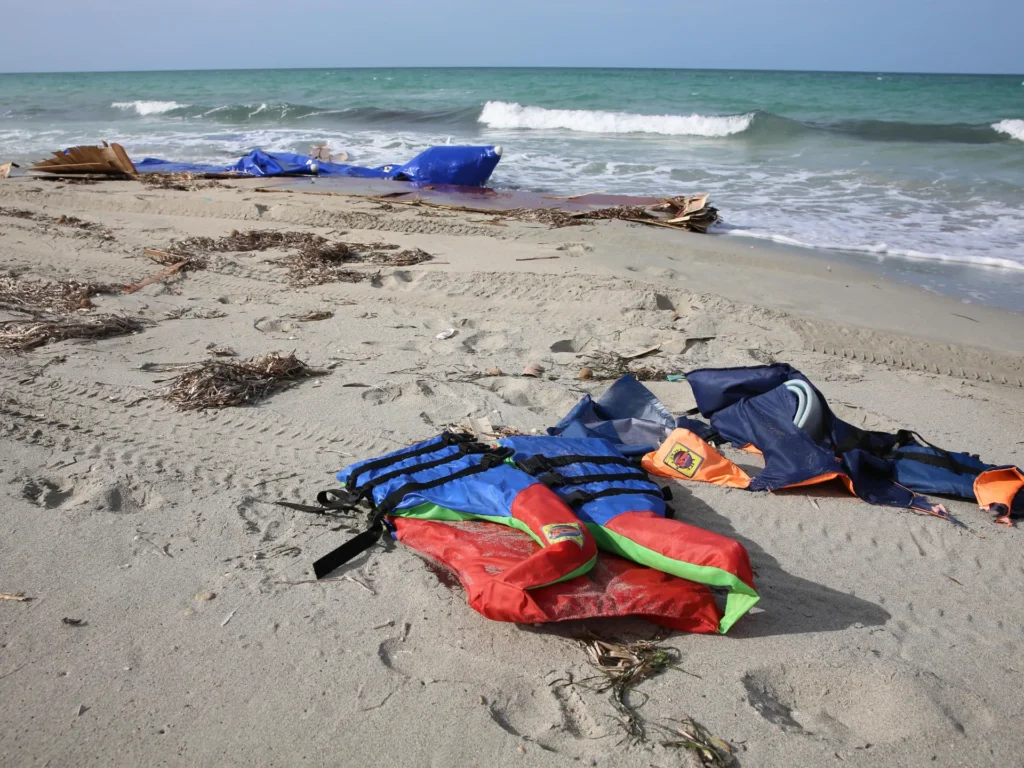
Hassan Al-Ghawil, head of investigations at the Qasr al-Akhyar police station, told Reuters that residents discovered the bodies on Emhamid Al-Sharif shore, in the western part of the coastal town. Authorities were alerted after bystanders spotted the victims lying along the sand.
Al-Ghawil indicated that community members also saw the body of a child wash ashore before high waves carried it back into the sea. Libya’s coast guard has been asked to search for the missing child, he added.
The recovered victims were described as dark-skinned migrants. Images circulated online — and viewed by Reuters — showed several bodies still partially encircled by black inflatable lifebuoys, suggesting they had been traveling aboard a small rubber craft commonly used by smugglers ferrying migrants across the Mediterranean.
“We notified the Red Crescent to retrieve the remains,” Al-Ghawil said, adding that the bodies were intact and that additional victims may yet surface as tides shift.
Qasr al-Akhyar lies roughly 73 kilometers (45 miles) east of Tripoli and has long been one of several points along Libya’s sprawling coastline where migrant boats depart or are intercepted.
Libya has served as a principal transit hub for migrants and asylum-seekers fleeing war, persecution and economic hardship in sub-Saharan Africa and parts of the Middle East. The surge in crossings intensified after the 2011 NATO-backed uprising that toppled longtime ruler Muammar Gaddafi, plunging the country into prolonged instability.
Since 2014, Libya has been divided between rival administrations in the east and west, each backed by armed factions. The fragmentation of state authority has enabled human trafficking networks to flourish, with smugglers operating detention warehouses and launching overcrowded boats from remote beaches.
The International Organization for Migration has repeatedly warned that Libya remains one of the most hazardous migration corridors in the world. Earlier this month, the IOM disclosed that 53 migrants, including two infants, were dead or missing after a rubber boat carrying 55 people capsized off the coast of Zuwara in western Libya.
Those figures underscore the persistent volatility of the Mediterranean route — a stretch of sea that has claimed thousands of lives over the past decade.
Last week, a United Nations report detailed systemic abuses faced by migrants inside Libya, including killings, torture, sexual violence and forced labor. The report urged governments to suspend the practice of returning intercepted migrant boats to Libyan shores until safeguards for human rights can be guaranteed.
International agencies say many migrants intercepted at sea are transferred to detention centers where conditions are often described as dire. Human rights monitors have documented overcrowding, inadequate food and medical care, and violence perpetrated by both state-affiliated units and armed groups.
Libyan authorities maintain that they are working to curb smuggling operations and stabilize coastal regions, though limited resources and competing power centers have complicated enforcement.
The discovery in Qasr al-Akhyar follows a pattern seen repeatedly along Libya’s coastline: small craft launched under cover of darkness, often overloaded and poorly equipped, capsizing before reaching international waters. Many passengers lack life jackets, and inflatable boats frequently deflate or rupture during the journey.
The presence of lifebuoys around some of the recovered victims suggests attempts were made to prevent drowning, though such measures offer little protection against high swells and prolonged exposure.
Migration experts note that departures often spike during favorable weather windows, even as seasonal storms increase unpredictability. The Mediterranean crossing from Libya to Italy can span more than 300 kilometers (186 miles), depending on the launch point.
While European Union naval patrols and Libyan coast guard interceptions have reduced some flows in recent years, smuggling networks continue to adapt routes and tactics.
The latest fatalities highlight not only the perilous maritime conditions but also the structural factors driving migration through Libya. Political fragmentation has left large swaths of territory beyond consistent government control, creating fertile ground for trafficking rings. Without a unified security apparatus or comprehensive judicial oversight, dismantling smuggling operations remains challenging.
The repeated discovery of bodies along Libya’s eastern and western shores suggests that enforcement measures alone have not deterred departures. Many migrants weigh the immediate dangers of the sea against prolonged detention or exploitation on land — a calculus that often leads them to risk the crossing despite well-documented hazards.
The U.N.’s call for a moratorium on returning migrants to Libya reflects a broader debate within Europe and North Africa over burden-sharing and accountability. Critics argue that European migration agreements with Libyan authorities effectively outsource border control without ensuring humane treatment. Supporters contend such arrangements are necessary to manage irregular flows and prevent further drownings.
The Qasr al-Akhyar tragedy also underscores the absence of comprehensive regional solutions. Efforts to address root causes — including economic collapse, armed conflict and climate stress in migrants’ countries of origin — remain uneven. Until those drivers are mitigated, Libya’s coastline is likely to remain both a launching point and a graveyard.
Humanitarian organizations say improved search-and-rescue coordination, expanded legal migration pathways and stronger oversight of detention facilities could reduce fatalities. Yet diplomatic tensions and resource constraints continue to stall sustained reform.
For now, the images of lifebuoys resting beside silent waves serve as a stark emblem of a crisis that has become tragically routine.
Reuters




