

Israeli warplanes struck multiple locations across the Gaza Strip on Sunday, killing at least 11 Palestinians, Gaza health and civil defense officials said, as Israel’s military declared the attacks were carried out in response to what it characterized as a serious breach of the ceasefire by Hamas fighters.
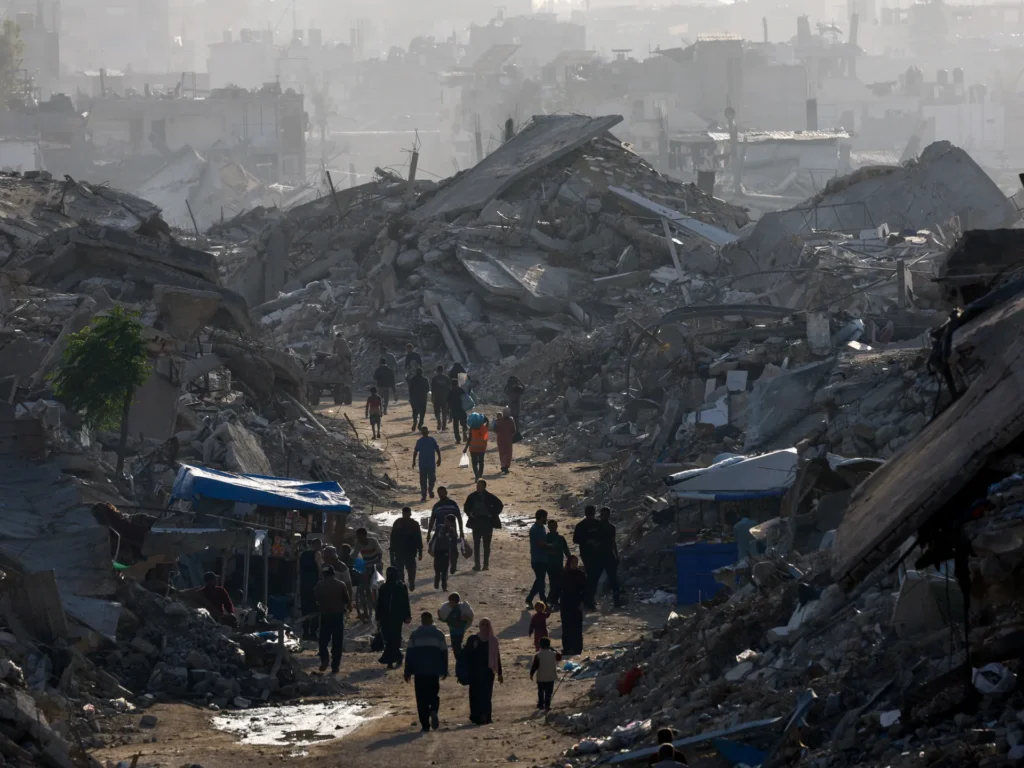
Medical personnel in Gaza indicated that one airstrike hit a tent encampment housing displaced families in northern Gaza, leaving at least four people dead. In the southern city of Khan Younis, hospital authorities confirmed that five others were killed in a separate strike. Another Palestinian was fatally shot in northern Gaza, local officials added.
Israeli forces also targeted sections of Gaza City, including the Tel Al-Hawa neighborhood, where the military asserted that militants were operating from underground tunnel networks. Palestinian authorities did not immediately provide casualty figures from those strikes.
An Israeli military official described the aerial bombardment as “precise” and consistent with international law. The official maintained that the operation followed what Israel considers a “blatant violation” of the October ceasefire agreement in the Beit Hanoun area one day earlier.
The military contended that armed militants surfaced from subterranean infrastructure near Israeli troops and crossed the so-called “Yellow Line,” a boundary established under the truce to delineate Israeli and Hamas-controlled areas. Approaching Israeli positions while armed amounted to a direct violation of the ceasefire’s terms, the official said.
Hamas rejected Israel’s account. Hazem Qassem, a spokesperson for the group in Gaza, denounced the strikes as a “massacre” targeting displaced civilians and labeled the operation a grave breach of the truce. He urged international mediators to intervene, particularly ahead of a high-level diplomatic meeting in Washington later this week.
The ceasefire, brokered with U.S. involvement, entered a new phase last month and forms a central pillar of President Donald Trump’s broader effort to wind down the war in Gaza. U.S. officials have indicated that President Donald Trump intends to unveil a multi-billion-dollar reconstruction initiative for Gaza and outline plans for a United Nations-authorized stabilization force during the upcoming talks.
Under the truce, Israeli troops repositioned behind the Yellow Line while retaining control of significant portions of the enclave. The agreement envisioned a gradual reduction in hostilities and included provisions calling for Hamas to relinquish its weapons — a stipulation the group has so far declined to fulfill. Israeli officials have cautioned that military measures will continue if Hamas does not comply with the framework.
Since the truce took effect, casualty figures have remained disputed. Gaza’s health ministry says more than 600 Palestinians have been killed by Israeli fire during the ceasefire period. Israel’s military states that four Israeli soldiers have died in Gaza over the same span.
The war erupted on Oct. 7, 2023, when Hamas militants carried out a cross-border attack on southern Israel that left more than 1,200 people dead, based on Israeli tallies. Israel’s subsequent military campaign in Gaza — encompassing extensive airstrikes and ground operations — has killed more than 72,000 Palestinians, Gaza health authorities say.
Media access to Gaza remains limited, complicating independent verification of casualty counts and battlefield claims.
Sunday’s strikes highlight the precarious nature of the ceasefire. Both Israel and Hamas have repeatedly accused one another of violations, underscoring the deep mistrust that persists despite diplomatic mediation. While the agreement has reduced large-scale offensives compared with earlier phases of the conflict, localized violence continues, particularly near contested zones such as the Yellow Line.
The renewed violence illustrates the structural fragility of ceasefires in asymmetrical conflicts, where ambiguous boundaries and competing narratives frequently undermine enforcement. The Yellow Line, conceived as a buffer to separate Israeli and Hamas forces, has become both a tactical and symbolic flashpoint. Its shifting interpretation by each side complicates implementation and increases the likelihood of clashes triggered by disputed movements.
Politically, the timing of the strikes adds pressure to President Donald Trump’s diplomatic initiative. Any escalation risks weakening international support for reconstruction efforts and complicating negotiations over stabilization forces. Hamas’ refusal to disarm remains a central obstacle; Israel regards disarmament as nonnegotiable for long-term security, while Hamas frames it as surrender.
Regionally, renewed hostilities may also influence neighboring states, particularly Egypt and Qatar, which have previously played mediating roles. Persistent ceasefire violations could strain diplomatic channels and affect broader Middle East stability at a time when international actors are seeking to prevent spillover.
Humanitarian implications are equally significant. Displacement remains widespread, and strikes on tent encampments underscore the vulnerability of civilians even during periods labeled as ceasefires. Rebuilding Gaza’s infrastructure will require not only financial commitments but sustained security guarantees — a challenge that remains unresolved.
The developments suggest that while the ceasefire framework has prevented full-scale warfare from resuming, it has not eliminated the underlying drivers of conflict. Without mutual confidence-building measures and enforceable monitoring mechanisms, each reported violation risks unraveling the fragile calm.
As diplomatic efforts continue in Washington and the region, Sunday’s airstrikes serve as a stark reminder that the Gaza truce remains tenuous, with both military calculations and political negotiations shaping its uncertain trajectory.
Reuters/KoreaTimes




