

Israeli airstrikes and gunfire killed five Palestinians in Gaza on Tuesday, health officials confirmed, marking the latest violence eroding a four-month-old U.S.-brokered truce in the enclave as both sides repeatedly trade accusations of ceasefire violations threatening the fragile peace agreement.
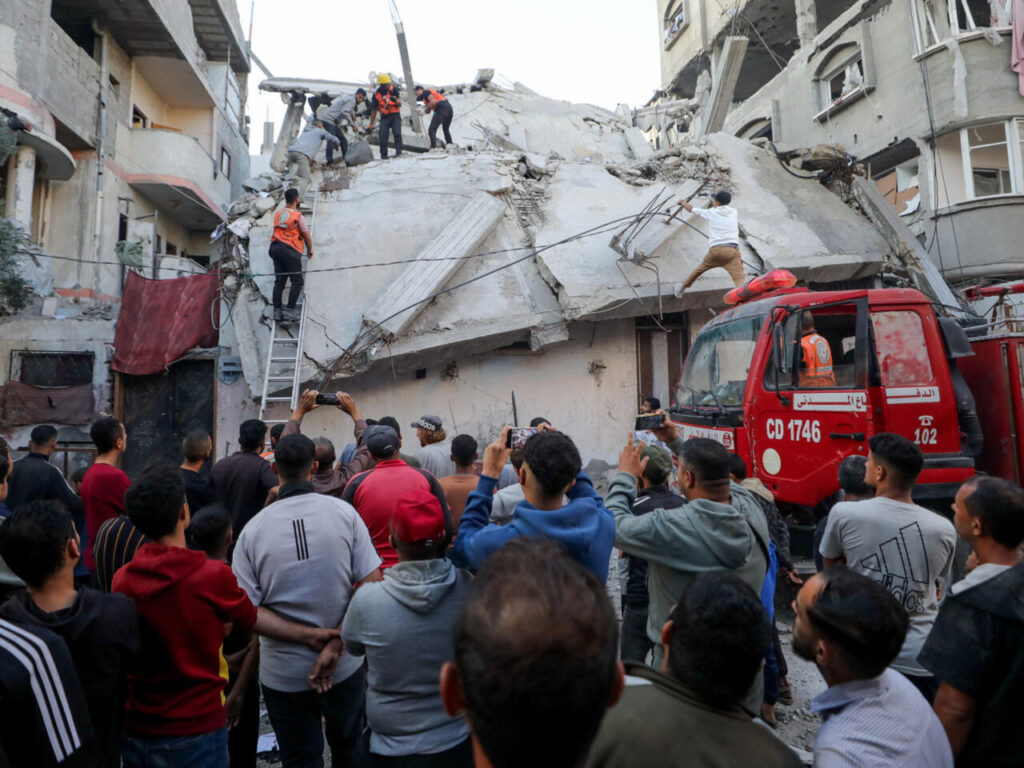
In Deir Al-Balah in central Gaza, an airstrike killed two individuals riding an electric bike, medics disclosed. Subsequently, Israeli drone fire killed a woman in Deir Al-Balah while troops shot dead a man in Khan Younis in the southern region, medical personnel detailed. Another man perished from Israeli gunfire in Jabalia in northern Gaza, Palestinian medics confirmed.
The Tuesday violence followed a deadly Monday encounter when Israeli forces killed four militants in the southern city of Rafah after they emerged from an underground tunnel and opened fire on troops. Without commenting directly on the four people killed Tuesday, the Israeli military asserted it carried out attacks targeting what it characterized as Hamas militants in response to Monday’s incident in Rafah.
In Gaza City, dozens of Palestinians rallied at funeral services for three people killed by an Israeli airstrike on an apartment building in the area Monday night. One body was draped in a Hamas green flag, while another displayed a green Hamas ribbon on his forehead, signaling that the two were members of the militant organization. Reuters was unable to ascertain the identities of those killed.
Israel and Hamas have repeatedly traded blame for violations of the ceasefire agreement, a cornerstone element of President Donald Trump’s plan to terminate the Gaza war—the deadliest and most destructive conflict in the generations-old Israeli-Palestinian struggle. The mutual accusations of treaty violations threaten to collapse entirely a truce that has proven fragile since its October implementation.
The next phase of Trump’s peace plan requires Hamas disarmament, Israeli troop withdrawal from Gaza territory, and deployment of an international peacekeeping force. Hamas has consistently rejected demands to surrender its weapons, while Israeli officials indicate they are preparing for a return to full-scale warfare should the ceasefire completely disintegrate.
At least 580 Palestinians have been killed by Israeli fire since the October ceasefire deal was finalized, Gaza’s health ministry calculates. Israel maintains that four soldiers have been killed by militants in Gaza over the identical period, highlighting the asymmetric casualty patterns that have characterized the conflict throughout.
The Gaza war commenced with the October 7, 2023 Hamas attack on southern Israel that killed more than 1,200 people, Israeli tallies indicate. Israel’s subsequent air and ground war in Gaza has killed more than 72,000 people since then, Palestinian health ministry data shows—a staggering death toll that underscores the conflict’s catastrophic humanitarian impact.
Arab News disclosed that Israeli military strikes Monday killed three people west of Gaza City, the hospital receiving the casualties confirmed. Shifa Hospital reported the deaths amid the months-old ceasefire that has witnessed continued fighting despite its nominal existence.
The Israeli army asserted Monday it is striking targets in response to Israeli troops coming under fire in Rafah, which it characterized as a ceasefire violation. The army emphasized it is striking targets “in a precise manner,” framing operations as measured responses rather than indiscriminate attacks.
The four-month-old U.S.-backed ceasefire followed stalled negotiations and included Israel and Hamas accepting a 20-point plan proposed by President Trump aimed at ending the war unleashed by Hamas’ October 7, 2023 attack into Israel. At the time, Trump proclaimed it would lead to a “Strong, Durable, and Everlasting Peace”—a characterization that now appears optimistic given persistent violence.
Hamas freed all living hostages it still held at the deal’s outset in exchange for thousands of Palestinian prisoners held by Israel and the remains of others. This prisoner exchange represented the ceasefire’s most tangible achievement, reuniting families separated by the conflict’s brutal dynamics.
However, the larger issues the agreement sought to address—including Gaza’s future governance structure—were met with substantial reservations from both sides, and the United States offered no firm implementation timeline. This ambiguity has enabled both parties to interpret ceasefire terms selectively while continuing military operations they characterize as defensive or responsive.
U.N. Secretary-General Antonio Guterres expressed grave concern Monday about the Israeli security cabinet’s decision to deepen the country’s control over the occupied West Bank. Spokesperson Stéphane Dujarric warned in a statement that the Israeli decision could erode prospects for a two-state solution.
“Such actions, including Israel’s continued presence in the Occupied Palestinian Territory are not only destabilizing but – as recalled by the International Court of Justice – unlawful,” Dujarric declared, invoking international legal frameworks that Israel’s policies allegedly violate.
Israel’s security cabinet on Sunday approved measures aiming to deepen Israeli control over the occupied West Bank and weaken the already limited powers of the Palestinian Authority. Far-right Finance Minister Bezalel Smotrich asserted the measures would facilitate Jewish settlers forcing Palestinians to relinquish land, adding that “we will continue to bury the idea of a Palestinian state.”
Israel captured the West Bank, Gaza and east Jerusalem in the 1967 Middle East war. Palestinians demand all three territories for a future state—a national aspiration that Israeli policies increasingly render impossible through settlement expansion and territorial control measures.
Ali Shaath, head of the National Committee for the Administration of Gaza, told Egypt’s Al-Qahera News Monday that passage through the Rafah crossing with Egypt is beginning to improve after a chaotic first week of reopening marked by confusion, delays and limited crossings. The Palestinian official designated to oversee day-to-day affairs in Gaza disclosed that operations at the crossing were improving, with 88 Palestinians scheduled to travel through Rafah on Monday—more than have crossed in the initial days since reopening.
The European Union border mission at the crossing indicated in a Sunday statement that 284 Palestinians had crossed since reopening. Travelers included people returning after fleeing the war and medical evacuees with their escorts. In total, 53 medical evacuees departed during the first five days of operations.
These figures remain substantially below the negotiated target of 50 medical evacuees exiting and 50 returnees entering daily—quotas established by Israeli, Egyptian, Palestinian and international officials. The shortfall reflects administrative obstacles, security screenings and the overwhelming demand from Gaza residents seeking passage.
Shaath and other committee members remain in Egypt without Israeli authorization to enter the war-battered enclave, limiting their capacity to facilitate operations and address problems as they arise. This administrative limbo reflects broader complications of establishing governance structures in a territory still technically under ceasefire rather than peace agreement.
The Rafah crossing opened last week for the first time since mid-2024, constituting one of the main requirements for the ceasefire between Israel and Hamas. It was closed Friday and Saturday due to confusion around operational procedures—disruptions that stranded travelers and highlighted coordination failures.
Palestinian officials estimate nearly 20,000 people are seeking to leave Gaza for medical care unavailable in its largely destroyed health system. The territory’s healthcare infrastructure sustained catastrophic damage during the conflict, leaving facilities unable to provide complex treatments for conditions including cancer, cardiac problems and trauma requiring specialized surgery.
Palestinians who returned to Gaza in the first days after the crossing reopened described hours-long delays and invasive searches by Israeli authorities and an Israeli-backed Palestinian armed group, Abu Shabab. Israel denied allegations of mistreatment, though multiple testimonies suggest screening processes extend far beyond security necessity into harassment territory.
Gaza’s Health Ministry disclosed Monday that five people were killed over the previous 24 hours, elevating the death toll to 581 since the October ceasefire. The truce led to the return of remaining hostages—both living captives and bodies—from the 251 abducted during the October 7, 2023 attack that triggered the war.
Hamas-led militants killed around 1,200 people, mostly civilians, in the attack. Israel’s military offensive has since killed over 72,000 Palestinians, the ministry calculates—an entity operating under the Hamas-run government and staffed by medical professionals. The United Nations and independent experts consider it the most reliable source on war casualties despite Israeli allegations of inflated figures.
The persistent violence since October’s ceasefire implementation demonstrates that neither side has genuinely committed to peace rather than merely accepting tactical pauses before resumed conflict. Hamas continues maintaining armed presence and capability, while Israel conducts operations it frames as defensive but Palestinians experience as continued occupation and violence.
Trump’s peace plan architecture assumed mutual war-weariness would compel compromise on fundamental issues including governance, security and territorial control. However, both sides appear to view the ceasefire as opportunity to reposition rather than reconcile, preparing for eventual hostilities renewal rather than building sustainable peace foundations.
The international peacekeeping force envisioned in Trump’s plan remains non-existent, with no nation volunteering troops for deployment into a volatile situation where they would face fire from both sides depending on their perceived neutrality. Without external enforcement mechanisms, the ceasefire depends entirely on Israeli and Hamas restraint—a fragile foundation given mutual distrust and incompatible objectives.
As casualties accumulate and ceasefire violations multiply, the question shifts from whether the truce will collapse to when collapse occurs and what triggers the final breakdown. Tuesday’s five deaths represent incremental steps toward that inevitable outcome absent genuine diplomatic breakthrough addressing root causes rather than merely managing symptoms of the Israeli-Palestinian conflict.




