

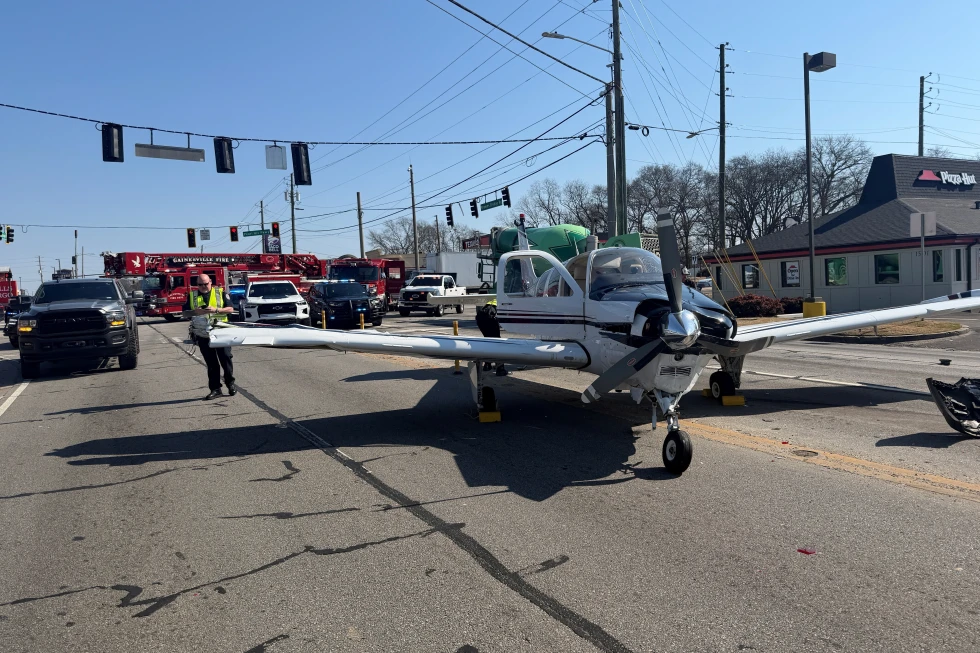
A single-engine aircraft suffering an apparent mechanical failure made a dramatic emergency landing on a heavily traveled roadway in northeast Georgia, colliding with three vehicles but sparing motorists and passengers from serious injury, authorities said.
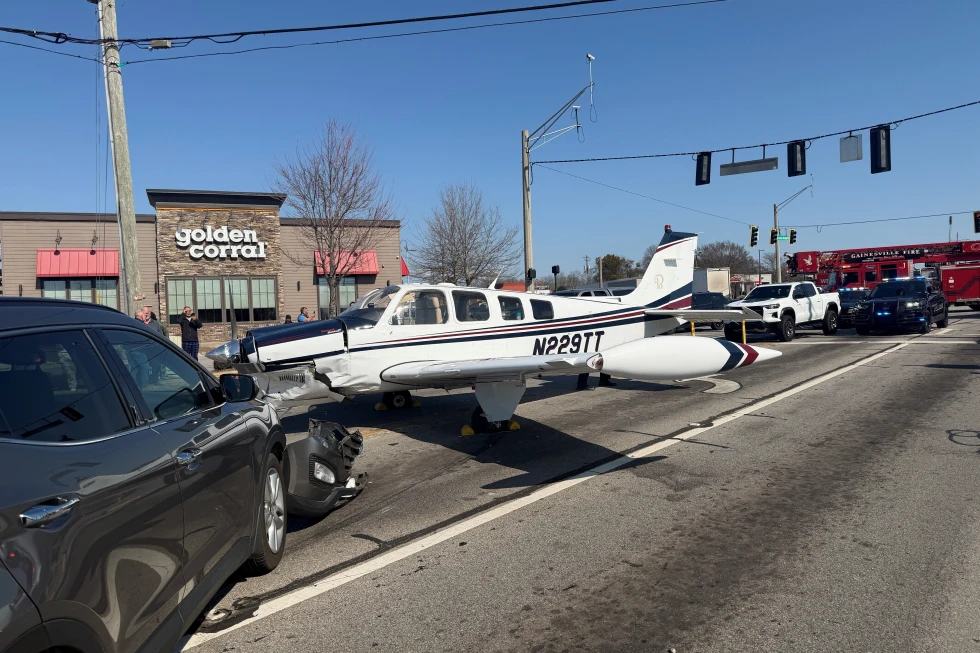
The Hawker Beechcraft Bonanza went down Monday on Browns Bridge Road in Gainesville, roughly 50 miles northeast of Atlanta, after the pilot determined the plane lacked sufficient power to reach a nearby airport, officials with the National Transportation Safety Board said. Two people were taken to a hospital with minor injuries, while no fatalities were reported.
The incident unfolded shortly after takeoff from Lee Gilmer Memorial Airport in Gainesville. The aircraft had been en route to Cherokee County Regional Airport in Canton when the pilot detected engine trouble moments after departure and attempted to reverse course.
Investigators said the pilot initially tried to glide the aircraft back to the departure airport but soon realized the loss of engine power made that impossible. With altitude rapidly diminishing and no clear runway within reach, the pilot opted to land on Browns Bridge Road, one of the region’s primary traffic corridors.
Air traffic control recordings captured the gravity of the moment. In audio archived by LiveATC.net, the pilot is heard telling controllers that the plane was unlikely to make it safely to an airport and asking them to relay a message of love to his wife and parents.
“I think we’re not going to make it,” the pilot said over the radio. “Please tell my wife, Molly, I love her, and my parents. I love them so much.”
More than 10 minutes later, the tone of the transmission shifted, with the pilot calmly telling controllers, “We’re going to be fine,” after the aircraft had come to rest on the roadway.
The pilot, identified by local media as Thomas Rogers, later described the decision-making process during an interview with WAGA-TV.
“We lost our engine taking off out of Gainesville,” Rogers said. “We tried to glide back, did everything by the book, but realized we weren’t going to make it back with how far out we were, so we came down on the road.”
Police said the plane struck three vehicles as it descended, pushing a fuel tank into one of the cars. Gainesville police Capt. Kevin Holbrook said the impact could have been far worse given the volume of traffic on the road at the time.
“The fact that they were able to land in the middle of hundreds of vehicles and only hit three of them, no power lines, is very remarkable,” Holbrook said. “The fact that no one was seriously injured or killed is just astonishing.”
Emergency responders quickly shut down the roadway as firefighters and police secured the scene and assessed the risk of fuel leaks or fire. Traffic was diverted for several hours while crews removed the aircraft and investigators began documenting the crash site.
The NTSB said it has opened an investigation into the incident, which will focus on the cause of the reported engine failure, the aircraft’s maintenance history and the pilot’s actions during the emergency. Federal Aviation Administration officials are assisting.
While the factual investigation remains ongoing, aviation experts say the outcome underscores how critical pilot training and quick decision-making can be when mechanical failures occur at low altitude.
Engine failures shortly after takeoff are among the most dangerous scenarios for pilots, leaving little time or margin for error. In such situations, pilots are trained to prioritize control of the aircraft and select the safest available landing area, even if that means using unconventional surfaces such as roads or open fields.
In this case, Browns Bridge Road’s straight stretch and relatively open sightlines may have contributed to the pilot’s ability to bring the plane down without catastrophic consequences. Authorities noted that the aircraft avoided power lines, utility poles and dense roadside structures, factors that often turn emergency landings into fatal crashes.
The incident also highlights the risks posed by aging general aviation aircraft. Many single-engine planes operating across the United States are decades old, and while they remain safe when properly maintained, mechanical issues remain a concern. According to federal aviation data, engine failures account for a significant share of emergency landings involving small planes.
At the same time, the outcome is likely to renew discussion about how local infrastructure intersects with aviation safety. As cities and suburbs expand closer to small airports, pilots facing emergencies may have fewer open spaces to choose from, increasing the likelihood that roads or populated areas become last-resort landing zones.
For motorists who witnessed the plane descending onto the roadway, the event was both shocking and surreal. Police said several drivers narrowly avoided being struck, and some stopped immediately to assist those involved until emergency crews arrived.
Officials credited a combination of pilot skill, favorable conditions and luck for preventing a tragedy on what is normally one of northeast Georgia’s busiest thoroughfares.
The aircraft was later removed from the scene, and the road was reopened after authorities determined there was no remaining hazard. Investigators are expected to issue a preliminary report in the coming weeks, though a full NTSB investigation could take months.
As the probe continues, aviation officials emphasized that emergency landings involving small aircraft are rare and that commercial air travel remains statistically safer than most other forms of transportation. Still, the incident serves as a stark reminder of how quickly routine flights can turn into life-or-death situations.
For the pilot and those on the ground, the outcome offered a measure of relief amid the chaos. What began as a routine hop between two Georgia airports ended with twisted metal on asphalt — but also with lives spared, a result authorities described as nothing short of extraordinary.
AP




