

WASHINGTON (BN24) — The global response to the United States’ airstrikes on three Iranian nuclear sites was swift and deeply divided on Sunday, with U.S. allies offering measured support and adversaries condemning the move as a reckless escalation that could ignite a wider regional war.
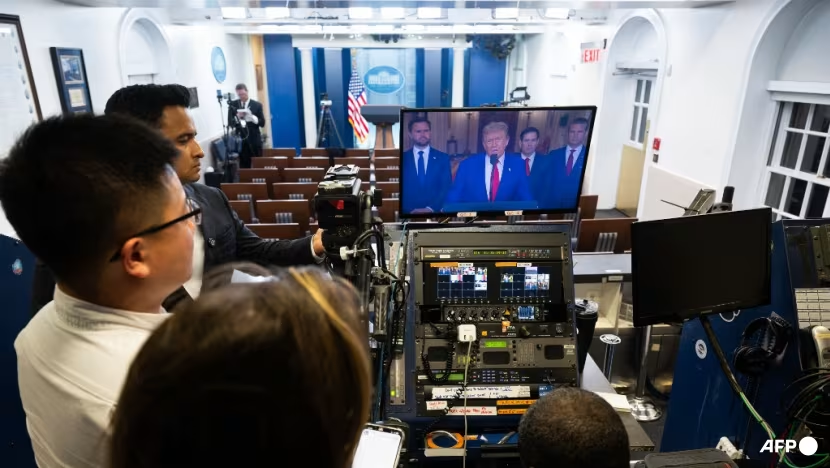
The operation, personally announced by President Donald Trump, marked the U.S.’s most direct military intervention yet in the ongoing Israel-Iran conflict. Trump confirmed strikes on Fordow, Natanz, and Isfahan — facilities central to Iran’s nuclear enrichment infrastructure.
While Israel praised the U.S. for what it called a bold stand against a dangerous adversary, other nations — including Iran, Cuba, Venezuela, and Qatar — denounced the attack as illegal and destabilizing. Meanwhile, global powers such as the United Nations, Britain, Japan, and the European Union urged restraint and a return to diplomacy.
Reactions From Around the World
Israel – Prime Minister Benjamin Netanyahu:
“Congratulations, President Trump. Your bold decision to target Iran’s nuclear facilities with the awesome and righteous might of the United States will change history,” Netanyahu said. “History will record that President Trump acted to deny the world’s most dangerous regime the world’s most dangerous weapons.”
Iran – Foreign Minister Abbas Araghchi:
Calling the strikes a “grave violation of the UN Charter,” Araghchi warned on social media that the attacks on “peaceful nuclear installations” would have “everlasting consequences.” He asserted that Iran reserves all options in defense of its sovereignty under international law.
United Nations – Secretary-General António Guterres:
Guterres condemned the U.S. strikes, calling them a “dangerous escalation” and warning of a conflict spiraling “out of control.” He urged member states to avoid “a spiral of chaos,” stressing that “there is no military solution. The only hope is peace.”
United Kingdom – Prime Minister Keir Starmer:
Starmer said Iran’s nuclear ambitions “must never culminate in a nuclear weapon” and acknowledged the U.S. had acted to alleviate that threat. However, he emphasized the need for diplomatic solutions to bring stability to the region.
European Union – Foreign Policy Chief Kaja Kallas:
Kallas echoed concerns over Iran’s nuclear program but urged all parties to “step back” and seek diplomacy. EU foreign ministers plan to discuss the crisis imminently.
Qatar – Foreign Ministry:
Qatar expressed regret and concern over the U.S. bombing of Iran, warning that the “dangerous tension” could lead to “catastrophic repercussions” on both regional and global levels.
Japan – Prime Minister Shigeru Ishiba:
“We are monitoring the situation with grave concern,” Ishiba said, calling for immediate de-escalation.
Italy – Foreign Minister Antonio Tajani:
Tajani said he hoped the strikes, which had “caused massive damage to nuclear weapons production,” would open a path toward renewed negotiations.
New Zealand – Foreign Minister Winston Peters:
Calling the strikes “extremely worrying,” Peters urged all sides to return to talks, insisting that “diplomacy will deliver a more enduring resolution.”
Australia – Government Spokesperson:
Reaffirming concerns about Iran’s nuclear program, Canberra called on all parties to prioritize de-escalation and diplomacy.
Mexico – Foreign Ministry:
Mexico reiterated its pacifist stance, urging the parties to “urgently pursue diplomatic dialogue.”
Venezuela – Foreign Minister Yvan Gil:
Venezuela denounced the strikes as “U.S. military aggression” carried out at Israel’s behest. Caracas demanded an immediate cessation of hostilities, calling the bombing illegal and destabilizing.
Cuba – President Miguel Díaz-Canel:
Díaz-Canel issued a harsh rebuke, condemning the U.S. attack as a “dangerous escalation” and “a serious violation of international law.” He warned of “irreversible consequences for humanity.”
Iranian Opposition – Maryam Rajavi, National Council of Resistance of Iran:
Rajavi welcomed the destruction of Iran’s nuclear assets, declaring, “Khamenei must go.” She blamed the regime’s nuclear ambitions for costing the nation lives and more than $2 trillion.
As international leaders scrambled to contain fallout from the strikes, Trump remained defiant, saying his administration would continue pressuring Iran to dismantle its nuclear program entirely. The world now braces for Tehran’s promised response — and what could become the gravest Middle East crisis in decades.
Reuters




