

Indonesia’s military announced Sunday that as many as 8,000 troops could be prepared by late June for possible deployment to Gaza as part of a humanitarian and peacekeeping mission, marking the first formal pledge of personnel to a security framework linked to President Donald Trump’s postwar reconstruction initiative.
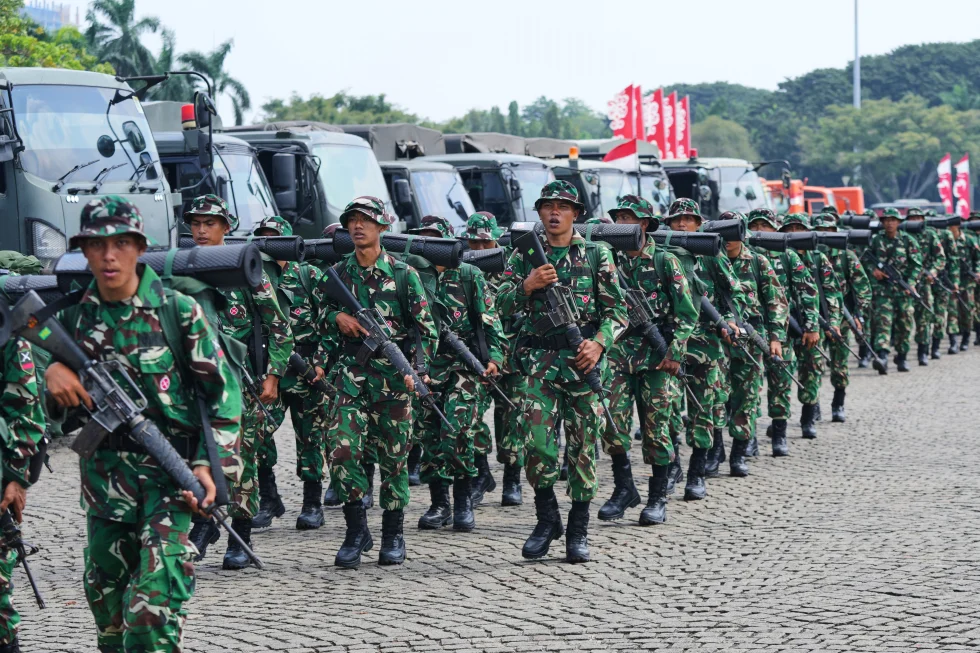
Brig. Gen. Donny Pramono, spokesperson for the Indonesian National Armed Forces, known as TNI, said the military has completed its proposed troop composition and timeline for readiness. A final political decision on whether and when to deploy has not yet been made.
“In principle, we stand ready to serve wherever assigned,” Pramono said in an interview with The Associated Press. He added that the force could mobilize on short notice once the government grants formal authorization.
The proposed deployment consists of a composite brigade of roughly 8,000 personnel, structured following deliberations at a Feb. 12 planning meeting. Preparations include medical screenings and administrative processing throughout February, culminating in a readiness review at month’s end.
Pramono indicated that about 1,000 troops could form an advance contingent by April if approval is granted, with the remainder of the force reaching operational readiness by June. He emphasized that readiness does not equate to automatic deployment, noting that the mission hinges on both domestic political authorization and international arrangements.
Indonesia’s Foreign Ministry has consistently maintained that any role in Gaza would be strictly humanitarian. Officials have said the focus would center on civilian protection, medical assistance and reconstruction efforts. Indonesian forces would not engage in combat operations or undertake actions that could result in direct clashes with armed groups.
If carried out, the deployment would make Indonesia the first nation to publicly commit troops to the stabilization component of President Donald Trump’s Board of Peace initiative for Gaza. The ceasefire between Israel and Hamas, which took effect Oct. 10 after two years of intense warfare, remains fragile but in place.
Indonesia, the world’s largest Muslim-majority country, does not maintain diplomatic ties with Israel and has long supported a two-state solution to the Israeli-Palestinian conflict. The Southeast Asian nation has provided sustained humanitarian assistance to Gaza, including financial backing for a hospital serving civilians affected by the war.
Government officials in Jakarta have explained their participation in the Board of Peace framework as a means of safeguarding Palestinian interests from within the diplomatic process. Israel is represented in the initiative, while Palestinian representation is absent — a dynamic Indonesian leaders have said warrants their involvement to balance perspectives.
Indonesia brings extensive experience in international peacekeeping. It ranks among the top 10 contributors to United Nations missions worldwide and has deployed personnel to conflict zones including Lebanon under U.N. mandates. That background, military officials say, positions the country to manage complex stabilization and humanitarian operations in volatile environments.
Indonesia’s readiness announcement carries both diplomatic and strategic implications. By preparing troops without yet committing them, Jakarta signals support for international stabilization efforts while preserving political flexibility at home. Parliamentary debate and public opinion could influence the final decision, particularly given Indonesia’s longstanding solidarity with the Palestinian cause.
Participation also reflects Indonesia’s broader ambition to assert itself as a leading voice in the Global South and the Muslim world. A role in Gaza could elevate its diplomatic standing, especially if reconstruction and stabilization efforts succeed in reducing violence and restoring basic services.
At the same time, the mission presents potential risks. Even in a non-combat capacity, peacekeeping forces operating in Gaza would face significant security challenges. The enclave’s dense urban landscape, history of militant activity and deep mistrust among parties to the conflict complicate stabilization efforts. Past peacekeeping operations in similarly volatile settings have demonstrated how quickly humanitarian mandates can become entangled in security confrontations.
For President Donald Trump’s reconstruction framework, Indonesia’s announcement offers a tangible sign of international buy-in. Securing troop commitments has been viewed as one of the most difficult elements of the plan, particularly given the political sensitivities surrounding foreign forces in Gaza. An early pledge from a Muslim-majority nation could encourage broader participation from other countries seeking to balance humanitarian objectives with political caution.
Regionally, Indonesia’s move may also influence debates among other nations considering involvement. Countries with established peacekeeping traditions could view Jakarta’s preparations as precedent-setting, while others may wait to assess operational details, command structures and legal mandates before committing personnel.
Ultimately, Indonesia’s declaration of readiness underscores both the opportunity and uncertainty surrounding postwar Gaza. While reconstruction and civilian protection are widely supported goals, translating diplomatic frameworks into secure, on-the-ground realities will require sustained coordination, clear mandates and durable political backing from all sides involved.
Whether Indonesian troops ultimately deploy will depend on decisions in Jakarta and international negotiations still underway. For now, the military’s preparations signal that at least one nation is positioning itself to play a direct role in shaping Gaza’s fragile post-conflict landscape.
AP




