

Iran confirmed early Sunday that Supreme Leader Ayatollah Ali Khamenei was killed in a sweeping joint assault by the United States and Israel, a development that shakes the foundation of the Islamic Republic and raises the specter of a broader regional war.
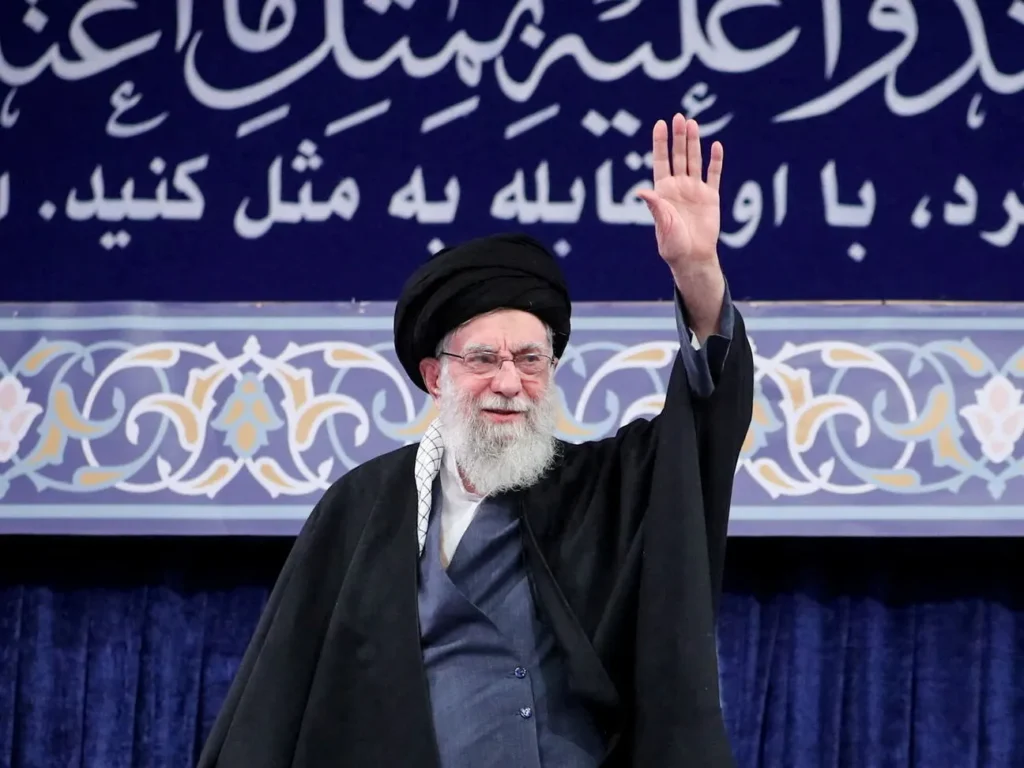
State television and multiple state-affiliated news agencies announced the death hours after President Donald Trump declared on social media that Khamenei had been killed in predawn strikes on Tehran. Iranian outlets Tasnim, Fars and IRIB carried statements confirming that the 86-year-old leader died at his compound in the capital.
“The Supreme Leader of Iran has reached martyrdom,” state broadcaster IRIB announced Sunday morning. The state-affiliated Mehr news outlet described Khamenei as a scholar and fighter who “sacrificed his life” in service to the nation.
Iranian authorities declared 40 days of public mourning and seven days of national holidays following his death.
Neither state television nor the official IRNA news agency initially specified the precise cause of death. However, Fars News Agency said Khamenei was killed “in his office in the household of the leader” while “carrying out his duties” during the early stages of Saturday’s attack.
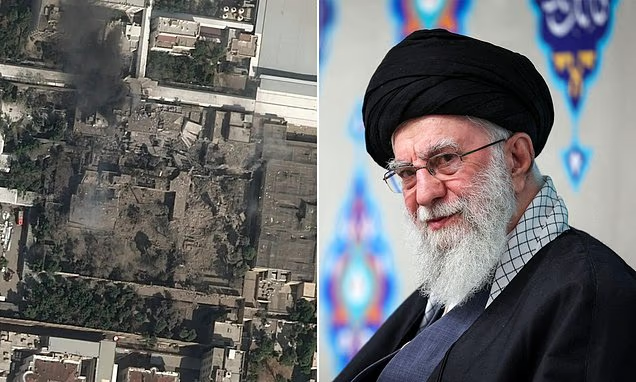
Satellite imagery from Airbus showed thick black smoke rising from the compound in central Tehran, near the university district. The images appeared to indicate that several structures inside the heavily fortified complex sustained significant damage.
The compound has long functioned as a central nerve center for Iran’s theocratic leadership, housing offices integral to military, political and religious decision-making.
Trump had announced the death several hours earlier, writing on social media that Khamenei was “one of the most evil people in history.” He warned that “heavy and pinpoint bombing” would continue in the days ahead as part of what he described as a campaign to dismantle Iran’s nuclear capabilities.
The president characterized the killing as a pivotal moment for the Iranian public, asserting that it represented their “greatest chance” to reclaim their country.
The joint U.S.-Israel operation unfolded during the Muslim holy month of Ramadan and followed months of rising tensions and faltering nuclear negotiations. Israeli officials said the assault had been planned in coordination with Washington for months.
Lt. Gen. Eyal Zamir, Israel’s military chief of staff, said Air Force pilots struck “hundreds of targets across Iran.” An Israeli official briefed on the campaign indicated that targets included military installations, intelligence hubs and symbols of government authority.
The U.S. military stated that it had faced “hundreds of Iranian missile and drone attacks” in retaliation but sustained no American casualties and only minimal damage to its regional bases. Iranian officials, meanwhile, informed the United Nations Security Council that hundreds of civilians had been killed or wounded in the strikes.
Iran responded by launching missiles and drones toward Israel and targeting U.S. military facilities in Bahrain, Kuwait and Qatar. The Israeli military said dozens of missiles were fired toward Israel, many of which were intercepted. Magen David Adom, Israel’s emergency response service, said a woman died in the Tel Aviv area after sustaining injuries from an Iranian missile.
In southern Iran, at least 115 people were reported killed when a girls’ school was struck, according to a local governor speaking on state television. U.S. Central Command spokesperson Capt. Tim Hawkins said he was aware of the claims and that officials were reviewing them.
IRNA reported at least 15 fatalities in southwestern Iran, citing Lamerd governor Ali Alizadeh, who said a sports hall, residential areas and a structure near a school were hit.
Flights across the Middle East were disrupted as air defense systems roared across regional skies. Shrapnel from an Iranian missile strike killed one person in the United Arab Emirates, state media there said.
Iran’s National Security Council secretary, Ali Larijani, warned that Israel and the United States would “regret their actions,” writing on X that Iran would deliver “an unforgettable lesson.”
Khamenei’s death leaves a profound leadership vacuum. Since succeeding Ayatollah Ruhollah Khomeini in 1989, he exercised final authority over all major state decisions, overseeing Iran’s clerical establishment and the Revolutionary Guard — the twin pillars of power in the Islamic Republic.
No successor has been publicly designated. Under Iran’s constitution, the Assembly of Experts is responsible for selecting a new supreme leader, but the sudden nature of the killing may complicate succession amid ongoing military conflict.
The strikes occurred after unsuccessful nuclear talks and amid U.S. intelligence assessments that Iran had rebuilt portions of its nuclear infrastructure. A senior U.S. official, speaking on condition of anonymity to discuss internal deliberations, indicated that Iran had developed advanced centrifuge capabilities essential for enriching uranium to weapons-grade levels.
Iran has maintained that it had not resumed enrichment since June, though it has restricted international inspectors’ access to bombed sites. Satellite imagery previously analyzed by The Associated Press showed renewed activity at certain facilities.
The conflict also threatens global markets, particularly if hostilities disrupt the Strait of Hormuz, through which roughly one-third of global seaborne oil exports passed in 2025. Saudi Arabia said it repelled Iranian attacks targeting its capital and eastern region. Bahrain confirmed a missile strike near the U.S. Navy’s Fifth Fleet headquarters, while Kuwait reported a drone strike on its main airport and injuries at Ali Al-Salem air base. Jordan said it intercepted dozens of drones and ballistic missiles.
Khamenei’s death represents one of the most consequential geopolitical shocks in the Middle East in decades. Unlike previous targeted killings of military commanders, this strike eliminated the central authority of Iran’s political-religious system. The absence of a designated successor creates uncertainty within the clerical establishment and the Revolutionary Guard, potentially intensifying internal power struggles at a moment of external confrontation.
Historically, external military pressure has consolidated nationalist sentiment within Iran rather than fragmented it. While some eyewitnesses in Tehran described celebratory reactions, sustained public mobilization remains uncertain given the state’s record of suppressing dissent. The Human Rights Activists News Agency has documented thousands of deaths during previous crackdowns, underscoring the risks for any renewed protest movement.
Regionally, the likelihood of prolonged proxy conflict is high. Iran’s allied militias in Lebanon, Iraq, Syria and Yemen retain capabilities that could draw neighboring states deeper into confrontation. Even limited disruption to oil shipping lanes could reverberate through global markets, raising energy prices and intensifying economic volatility.
For Washington, the operation marks a dramatic escalation from deterrence to direct decapitation strategy. It also tests the durability of an “America First” doctrine that pledged to avoid prolonged foreign entanglements. Whether the strike leads to regime transformation, prolonged insurgency or negotiated settlement will shape the trajectory of Middle Eastern politics for years to come.
Iran’s confirmation of Khamenei’s death closes one chapter in the Islamic Republic’s history. What follows remains uncertain.
AP/Reuters/Guardian




