

An Iranian drone struck the U.S. Embassy compound in Saudi Arabia’s capital early Tuesday, igniting a small fire and prompting American officials to urge citizens to avoid the area, as Israeli ground forces advanced into southern Lebanon in what has become a rapidly expanding regional war.
The embassy said the blaze was quickly contained and no casualties were immediately reported. The strike followed a similar drone incident targeting the U.S. Embassy in Kuwait earlier, underscoring Iran’s widening campaign against American installations in Gulf states that host U.S. troops and military assets.
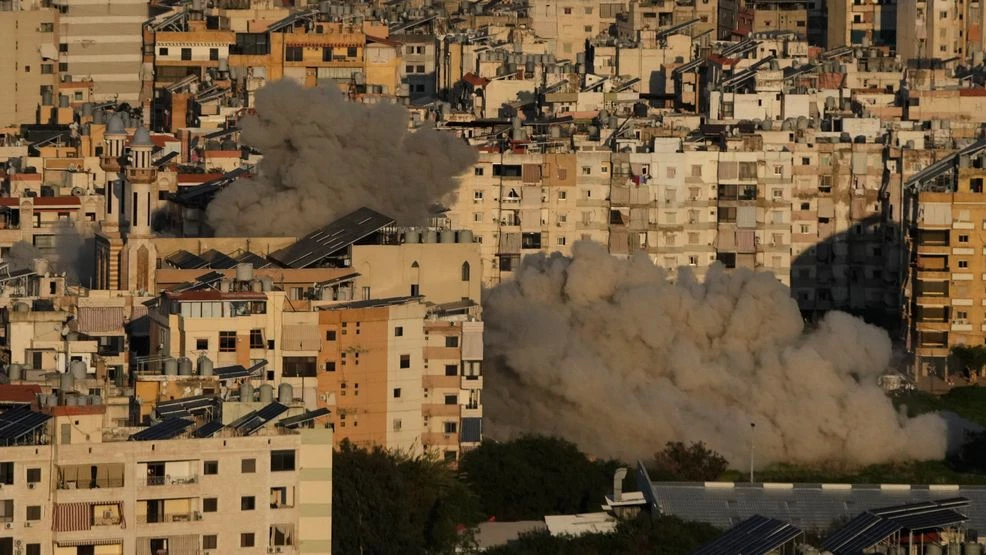
Tehran has escalated retaliatory attacks since the United States and Israel launched coordinated strikes inside Iran over the weekend. The confrontation has since spread beyond the original battlegrounds, drawing in Lebanon, Gulf Arab states and multiple Iran-aligned groups.
In Lebanon, Israeli Defense Minister Israel Katz announced that Israeli troops had been directed to “hold and advance” into areas of southern Lebanon to prevent further cross-border attacks by Hezbollah. The statement marked Israel’s first public confirmation that its campaign would extend beyond airstrikes to include ground operations.
Israeli forces have issued evacuation orders for villages south of the Litani River, leaving much of the region largely deserted. Southern suburbs of Beirut, long regarded as Hezbollah strongholds, appeared largely emptied as residents fled north.
What began as direct hostilities between Iran and a U.S.-Israeli coalition has evolved into a broader confrontation spanning at least nine countries.
The joint U.S.-Israeli aerial campaign commenced Saturday with strikes in Tehran that killed Iran’s supreme leader, Ali Khamenei, according to Israeli and American officials. Iran responded with missile salvos aimed at Israel and attacks targeting American positions across the Gulf.
Israeli Prime Minister Benjamin Netanyahu cautioned that the conflict could persist for an extended period, telling Fox News that while it would not last years, it would require time to achieve its objectives.
U.S. President Donald Trump offered varying timelines, saying Monday that operations could extend “far longer” than the month initially envisioned.
Secretary of State Marco Rubio said in televised remarks that the most severe blows against Iran “are yet to come,” while Defense Secretary Pete Hegseth publicly raised the possibility of deploying American ground forces — a prospect many analysts describe as fraught given Iran’s mountainous terrain and population size.
Rubio indicated the administration believed Israeli military action would provoke retaliation against U.S. forces and argued that preemptive strikes were intended to limit American casualties.
Trump has alternated between describing the campaign as an effort to halt Iran’s nuclear ambitions and suggesting that regime change in Tehran could result. Iran maintains its nuclear program is peaceful.
Overnight explosions reverberated across Iranian cities, particularly Tehran. Casualty figures remain difficult to verify independently, with estimates ranging from 555 to as many as 1,500 deaths. Iranian authorities reported that 165 people were killed in a strike on a girls’ elementary school in southern Iran.
Iran has launched repeated ballistic missile barrages toward Israel. Israeli defense systems intercepted most projectiles, though 11 people were killed when several missiles penetrated defenses.
The United States acknowledged the deaths of six service members in Kuwait, where American forces are stationed.
Iran has also targeted Gulf energy infrastructure. Qatar announced a suspension at its largest liquefied natural gas facility, and Saudi Arabia halted operations at the Ras Tanura refinery.
Tehran declared the Strait of Hormuz closed after several vessels were struck while attempting passage. Brig. Gen. Ebrahim Jabbari, an adviser to Iran’s paramilitary Revolutionary Guards, warned ships against entering the waterway, a critical artery for global oil shipments.
Energy markets reacted swiftly, with global prices climbing amid fears of prolonged supply disruptions.
Hezbollah said it launched two waves of missiles overnight against Israeli military installations in the north, including the Ramat David and Meron airbases. It also claimed rocket strikes in the Golan Heights.
Israel’s military announced it had killed several senior Hezbollah figures, including intelligence chief Hussein Makled. Israeli forces also struck facilities linked to Hezbollah’s financial network, including al-Qard al-Hassan bank, and targeted infrastructure tied to its media outlet al-Manar.
Human rights organizations cautioned that attacks on non-military targets, even if affiliated with armed groups, could violate international law.
Israeli airstrikes in Lebanon have killed at least 52 people and displaced roughly 29,000, according to local authorities.
In an unprecedented move, Lebanon’s government prohibited Hezbollah’s military and security activities and directed judicial authorities to pursue those responsible for launching rockets into Israel, reflecting mounting domestic criticism that Hezbollah’s actions jeopardize national stability.
The rapid expansion of hostilities highlights the fragility of deterrence frameworks that have governed Middle Eastern security for decades. The simultaneous targeting of diplomatic missions, energy infrastructure and military installations signals a shift toward broader strategic confrontation rather than limited proxy exchanges.
Iran’s move to disrupt the Strait of Hormuz introduces global economic consequences that could draw additional powers into crisis management efforts. Roughly one-fifth of the world’s oil supply transits the narrow waterway, and prolonged closure could trigger sustained inflationary pressures worldwide.
Israel’s ground incursion into southern Lebanon suggests a willingness to neutralize Hezbollah’s capabilities decisively, even at the risk of extended conflict. Yet Hezbollah’s degraded but still operational missile arsenal indicates that Israel faces a protracted security challenge on its northern frontier.
For Washington, policy coherence remains under scrutiny. Diverging public explanations regarding objectives — whether preventing nuclear proliferation, deterring attacks or fostering regime change — complicate diplomatic messaging to allies and adversaries alike.
With civilian casualties mounting and energy markets unsettled, international mediation efforts may intensify. However, absent clear off-ramps from principal actors, the trajectory points toward sustained instability rather than swift resolution.
As embassies harden defenses and regional militaries mobilize, the Middle East appears to be entering one of its most volatile chapters in recent memory.




