

(AP) — Iran’s clerical leadership has named Mojtaba Khamenei as the country’s new supreme leader, state television announced early Monday, following the killing of his father Ali Khamenei less than two weeks ago.
The announcement marks a historic transfer of power at the top of the Islamic Republic as the country remains engulfed in a widening regional war.
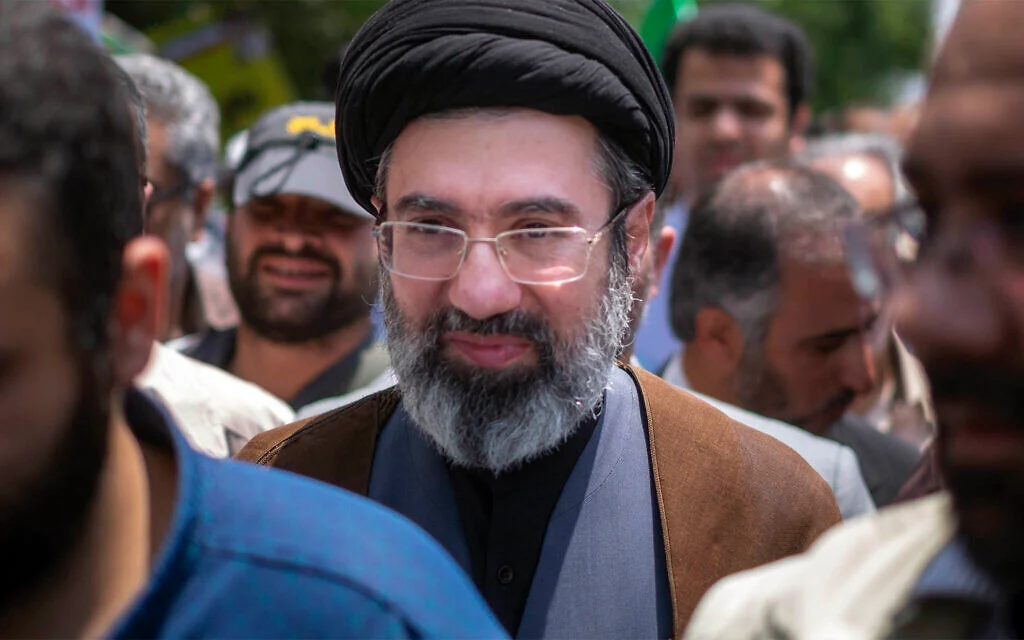
Iranian state TV said the decision came after a vote by the Assembly of Experts, an 88-member council of clerics responsible for appointing the nation’s supreme leader.
According to the broadcast, Mojtaba Khamenei received “strong” support from the council, which urged Iranians to unite behind the new leader.
Footage aired by state media showed crowds celebrating in public spaces across Tehran shortly after the announcement.
Since the Iranian Revolution, the Islamic Republic has seen only one previous transition of power in the office of supreme leader.
Ali Khamenei held the position for decades, wielding ultimate authority over Iran’s government, military and judiciary until he was killed in an Israeli strike earlier this month, according to Iranian officials.
His death triggered an urgent succession process at a time when the country was already facing escalating military confrontation with Israel and its allies.
The appointment of his son had long been rumored in political circles, though critics had questioned the prospect of a hereditary-style transfer of power within the Islamic Republic’s leadership.
Mojtaba Khamenei, a cleric known for his influence behind the scenes, has largely remained out of the public spotlight.
Despite being widely viewed as a powerful figure within Iran’s political establishment, he has never held an elected or officially appointed government position.
In recent days he had not appeared publicly, fueling speculation about the succession process.
As supreme leader, he now holds sweeping powers over the state.
The position grants him final authority over Iran’s government, command of the armed forces and control of the powerful Islamic Revolutionary Guard Corps.
He also oversees Iran’s strategic weapons programs and nuclear policy, including a stockpile of highly enriched uranium that analysts say could potentially be used to build nuclear weapons if authorized.
The leadership change has already drawn criticism from Donald Trump, who has been outspoken about Iran’s future leadership.
“Khamenei’s son is unacceptable to me,” Trump said previously. “We want someone that will bring harmony and peace to Iran.”
Trump also told ABC News that he believes the United States should have a role in shaping the country’s leadership after the war.
“A new leader is not going to last long without approval,” he said.
The White House did not immediately respond to requests for comment after the succession announcement.
Iran’s powerful security establishment quickly signaled backing for the new supreme leader.
The Islamic Revolutionary Guard Corps released a statement expressing support for Mojtaba Khamenei’s leadership.
Meanwhile, the Iran-backed Lebanese militant group Hezbollah posted an image of him on Telegram with the caption: “Leader of the blessed Islamic revolution.”
The announcement comes as the regional war that began on Feb. 28 continues to escalate.
Civilian casualties have mounted across several countries in the Middle East.
Authorities say the conflict has killed at least 1,230 people in Iran, 397 in Lebanon, and 11 in Israel.
Additional deaths have also been reported among foreign residents in Gulf countries hit by missile and drone attacks.
Iran’s president, Masoud Pezeshkian, signaled a tougher stance over the weekend after briefly offering conciliatory remarks toward neighboring states.
“The more pressure they impose on us, the stronger our response will naturally be,” Pezeshkian said Sunday.
Iranian officials have accused regional governments hosting U.S. forces of enabling attacks against Iran.
Several Gulf countries have reported incoming missiles and drones since the conflict began, including Bahrain, Kuwait, Saudi Arabia, and the United Arab Emirates.
Bahrain accused Iran of damaging a desalination plant vital to its water supply, while Saudi Arabia reported its first civilian deaths after a projectile struck a residential area.
Meanwhile, Israel’s military said two soldiers were killed during fighting in southern Lebanon, where clashes with Hezbollah have intensified.
The U.S. military also confirmed that one American service member died from injuries sustained during an Iranian attack on troops stationed in Saudi Arabia earlier in the conflict.
With Mojtaba Khamenei now holding the most powerful position in Iran, analysts say the country is entering an uncertain period.
The new supreme leader must navigate a rapidly escalating regional conflict while consolidating authority inside Iran’s political and clerical establishment.
Whether his leadership will unify Iran’s factions or deepen divisions remains an open question — one that could shape the direction of the Middle East in the coming years.





