

Iran ground to a near-complete standstill Wednesday as the government ordered an extraordinary shutdown affecting 21 of the country’s 31 provinces, closing businesses, universities, and government offices in a desperate attempt to contain protests that have erupted over a deepening political and economic crisis threatening the Islamic Republic’s stability.
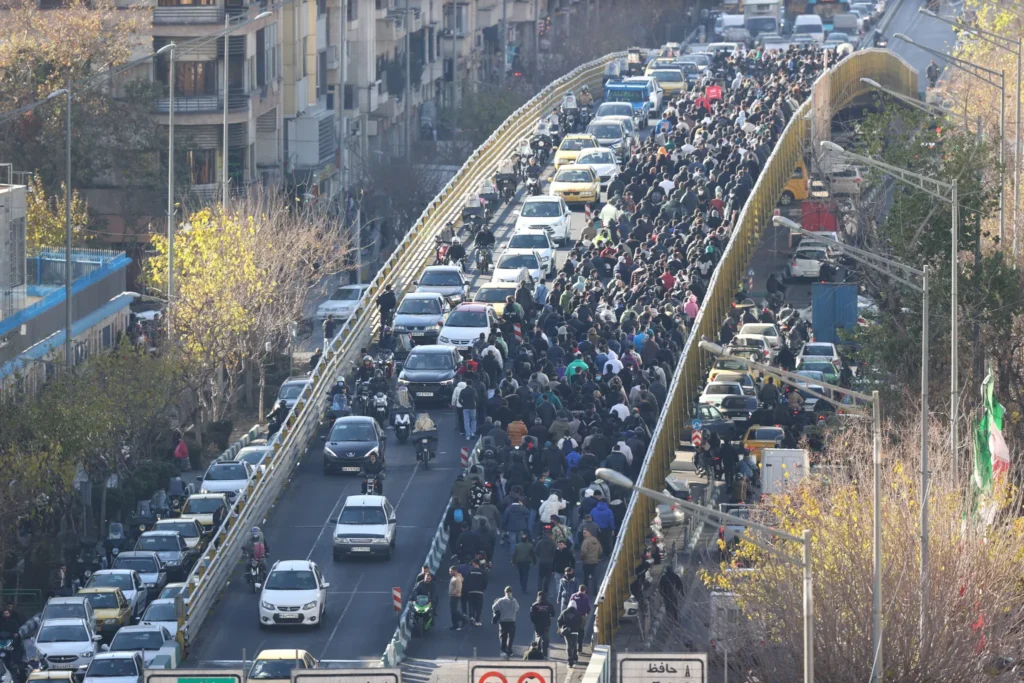
The unprecedented nationwide closure, ordered by President Masoud Pezeshkian, affected major population centers including the capital Tehran as authorities sought to suppress mounting public fury driven by hyperinflation, currency instability, and collapsing living standards that have pushed millions of Iranians toward economic desperation. The shutdown represents one of the most drastic government responses to civil unrest since the 2022 protests following Mahsa Amini’s death in police custody.
Demonstrations, strikes, and violent clashes between protesters and security forces continued for a fourth consecutive day across multiple cities, with video footage documenting intensifying confrontations between citizens and the Islamic Revolutionary Guard Corps forces deployed to maintain order. The sustained nature of the unrest suggests deeper discontent than periodic protests that Iranian authorities have successfully suppressed in recent years.
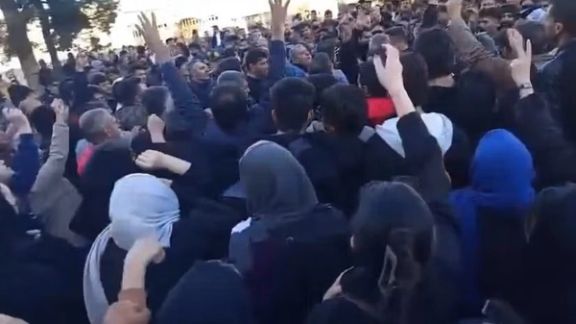
Video footage circulating online and disseminated by the People’s Mojahedin Organization of Iran (MEK), an opposition group based outside the country, captured intense confrontations between protesters and security forces in major cities including Shiraz, Isfahan, Kermanshah, and Tehran. The recordings show protesters chanting anti-regime slogans while directly confronting security personnel in crowded streets, demonstrating a level of public defiance that authorities have struggled to contain through traditional intimidation tactics.
The footage includes disturbing scenes of screaming and what appears to be gunfire, with demonstrators hurling objects at security forces while shouting “Death to the dictator” and “Proud Arakis, support, support.” The use of such explicitly anti-government slogans in public spaces reflects eroding fear of repercussions that has historically kept many Iranians from openly challenging the regime, suggesting that economic desperation may have overcome concerns about arrest or violence.
Additional video shared by MEK shows crowds chanting “Death to Khamenei!” and “Shame on you, shame on you!” in direct challenges to Supreme Leader Ayatollah Ali Khamenei’s authority. The anger appears to have spread particularly intensely through bazaar-led protests in Tehran, where traditional merchants have historically played significant roles in Iranian political upheavals. Bazaar communities helped drive both the 1979 Islamic Revolution and subsequent periods of unrest, making their participation in current protests especially concerning for the government.
Some of the most dramatic confrontations occurred in Fasa, a city in south-central Iran where video circulating online captured demonstrators hurling objects at government complex gates and physically shaking the barriers until they opened. The breach of government property represents an escalation beyond street protests into direct assaults on state infrastructure, crossing thresholds that typically trigger severe security responses.
Opposition groups reported that protesters in Fasa stormed the governor’s office, prompting Islamic Revolutionary Guard Corps forces to open fire on crowds, according to Reuters. The use of live ammunition against demonstrators marks a significant escalation in state violence, though casualty figures remain unconfirmed due to government information controls and the challenges opposition groups face verifying reports from inside Iran.
Military helicopters were observed flying over Fasa in what appeared to be deliberate shows of force intended to intimidate residents and prevent unrest from spreading to surrounding communities. The deployment of airborne assets for crowd control suggests authorities view the situation as sufficiently serious to warrant military rather than police responses, blurring lines between civil law enforcement and martial action.
In Kermanshah, located in western Iran near the Iraqi border, bazaar merchants directly confronted security forces while chanting “Dishonorable, dishonorable,” according to video documentation. The willingness of business owners to close shops and engage in street protests despite economic costs reflects how deeply the financial crisis has affected even traditionally conservative merchant classes who might ordinarily prioritize stability over confrontation.
The one-day shutdown affecting 21 provinces represents an acknowledgment by President Pezeshkian that normal governance has become impossible amid the escalating unrest. By closing government offices, universities, and businesses, authorities essentially conceded that attempting to maintain regular operations would expose more citizens to protest participation while providing additional targets for demonstrators to disrupt.
The unrest unfolds against a backdrop of catastrophic economic deterioration. Iran’s currency has plummeted against foreign currencies as international sanctions continue choking oil exports and financial transactions. Inflation has rendered basic necessities increasingly unaffordable for ordinary Iranians, with food prices surging beyond what many families can sustain. The economic collapse has particularly devastated the urban middle class, historically a stabilizing force in Iranian society.
Mounting public anger has forced a series of emergency leadership changes that add uncertainty to an already volatile situation. On Wednesday, Pezeshkian appointed Abdolnaser Hemmati, a former economy minister, as the new central bank chief following Mohammad Reza Farzin’s resignation. The appointment came as authorities scrambled to demonstrate responsiveness to economic concerns while lacking obvious solutions to structural problems rooted in international isolation and domestic mismanagement.
State media quoted Pezeshkian acknowledging that the central bank position is “extremely difficult and complex,” warning that Hemmati would face “intense pressure and criticism amid ongoing economic turmoil,” according to the Islamic Republic News Agency. The unusually candid admission of challenges facing the new appointee suggests recognition that monetary policy interventions alone cannot address the multifaceted crisis driving public anger into the streets.
Separately, Supreme Leader Ayatollah Ali Khamenei announced the appointment of IRGC Brigadier General Ahmad Vahidi as deputy commander in chief of the Revolutionary Guards. The timing of the military leadership change alongside civilian economic appointments suggests coordination between political and security establishments to simultaneously address economic grievances and prepare for potential escalation requiring enhanced security force coordination.
Vahidi’s appointment carries particular significance given his background and the current crisis. As a senior Revolutionary Guard commander, his elevation signals potential hardening of security responses if protests continue expanding. The Revolutionary Guards serve as the regime’s ideological army, distinct from regular military forces, with primary loyalty to the Supreme Leader rather than civilian government institutions.
The economic crisis driving the protests stems from multiple interconnected factors. International sanctions imposed primarily by the United States have severely restricted Iran’s ability to export oil, historically the economy’s foundation. Banking sanctions prevent normal international financial transactions, forcing Iran into creative but inefficient workarounds that increase costs and reduce trade volumes. Domestic mismanagement, corruption, and inefficient state control over major economic sectors compound the damage from external pressure.
Currency instability has created particular hardship for ordinary Iranians. As the rial’s value collapses against dollars and euros, imported goods become prohibitively expensive while inflation erodes purchasing power for domestically produced items. Iranians who held savings in rials have watched their wealth evaporate, creating anger directed at government economic management perceived as incompetent or deliberately sacrificing public welfare for ideological commitments.
The protests reflect a generational shift in Iranian society where younger Iranians, who don’t remember the 1979 revolution or the Iran-Iraq War that helped consolidate the Islamic Republic’s control, increasingly question whether the current system serves their interests. This demographic, facing unemployment, restricted social freedoms, and economic hopelessness, has proven more willing to challenge authority than their parents’ generation.
The bazaar merchants’ participation adds a crucial element given their historical role in Iranian politics. Traditional bazaar communities combine economic power with religious conservatism that historically aligned with the clerical establishment. When bazaaris turn against the government, as occurred before the 1979 revolution, it signals that even constituencies who might philosophically support Islamic governance believe current leadership has failed fundamental responsibilities to maintain economic stability and protect business interests.
The government’s information control efforts face unprecedented challenges in the social media era. Despite sophisticated internet filtering and periodic shutdowns, Iranians continue sharing video documentation of protests and security force responses through virtual private networks and other circumvention tools. International opposition groups like MEK amplify this content, though their materials require careful evaluation given their political agendas and occasional history of exaggerating or misrepresenting events.
The four-day duration of sustained protests across multiple cities suggests this wave of unrest differs from brief eruptions that security forces have successfully suppressed through overwhelming force and mass arrests. Prolonged demonstrations require sustained public commitment despite risks of violence, imprisonment, and torture that Iranian security services have historically employed to break opposition movements.
International reactions to the protests will likely remain muted given limited Western leverage over Iranian domestic affairs and ongoing nuclear negotiations where some governments seek to avoid inflammatory rhetoric that might complicate diplomacy. Human rights organizations will document abuses, but practical international intervention appears unlikely absent dramatically escalating violence that creates unavoidable humanitarian crises.
The shutdown’s economic costs are substantial even for a single day. Closing businesses and government offices in 21 provinces means lost productivity, disrupted supply chains, and forgone commercial activity in an economy already stressed by international isolation. The willingness to accept these costs reflects government calculations that preventing protest expansion justifies immediate economic damage.
Whether the shutdown and security crackdowns can contain the unrest or whether they instead fuel greater anger by demonstrating government desperation remains uncertain. Historical precedents suggest that once protests reach critical mass across multiple cities, suppression often requires sustained brutal violence that can itself generate international pressure and radicalize previously uncommitted citizens who witness or experience state brutality.
The crisis poses fundamental challenges for Iran’s governing system. If economic conditions continue deteriorating without realistic prospects for sanctions relief or successful domestic reforms, public anger may become endemic rather than episodic. The Islamic Republic has survived previous crises through combinations of repression, economic adjustments, and allowing limited dissent within carefully controlled boundaries. Whether those strategies remain viable amid current pressures tests the regime’s adaptability and resilience.
NewYorkPost




