

Thousands of Iranians poured into streets across the capital Thursday night and shouted from their homes after exiled Crown Prince Reza Pahlavi called for mass demonstrations against the Islamic Republic, triggering immediate nationwide internet and telephone blackouts as the government moved to suppress what represents the most direct challenge to clerical rule in years.
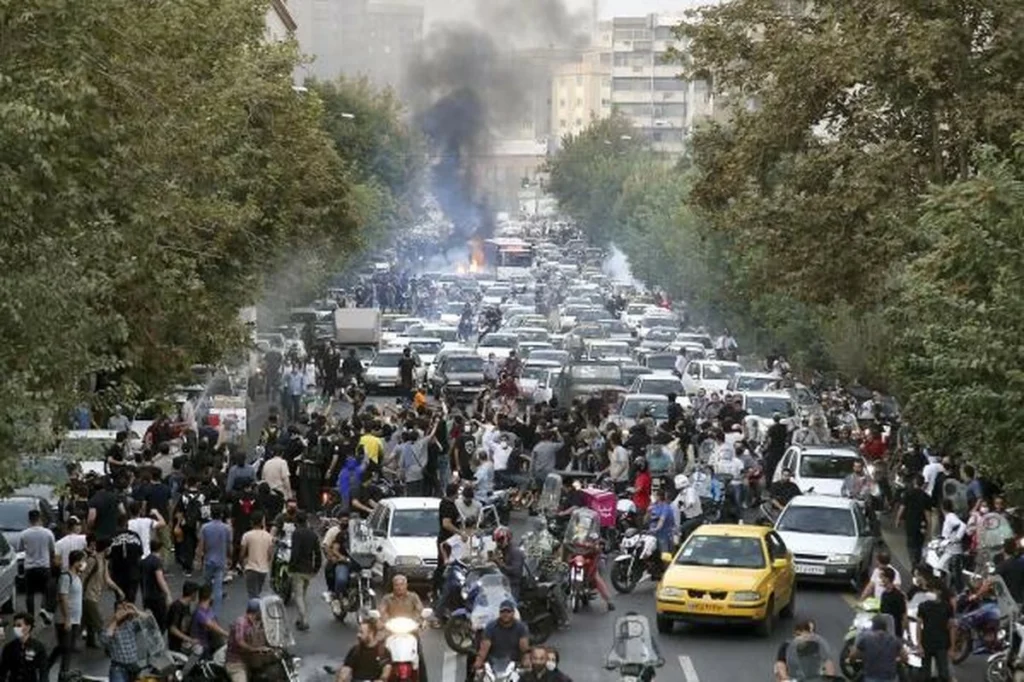
The protests erupted precisely at 8 p.m. local time (1630 GMT) when Pahlavi had urged Iranians to take to the streets, with neighborhoods across Tehran immediately erupting in chanting as witnesses described thousands visible on streets despite government warnings and threats of drone surveillance to identify participants. The coordinated timing and enthusiastic response demonstrated that substantial segments of Iran’s population remain willing to risk severe punishment by openly defying the regime.
Internet access and telephone lines throughout Iran cut out immediately after protests began, according to CloudFlare, an internet monitoring firm, and NetBlocks, an advocacy group tracking digital restrictions. Both organizations attributed the communications blackout to deliberate Iranian government interference designed to prevent protesters from coordinating activities and sharing footage documenting the demonstrations’ scale with international audiences.
Attempts to dial landlines and mobile phones from Dubai to Iran could not be connected, confirming the comprehensive nature of the communications shutdown. Such systematic outages have historically preceded intense government crackdowns in Iran, raising fears that security forces would exploit the information blackout to conduct violent suppression operations without real-time documentation that might generate international condemnation.
The demonstration represented the first major test of whether the Iranian public could be swayed by Crown Prince Reza Pahlavi, whose fatally ill father Mohammad Reza Shah Pahlavi fled Iran just before the country’s 1979 Islamic Revolution that installed the theocratic government currently ruling the country. The younger Pahlavi has lived in exile for decades, maintaining a political presence through social media and interviews but lacking organizational infrastructure inside Iran that would enable him to directly mobilize supporters.
Demonstrations included explicit cries supporting the deposed shah and his son, rhetoric that could historically bring death sentences but now underlines the profound anger fueling protests that began over Iran’s collapsing economy. The willingness of protesters to publicly praise the monarchy while calling for the Islamic Republic’s destruction reflects how thoroughly the regime has lost legitimacy among significant portions of the population, particularly younger Iranians with no personal memory of pre-revolutionary Iran.
When 8 p.m. arrived Thursday, neighborhoods across Tehran erupted in chanting with witnesses describing coordinated vocal protests. The chants included “Death to the dictator!”—referring to Supreme Leader Ayatollah Ali Khamenei—and “Death to the Islamic Republic!” demonstrating that protesters seek regime change rather than reforms within the existing theocratic system.
Others praised the shah, shouting “This is the last battle! Pahlavi will return!”—an extraordinary public embrace of monarchist sentiment in a country where the Islamic Republic has spent 46 years portraying the Pahlavi dynasty as corrupt Western puppets whose overthrow represented liberation. The chants supporting Pahlavi’s return suggest either genuine monarchist sentiment among some protesters or tactical embrace of any alternative to clerical rule regardless of ideological preferences.
“Great nation of Iran, the eyes of the world are upon you. Take to the streets and, as a united front, shout your demands,” Pahlavi stated in his call to action. “I warn the Islamic Republic, its leader and the (Revolutionary Guard) that the world and (President Donald Trump) are closely watching you. Suppression of the people will not go unanswered.”
Pahlavi had indicated he would offer further organizational plans depending on the response to his initial demonstration call, suggesting he views Thursday’s protests as gauging whether he commands sufficient support to pursue more ambitious opposition strategies. His explicit invocation of Trump and warning about international consequences reflected attempts to deter violent crackdowns by suggesting that suppression would trigger American intervention.
However, Pahlavi’s support of and from Israel has drawn substantial criticism, particularly after the 12-day war Israel waged on Iran in June 2025 that destroyed Iranian military installations and killed hundreds. His Israeli connections complicate his appeal within Iran, where even regime critics often maintain strong Palestinian solidarity and anti-Zionist positions that make collaboration with Israel politically toxic.
Demonstrators have shouted support for the shah in various protests, though it remains unclear whether that reflects genuine support for Pahlavi personally or simply nostalgia for pre-revolutionary Iran when the country enjoyed greater international integration, higher living standards, and more personal freedoms despite the shah’s authoritarian governance and secret police brutality.
Iranian officials appeared to take the planned protests seriously despite publicly dismissing Pahlavi as an irrelevant exile. The hard-line Kayhan newspaper published online video claiming security forces would deploy drones to identify participants, threatening that facial recognition technology and other surveillance methods would enable post-protest arrests even if demonstrations proceeded without immediate violent suppression.
Thursday’s demonstrations occurred against a backdrop of sustained unrest that had already spread across Iran on Wednesday, with markets and bazaars shutting down in support of protesters. The bazaar closures carry particular significance given that merchant communities played crucial roles in the 1979 revolution and their opposition historically signals that even traditionally conservative constituencies have turned against the government.
So far, violence surrounding the demonstrations has killed at least 41 people while more than 2,270 others have been detained, according to the U.S.-based Human Rights Activists News Agency, an organization tracking casualties and arrests through networks inside Iran. The death toll and mass detentions demonstrate that despite Thursday representing the most visible large-scale demonstrations, the protests have already generated substantial bloodshed and repression in preceding days.
The growth of protests increases pressure on Iran’s civilian government and Supreme Leader Ayatollah Ali Khamenei, whose authority rests on claims that the Islamic Republic represents the Iranian people’s will and that the clerical system provides superior governance compared to the deposed monarchy. Sustained mass protests directly challenge those legitimacy claims while demonstrating that substantial segments of society reject theocratic rule.
The protests themselves have remained broadly leaderless, operating through decentralized coordination via social media and word-of-mouth rather than through organizational hierarchies that security forces could target by arresting leadership. This leaderless structure provides resilience against decapitation but also limits protesters’ ability to articulate specific demands, negotiate with authorities, or coordinate strategic escalation.
It remains unclear how Pahlavi’s call will affect demonstrations moving forward and whether his emergence as a potential figurehead will help or hurt the opposition movement. “The lack of a viable alternative has undermined past protests in Iran,” wrote Nate Swanson of the Washington-based Atlantic Council, who studies Iranian politics and opposition movements.
“There may be a thousand Iranian dissident activists who, given a chance, could emerge as respected statesmen, as labor leader Lech Wałęsa did in Poland at the end of the Cold War,” Swanson observed. “But so far, the Iranian security apparatus has arrested, persecuted and exiled all of the country’s potential transformational leaders,” creating a vacuum where opposition lacks recognized figures who could negotiate transitions or provide focal points for organizing sustained resistance.
Iranian officials have offered no public acknowledgment of the protests’ scale, maintaining information blackouts about demonstrations that raged across numerous locations Thursday even before the 8 p.m. coordinated action. However, there has been reporting about security officials being injured or killed in confrontations with protesters or armed groups exploiting the chaos.
The judiciary’s Mizan news agency reported that a police colonel suffered fatal stab wounds in a town outside Tehran, while the semi-official Fars news agency stated that gunmen killed two security force members and wounded 30 others in a shooting in the city of Lordegan in Chaharmahal and Bakhtiari province—incidents suggesting that at least some protesters or opposition elements have adopted violent tactics beyond peaceful demonstrations.
A deputy governor in Iran’s Khorasan Razavi province told Iranian state television that an attack on a police station killed five people Wednesday night in Chenaran, approximately 700 kilometers (430 miles) northeast of Tehran. Late Thursday, the Revolutionary Guard announced that two members of its forces were killed in Kermanshah, indicating that security force casualties have occurred across multiple provinces rather than concentrating in the capital.
The attacks on security forces represent escalation beyond previous protest cycles where demonstrators largely engaged in civil disobedience and street protests while avoiding direct armed confrontation with police or Revolutionary Guard units. The violence could provide justification for harsher crackdowns while potentially alienating moderates who support reform but oppose armed insurgency.
Iran has faced multiple rounds of nationwide protests in recent years as economic conditions have deteriorated and political freedoms have contracted. As international sanctions tightened and Iran struggled economically after the June 2025 war with Israel, the rial currency collapsed in December, reaching 1.4 million to $1—a catastrophic devaluation that has rendered imports prohibitively expensive and obliterated savings held in local currency.
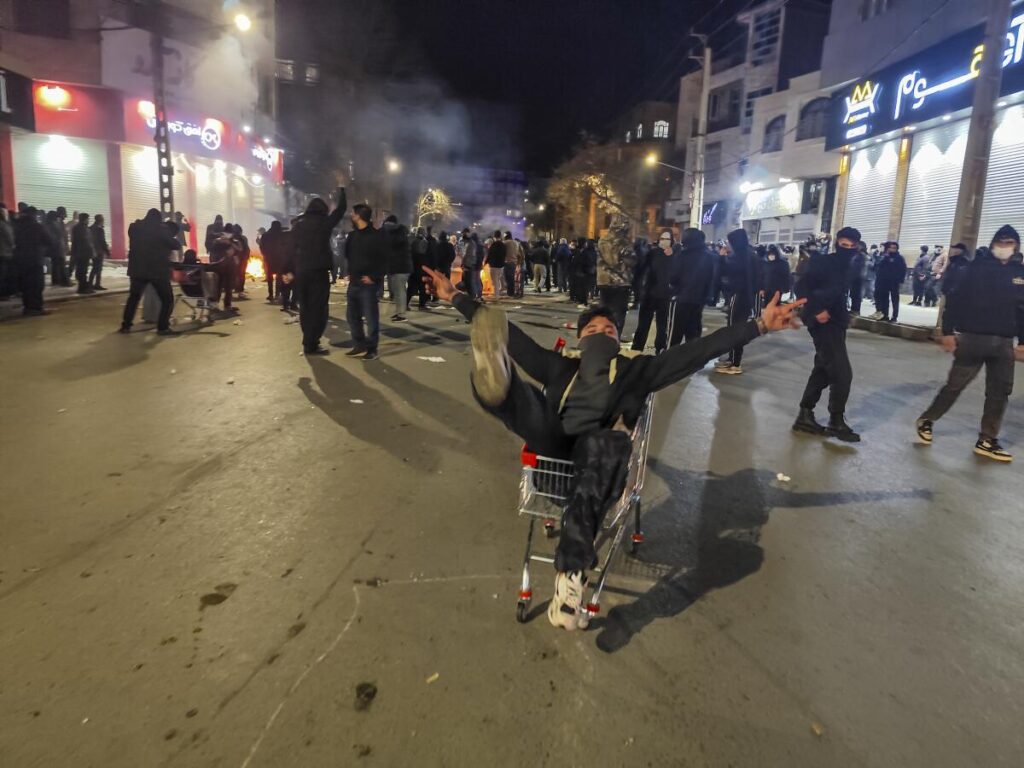
Protests began soon after the currency collapse, with demonstrators chanting against Iran’s theocracy and explicitly calling for regime change rather than economic policy adjustments. The direct attacks on the Islamic Republic’s legitimacy rather than focusing narrowly on economic grievances distinguished these protests from earlier cycles that authorities successfully portrayed as limited complaints about specific policies rather than fundamental opposition to clerical rule.
It remains unclear why Iranian officials have not yet implemented the full-scale violent crackdowns that have suppressed previous protest waves, with 2019 demonstrations ending after security forces killed an estimated 1,500 people in systematic massacres. President Trump warned last week that if Tehran “violently kills peaceful protesters,” America “will come to their rescue,” suggesting potential U.S. military intervention if Iran conducts mass killings.
Trump’s warning drew sharp rebuke from Iran’s Foreign Ministry, which issued a statement declaring: “Recalling the long history of criminal interventions by successive U.S. administrations in Iran’s internal affairs, the Foreign Ministry considers claims of concern for the great Iranian nation to be hypocritical, aimed at deceiving public opinion and covering up the numerous crimes committed against Iranians.”
However, the Iranian government’s harsh rhetoric has not deterred the U.S. State Department from using social media platform X to highlight footage purportedly showing demonstrators putting up stickers naming roads after Trump or throwing away government-subsidized rice in symbolic rejection of the regime’s economic management.
“When prices are set so high that neither consumers can afford to buy nor farmers can afford to sell, everyone loses,” the State Department stated in one message amplifying protest footage. “It makes no difference if this rice is thrown away,” the statement continued, characterizing the discarded subsidized food as indictment of economic policies that have failed both producers and consumers.
Meanwhile, Nobel Peace Prize laureate Narges Mohammadi remains imprisoned by Iranian authorities following her December 2025 arrest. Mohammadi has become an international symbol of Iranian resistance, with her continued detention despite Nobel recognition demonstrating the regime’s willingness to ignore international opinion when suppressing domestic dissent.
“Since Dec. 28, 2025, the people of Iran have taken to the streets, just as they did in 2009, 2019,” her son Ali Rahmani stated, connecting current protests to previous uprising cycles. “Each time, the same demands came up: an end to the Islamic Republic, an end to this patriarchal, dictatorial and religious regime, the end of the clerics, the end of the mullahs’ regime.”
Rahmani’s statement emphasized continuity in Iranian opposition demands across protest cycles separated by years, suggesting that the fundamental grievances driving unrest remain unaddressed by a government unwilling to consider reforms that would undermine clerical authority. The repeated protest cycles demonstrate that suppression provides only temporary stability rather than resolving underlying legitimacy crises.
The internet and communications shutdown creates information blackout that makes assessing Thursday night’s protests’ full scope impossible, with international observers dependent on whatever footage protesters managed to upload before connectivity was severed or information that emerges in coming days once some communications are restored. The blackout itself signals government concern about the demonstrations’ scale and potential to spread if Iranians could see thousands of compatriots openly defying authorities.
For Crown Prince Reza Pahlavi, Thursday’s response provides crucial data about whether he commands genuine support inside Iran or whether chants praising his father represent general anti-regime sentiment rather than specific monarchist preferences. If subsequent days show sustained mobilization responding to his calls, it would position him as the opposition’s most prominent figure despite decades in exile. Conversely, if protests diminish or participants reject his leadership, it would confirm that Iran’s opposition remains fragmented without consensus about post-regime governance.
The coming days will reveal whether Iranian security forces implement the violent suppression that has ended previous protest cycles or whether Trump’s warnings and international attention create sufficient deterrence to prevent mass killings. The regime faces difficult calculations about whether tolerating continued protests risks encouraging escalation or whether brutal crackdowns would trigger the American intervention Trump has threatened, creating a potential stalemate where protests continue at reduced intensity while authorities avoid massacres that might provoke foreign intervention.
AP originally




