

(AP) — Satellite imagery, expert assessments and statements from U.S. officials indicate that the devastating explosion that destroyed a school in southern Iran and killed scores of students may have been the result of an American airstrike targeting a nearby compound linked to Iran’s Revolutionary Guard.
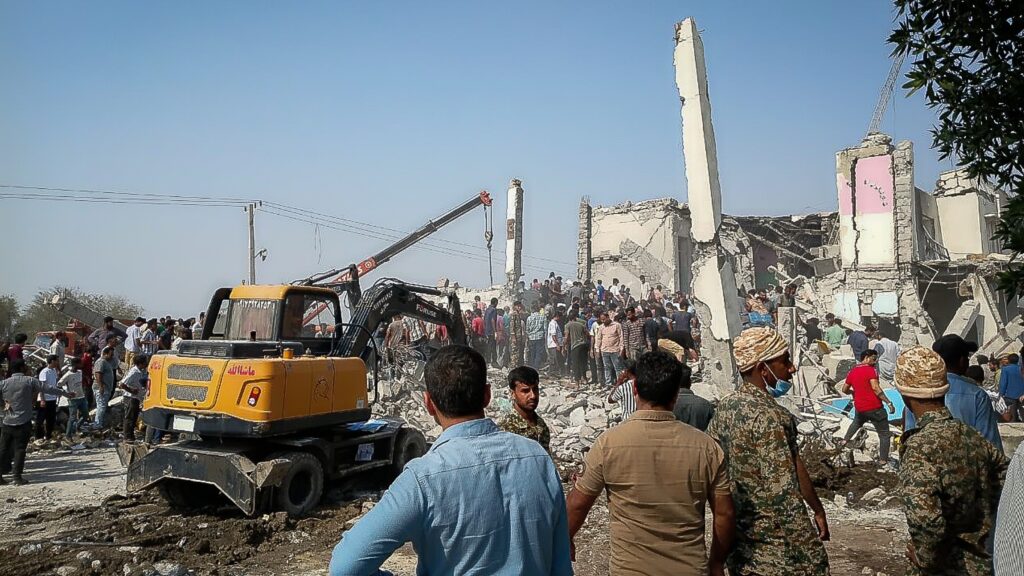
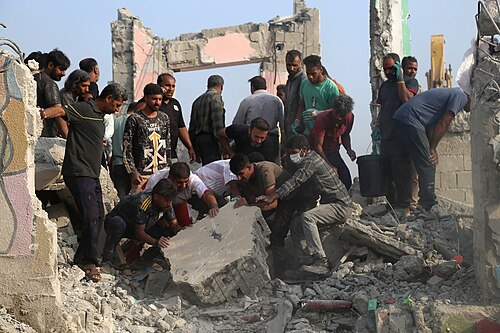
The Feb. 28 blast struck Shajareh Tayyebeh Elementary School in the coastal city of Minab, located about 1,100 kilometers (680 miles) southeast of Tehran. Iranian state media indicated that more than 165 people died, the majority of them children who were attending classes when the explosion occurred.
The incident represents the deadliest reported civilian event since the current conflict involving Iran and its adversaries escalated earlier this year.
Satellite photographs captured Wednesday and reviewed by The Associated Press reveal extensive destruction at the school site, where most of the structure appears to have been flattened. The images show a distinctive crescent-shaped breach in the roof and debris scattered across the campus.
Experts examining the imagery indicated that the pattern of destruction is consistent with precision air-delivered munitions.
U.S. officials have not acknowledged responsibility for the strike.
During a Pentagon media briefing Wednesday, Defense Secretary Pete Hegseth indicated that the U.S. military was reviewing the circumstances surrounding the incident.
“All I can say is that we’re investigating that,” Hegseth said. “We, of course, never target civilian targets. But we’re taking a look and investigating that.”
Iranian authorities have accused both the United States and Israel of carrying out the strike.
Neither country has publicly confirmed involvement.
However, several factors suggest the possibility that U.S. forces may have been responsible.
A U.S. official who spoke with The Associated Press indicated that the strike was likely American. The official spoke on condition of anonymity because they were not authorized to discuss the matter publicly.
Another indicator involves the launch of a formal review by the U.S. military. Pentagon guidelines for mitigating civilian harm state that such reviews typically begin after investigators determine there may be a possibility that U.S. operations contributed to civilian casualties.
Capt. Tim Hawkins, spokesperson for U.S. Central Command, declined to discuss details of the case.
“It would be inappropriate to comment given the incident is under investigation,” Hawkins told The Associated Press.
At the White House, Press Secretary Karoline Leavitt indicated Friday that there were no new updates regarding the inquiry.
The school sits adjacent to a walled complex identified on maps as the Seyyed Al-Shohada Cultural Complex, which is associated with Iran’s Revolutionary Guard.
Satellite images show extensive damage inside the compound, including multiple buildings that appear to have been struck by munitions.
The photographs reveal blast craters, charred sections of roofing and collapsed structures within the military compound.
Iranian digital mapping platforms also identify living quarters nearby for the Assef Brigades, a unit linked to the 16th Assef Coastal Missile Group within the Revolutionary Guard’s naval forces.
Military analyst Farzin Nadimi, a senior fellow at the Washington Institute for Near East Policy, indicated that the nearby unit operates under the Guard’s 1st Naval District, which oversees security in the Strait of Hormuz.
The strategic waterway represents one of the world’s most critical maritime chokepoints, with roughly one-fifth of global oil and natural gas shipments passing through it.
The United States has conducted multiple strikes against naval-related targets in the region during the current conflict and has acknowledged operations within Hormozgan Province, where Minab is located.
American naval forces operating in the Arabian Sea, including the aircraft carrier USS Abraham Lincoln, would have the capability to conduct air operations within range of the site.
Israel, meanwhile, has concentrated its military operations closer to its own borders and has not acknowledged strikes south of the city of Isfahan, approximately 800 kilometers (500 miles) from Minab.
Three independent specialists who reviewed the satellite images for The Associated Press indicated that the pattern of damage strongly suggests multiple precision-guided munitions struck the area.
Corey Scher, a researcher who studies satellite imagery and radar data to analyze changes in conflict zones, observed that the damage appeared highly concentrated within the compound.
“All the strikes are clustered within the walled-off compound,” Scher said. “That’s one level of precision at the block level. And then most of the strikes are basically leading to direct hits on buildings.”
Scher noted that the explosions appear to have occurred when the munitions struck surfaces directly rather than detonating in the air.
“It looks like the explosion happened at the time they hit the surface, whether it was the building or the ground,” he explained.
Sean Moorhouse, a former British Army officer and explosive ordnance disposal specialist, indicated that the damage pattern could be consistent with multiple high-explosive warheads weighing roughly 2,000 pounds (900 kilograms).
Such impacts would also undermine theories suggesting that a malfunctioning Iranian missile may have accidentally struck the site, Moorhouse said.
Another weapons specialist, N.R. Jenzen-Jones, director of Armament Research Services, said the strike appeared to involve several near-simultaneous impacts.
“If indeed it is confirmed that an American or Israeli strike hit the school, there are several potential points of failure in the targeting cycle,” Jenzen-Jones said.
He suggested the incident could have stemmed from intelligence failures or outdated targeting data.
The strike has drawn strong criticism from the United Nations and several international human rights organizations.
U.N. Secretary-General officials and human rights advocates have urged transparency regarding the circumstances of the attack.
Ravina Shamdasani, spokesperson for the U.N. Human Rights Office, emphasized that families of the victims deserve clarity.
“The families of the little girls who were killed are entitled to the truth of how this happened,” Shamdasani said.
Legal experts have noted that attacks on schools can constitute violations of international humanitarian law.
Elise Baker, a senior staff lawyer at the Atlantic Council, explained that civilian structures such as schools are protected under the laws governing armed conflict.
“Strikes can only legally target military objectives and combatants,” Baker said. “The school was a civilian object and the students and teachers were civilians.”
Baker added that the presence of a nearby military facility does not automatically justify attacks that place civilians at risk.
The Minab explosion highlights the growing challenges military planners face when conducting precision strikes in areas where military installations and civilian infrastructure exist side by side.
Across many regions of the Middle East, military bases, housing compounds and public institutions often coexist within densely populated urban zones. This overlap significantly increases the risk of civilian casualties even during highly targeted operations.
Modern air forces increasingly rely on precision-guided munitions designed to limit collateral damage. However, those systems still depend heavily on accurate intelligence and up-to-date targeting data.
If a facility previously associated with military operations becomes a civilian site — such as a school or residential complex — outdated information can lead to catastrophic consequences.
Analysts also note that militaries frequently face pressure to act quickly during wartime operations, particularly when targeting mobile missile units or naval assets. Rapid decision-making can sometimes leave little time for thorough verification of nearby civilian activity.
The Minab strike could therefore represent a broader illustration of how intelligence gaps, operational urgency and geographic proximity between military and civilian sites can converge to produce devastating outcomes.
As the investigation continues, the incident is likely to intensify global scrutiny of military operations in the region and the safeguards used to prevent civilian casualties.
For the families of the children who died in the blast, however, the central question remains unchanged: how a school became the site of one of the deadliest events of the conflict.




