

Islamic militants abducted more than 300 civilians during coordinated raids in northeastern Nigeria, officials said Friday, marking one of the largest mass kidnappings in the region in recent months and highlighting the enduring threat posed by extremist groups operating in the area.
Local authorities indicated that the abductions occurred when heavily armed fighters stormed rural communities in Borno State, a region that has long been the epicenter of Nigeria’s insurgency.
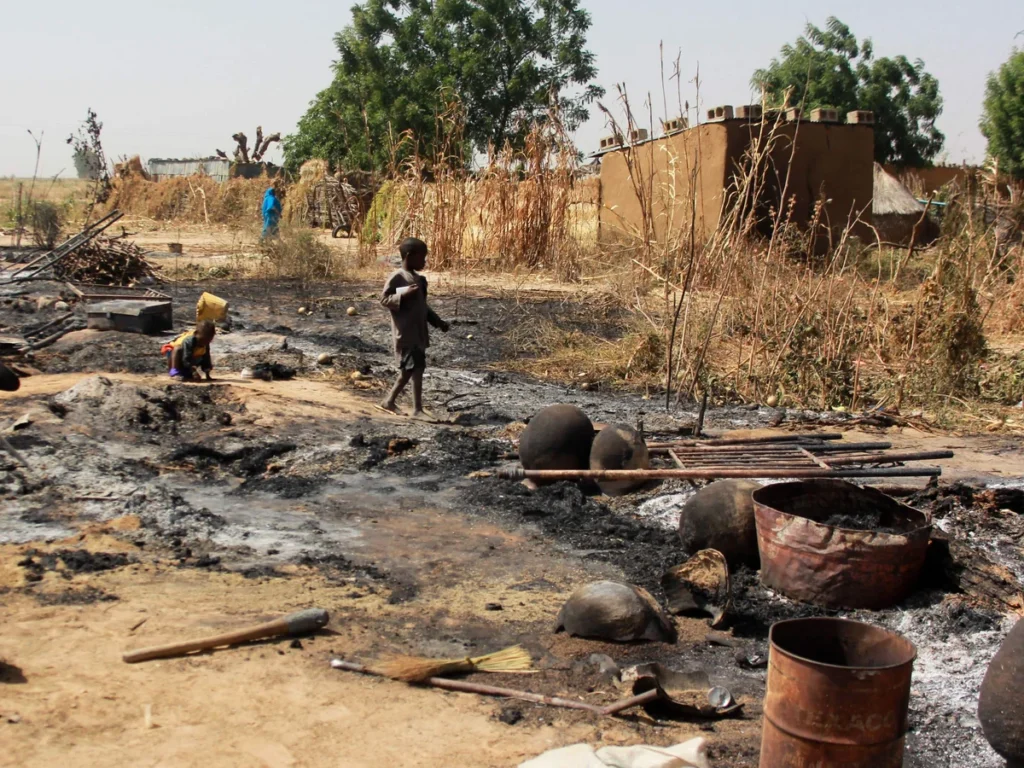
Government officials and security sources said the attackers swept through several villages, rounding up residents and forcing them into trucks and motorcycles before disappearing into remote bushland. The victims include women, children and elderly residents, local authorities said.
Community leaders and security personnel have begun efforts to determine the precise number of abducted people, though preliminary estimates suggest that more than 300 individuals were taken during the raids.
Officials believe the operation was carried out by militants linked to extremist groups that have waged a violent campaign in northeastern Nigeria for more than a decade.
Nigeria’s military and regional officials have not yet formally attributed the attack to a specific faction, but security analysts say the tactics resemble those frequently used by Boko Haram and its splinter group Islamic State West Africa Province (ISWAP).
Both organizations have repeatedly targeted rural communities across northeastern Nigeria, carrying out kidnappings, bombings and assaults on military installations.
Local government officials said the militants arrived in large numbers and surrounded the villages before residents could flee.
Witnesses described scenes of panic as families attempted to escape the attackers.
Some villagers managed to hide in nearby forests while others fled to neighboring communities, but hundreds were unable to escape.
Security forces and local militias have begun search operations in surrounding areas in an effort to locate the abducted civilians.
Military officials said troops have been deployed along key roads and suspected militant routes, though the vast terrain and dense forests in the region make rescue operations particularly challenging.
Local authorities also appealed for calm among residents, urging communities to cooperate with security agencies and provide information that could help locate the captives.
Community leaders in Borno State said many families remain uncertain about the fate of their relatives.
Some villages have been largely emptied as residents fled to nearby towns for safety.
Mass abductions have become a hallmark of the insurgency in northeastern Nigeria.
Militant groups frequently kidnap civilians to use as bargaining chips for ransom, forced labor or recruitment.
The most widely known case occurred in 2014, when Boko Haram abducted 276 schoolgirls from the town of Chibok, sparking global outrage and the #BringBackOurGirls campaign.
Although some of the girls were eventually released, many remain missing.
Since then, numerous similar kidnappings have taken place across Nigeria, particularly in rural areas where security forces have limited presence.
Experts say such attacks are often designed to spread fear among local populations and undermine confidence in government security efforts.
The ongoing insurgency has triggered one of Africa’s largest humanitarian crises.
Millions of people have been displaced across northeastern Nigeria, with many living in crowded camps or informal settlements.
Aid agencies have repeatedly warned that the region faces severe food shortages and limited access to healthcare due to persistent violence.
Humanitarian organizations operating in Borno State say attacks and kidnappings continue to disrupt relief operations and restrict movement in some areas.
The abduction of hundreds of civilians could further worsen the humanitarian situation, particularly if families are forced to flee their homes in fear of additional raids.
The mass kidnapping illustrates the enduring resilience of extremist groups in northeastern Nigeria despite years of military operations aimed at dismantling their networks.
Nigeria’s armed forces, supported by a regional coalition known as the Multinational Joint Task Force, have launched numerous offensives against militant strongholds in recent years.
While those operations have succeeded in recapturing some territory, insurgent groups have adapted by shifting tactics.
Instead of attempting to control large urban areas, militants increasingly focus on asymmetric attacks, including ambushes, suicide bombings and kidnappings in remote communities.
Security experts note that these tactics allow militants to maintain influence even when they face heavy military pressure.
Another factor complicating the conflict is the fragmentation of militant groups.
Boko Haram itself splintered several years ago, producing rival factions that sometimes compete for influence while continuing attacks against government forces and civilians.
This fragmentation has made the insurgency more unpredictable and harder to contain.
The security crisis in northeastern Nigeria has also spilled across borders into Chad, Niger, and Cameroon, creating a regional conflict that affects millions of people.
Militant groups frequently move across these borders to evade security forces, exploiting the vast and difficult terrain around Lake Chad.
Regional governments have attempted to coordinate counterterrorism operations, but limited resources and political challenges have slowed progress.
Analysts warn that unless security conditions improve significantly, extremist groups could continue using mass kidnappings as a strategic tool.
Such operations not only generate ransom revenue but also reinforce militants’ ability to intimidate populations and weaken local governance.
For families whose relatives were taken in the latest abductions, however, the geopolitical analysis offers little comfort.
As search operations continue, communities across northeastern Nigeria remain on edge, hoping that the hundreds of civilians seized during the raids can eventually be brought home safely.
AP




