

Israeli warplanes struck multiple locations across southern and eastern Lebanon late Monday and early Tuesday, escalating military pressure just days before Lebanese officials are set to hold a pivotal meeting on efforts to disarm Hezbollah and other militant groups operating near the border with Israel.
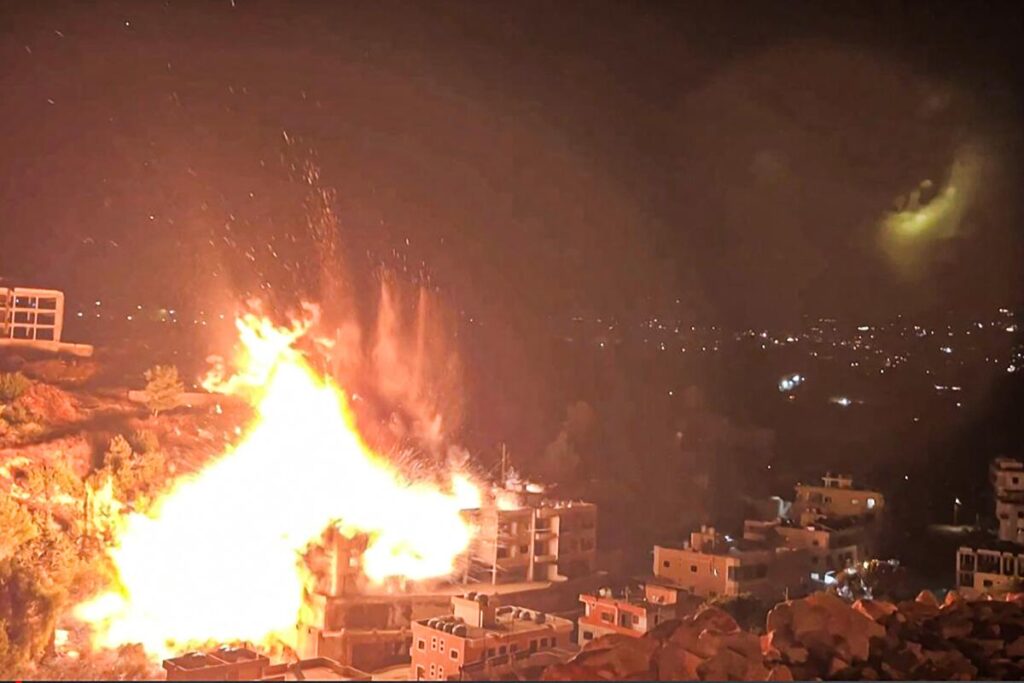
One of the most significant strikes occurred shortly after 1 a.m. Tuesday in the southern coastal city of Sidon, Lebanon’s third-largest city, where an air raid flattened a three-story commercial building in a busy industrial district. The attack came ahead of a scheduled government briefing by Lebanon’s army commander on the progress of extending state authority into long-contested areas and removing armed groups from the country’s south.
An Associated Press photographer at the scene in Sidon said the destroyed structure was located in a commercial zone filled with workshops and auto repair shops and appeared to be uninhabited at the time of the strike. Ambulances transported at least one injured person from the area, while rescue teams searched through debris for possible victims. No fatalities had been reported by early Tuesday.
Lebanese President Joseph Aoun condemned the strikes, warning that the timing and scale of the attacks undermined international efforts to stabilize the country and threatened Beirut’s own attempts to reassert control over regions historically dominated by Hezbollah.
In a statement issued Tuesday, Aoun said the airstrikes ran counter to diplomatic initiatives aimed at reducing tensions and jeopardized Lebanon’s “serious efforts to extend the authority of the state and implement commitments related to security and stability.”
Israel’s military said the strikes targeted weapons storage facilities and infrastructure belonging to Hezbollah and Hamas, both designated as militant groups by Israel and the United States. In a statement released Tuesday, the military acknowledged that the sites were embedded within civilian areas but blamed the groups for operating among noncombatants.
The attacks were part of near-daily Israeli military action that has continued despite a ceasefire brokered more than a year ago, following a devastating conflict between Israel and Hezbollah. Under that agreement, Lebanon pledged to dismantle armed groups south of the Litani River — a commitment Israeli officials say has not been fully implemented.
The latest airstrikes came nearly two hours after Israel’s military Arabic-language spokesman, Avichay Adraee, issued public warnings on the social media platform X, advising residents to evacuate areas in two villages in eastern Lebanon’s Bekaa Valley and two villages in the country’s south ahead of imminent strikes.
Lebanon’s state-run National News Agency reported that one of the homes hit in the Bekaa Valley village of Manara belonged to Sharhabil al-Sayed, identified as a Hamas military commander who was killed in an Israeli drone strike in May 2024. Residents evacuated the targeted areas after Israel’s warnings, and there were no immediate reports of casualties in those strikes.
Earlier Monday, Lebanon’s Health Ministry said an Israeli drone strike on a vehicle in the southern village of Braikeh wounded two people. The Israeli military said the strike targeted two Hezbollah members.
The airstrikes occurred as Lebanon’s government prepares for a sensitive and politically fraught discussion on Hezbollah’s disarmament. The Cabinet is scheduled to meet Thursday, with army commander Gen. Rudolph Haikal expected to brief ministers on ongoing security operations and future plans.
Lebanon’s army last year began disarming Palestinian factions operating in refugee camps and other areas outside full state control. Government officials have repeatedly said that by the end of 2025, all territory south of the Litani River — an area long regarded as Hezbollah’s stronghold — would be free of the group’s armed presence.
Monday’s strikes, however, targeted villages north of the Litani River and well beyond the immediate border area with Israel, raising concerns among Lebanese officials and analysts that Israel’s military campaign may be expanding geographically even as political negotiations intensify.
The current push to dismantle Hezbollah’s military capabilities follows a 14-month war between Israel and the Iran-backed group that ended in November 2024 with a U.S.-brokered ceasefire. That conflict severely weakened Hezbollah, killing much of its senior political and military leadership and destroying large portions of its infrastructure.
The war began on Oct. 8, 2023, one day after Hamas launched an unprecedented attack on southern Israel. In what it described as solidarity with Hamas, Hezbollah began firing rockets into northern Israel, prompting Israeli retaliation. Israel escalated its campaign in September 2024 with widespread airstrikes across Lebanon, followed by a ground invasion aimed at pushing Hezbollah away from the border.
Although the ceasefire halted large-scale fighting, Israel has continued to carry out targeted strikes, saying they are necessary to prevent Hezbollah from rebuilding its military capabilities. According to the office of the U.N. High Commissioner for Human Rights, at least 127 civilians have been killed in Israeli strikes in Lebanon since the ceasefire took effect.
Analysts say the timing of the latest attacks reflects Israel’s skepticism toward Lebanon’s ability — or willingness — to fully disarm Hezbollah. While Beirut has publicly committed to restoring state authority, Hezbollah remains a powerful political and military force with deep roots in Lebanese society and significant backing from Iran.
For Lebanon, the challenge is balancing internal stability with external pressure. Any aggressive move against Hezbollah risks political backlash and potential unrest, while failure to act invites continued Israeli military action. President Aoun and Prime Minister Najib Mikati’s government face mounting pressure from Western and regional partners to demonstrate concrete progress ahead of renewed diplomatic engagement.
The strikes have also heightened fears among civilians already struggling with Lebanon’s prolonged economic crisis. Sidon residents surveyed by the AP said the attack revived memories of the broader war and raised concerns that fragile calm could collapse into renewed large-scale conflict.
As Lebanon’s leaders prepare to meet later this week, the latest Israeli airstrikes underscore the narrow window for diplomacy. Whether the disarmament talks lead to tangible changes on the ground — or further escalation — could shape the trajectory of Israeli-Lebanese relations and regional stability in the months ahead.
Associated Press




