

(AP) — Israel intensified its aerial assault on Tehran and key Iranian military installations Tuesday, while Iran broadened its retaliation beyond Israeli territory, launching drone and missile attacks across the Gulf and striking U.S. diplomatic compounds in Saudi Arabia and the United Arab Emirates.
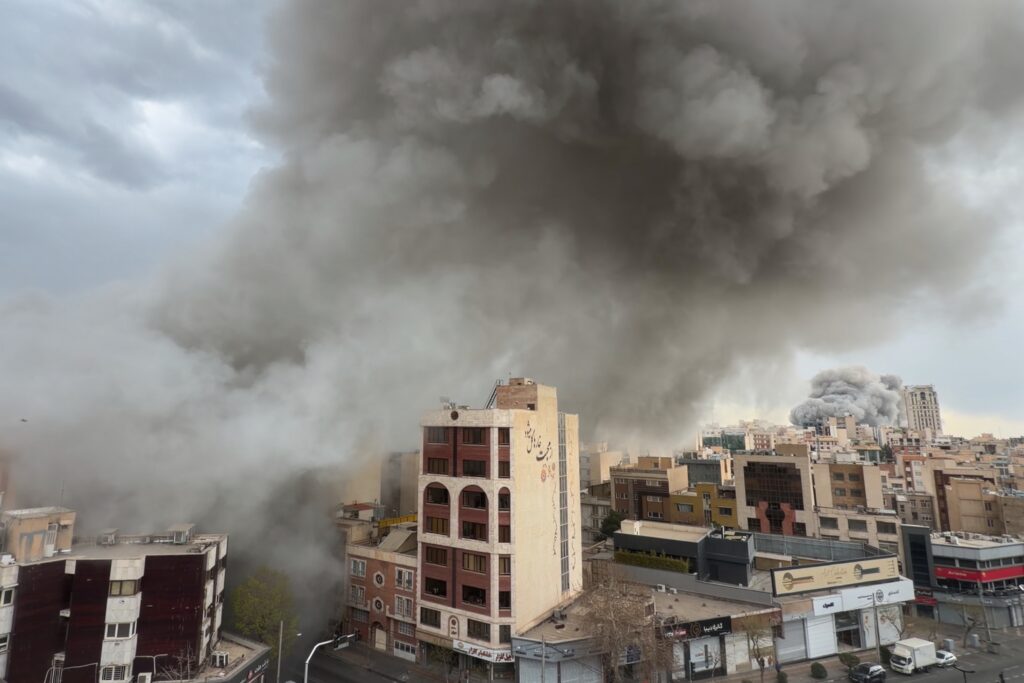
Four days into a widening conflict that President Donald Trump has indicated could stretch on for weeks, the human toll is mounting. Nearly 800 people have been killed in Iran since the fighting began, according to figures cited by The Associated Press, while at least 11 people in Israel have died amid sustained Iranian missile barrages.
Explosions reverberated across Tehran overnight as Israeli aircraft targeted ballistic missile infrastructure and what Israeli officials described as a covert underground nuclear research facility. In neighboring Lebanon, Israel said it carried out retaliatory strikes against the Iranian-backed militant group Hezbollah.
Iran, in turn, expanded its campaign across the region. Drone strikes hit the U.S. Embassy in Riyadh, igniting a small fire, and struck a parking area outside the U.S. Consulate in Dubai, U.S. Secretary of State Marco Rubio said. No American personnel were reported injured in either incident.
The conflict’s accelerating tempo has raised urgent questions about its scope, objectives and endgame.
The Israeli military announced it conducted a series of air operations in Tehran and Isfahan aimed at facilities used to manufacture and store ballistic missiles. Military spokesperson Brig. Gen. Effie Defrin said Israeli forces also destroyed what he described as Iran’s “secret underground nuclear headquarters,” alleging the site had been used for research tied to nuclear weapons development.
Iran has long maintained that its nuclear program is peaceful and denies seeking atomic weapons capability.
The International Atomic Energy Agency said Iran’s Natanz enrichment site had sustained “recent damage” but reported no expected radiological consequences. The United States struck Natanz during a 12-day war in June, significantly degrading Iran’s nuclear capacity at the time.
Satellite imagery released by a Colorado-based commercial firm indicated that part of Iran’s presidential complex in Tehran sustained heavy structural damage, including the destruction of a domed roof. Iranian authorities did not immediately acknowledge the strike.
Communications within Iran have been disrupted amid continuous bombardment and tightened restrictions on journalists. Residents in northern Tehran described hearing repeated explosions through the night. In the normally busy Tajrish district, many storefronts remained shuttered, though bakeries and grocery stores stayed open.
Iran has fired dozens of ballistic missiles toward Israel, most of which Israeli air defenses intercepted, according to Israeli authorities.
Beyond Israel, Iranian drones and missiles have targeted U.S. diplomatic sites and Gulf infrastructure. The Saudi Defense Ministry confirmed that two drones struck the U.S. Embassy compound in Riyadh, causing limited damage. The United Arab Emirates said it intercepted the vast majority of more than 1,000 Iranian missile and drone launches directed toward its territory.
U.S. embassies in Saudi Arabia, Kuwait and Lebanon closed to the public as Washington ordered the departure of non-essential personnel and families from several Middle Eastern nations, including Kuwait, Bahrain, Iraq, Qatar, Jordan and the UAE. The State Department is arranging military and charter flights for American citizens seeking to leave the region.
The U.S. military also confirmed the deaths of four Army Reserve soldiers in a drone strike on a command center in Kuwait. The soldiers were assigned to the 103rd Sustainment Command based in Des Moines, Iowa. Two additional service members were killed in the same strike.
The Pentagon identified the four soldiers as Capt. Cody A. Khork of Florida; Sgt. 1st Class Noah L. Tietjens of Nebraska; Sgt. 1st Class Nicole M. Amor of Minnesota; and Spc. Declan J. Coady of Iowa.
The Biden administration has articulated multiple objectives for the joint U.S.-Israeli campaign, including dismantling Iran’s missile arsenal, crippling its navy, preventing nuclear weapons development and curbing support for allied militant groups.
Although initial strikes reportedly killed Iran’s Supreme Leader, Ayatollah Ali Khamenei, senior U.S. officials later clarified that regime change is not an official policy goal. Trump, speaking from the Oval Office, said the United States had considered potential successors within Iran’s leadership but indicated those figures are now dead.
He added that an internal figure within Iran might ultimately assume power but cautioned against the possibility that any successor could prove equally hardline.
Iranian authorities are now navigating a rare leadership transition. The selection of a new supreme leader marks only the second such shift since the 1979 Islamic Revolution. Possible candidates range from hardliners favoring confrontation with the West to reformist figures advocating renewed diplomacy.
In Lebanon, Israel’s strikes against Hezbollah killed 50 people, including seven children, according to Lebanon’s health ministry. The Iranian-backed group has exchanged fire with Israeli forces since hostilities escalated.
Turkish Foreign Minister Hakan Fidan sharply criticized Iran’s decision to target Gulf neighbors that had sought to avoid direct involvement. He described the strategy as dangerously flawed and warned it risked drawing additional states into open conflict.
The cumulative casualties underscore the widening geographic footprint of the war. According to the Iranian Red Crescent Society, at least 787 people have been killed inside Iran. Additional fatalities have been reported in the United Arab Emirates, Kuwait and Bahrain.
The expanding battlefield reflects a strategic shift by both Israel and Iran. Israel appears intent on degrading Iran’s long-term military and nuclear infrastructure rather than merely responding to immediate threats. By targeting missile production sites and alleged nuclear research facilities deep inside Tehran, Israel signals a willingness to reshape Iran’s strategic posture.
Iran’s retaliation, meanwhile, suggests a calculated effort to internationalize the conflict. By striking U.S. diplomatic compounds and Gulf infrastructure, Tehran may be seeking to pressure Washington’s regional allies and raise the economic costs of continued operations.
Energy markets have already reacted nervously amid concerns over potential disruptions to Gulf shipping lanes. Insurance premiums for commercial vessels transiting the Strait of Hormuz have climbed, reflecting fears of further escalation.
At the same time, the leadership vacuum in Tehran introduces uncertainty. A contested succession process could embolden hardline factions or prompt internal instability, complicating diplomatic efforts to contain the conflict.
Despite the mounting casualties and widening theater of operations, neither side has articulated a clear pathway toward de-escalation. With U.S. personnel now among the dead and diplomatic compounds under attack, Washington’s role risks deepening further.
As airspace closures strand civilians and foreign governments scramble evacuation flights, the war’s trajectory appears increasingly volatile — and its endpoint uncertain.




