

(AP/NBC) — Israel’s killing of Iran’s intelligence minister has marked a significant escalation in its campaign against Tehran’s leadership, even as analysts warn that such strikes are unlikely to alter the broader course of a war now reverberating across global energy markets and regional security.
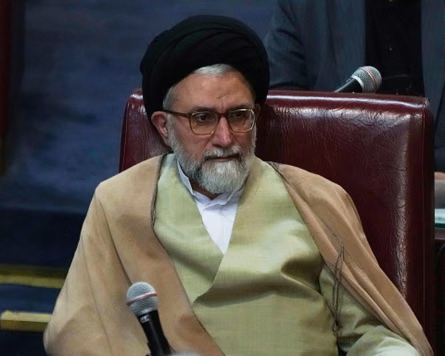
Iranian officials confirmed that Esmail Khatib was killed in an overnight Israeli strike, making him one of the highest-ranking figures targeted since the conflict began. The killing follows closely behind Israel’s assassination of senior political leader Ali Larijani and paramilitary commander Gholam Reza Soleimani, underscoring a sustained effort to dismantle Iran’s leadership structure.
Israeli Defense Minister Israel Katz signaled that further operations are imminent, promising “significant surprises” as Israel intensifies its offensive against the Islamic Republic.
Israel’s ability to target senior Iranian officials has drawn attention from defense analysts, who describe the operations as tactically effective but strategically uncertain.
Experts told NBC News that the removal of figures like Khatib and Larijani may disrupt Iran’s internal coordination but is unlikely to decisively shift the trajectory of the war.
Michael Stephens of the Royal United Services Institute described the killings as notable achievements but questioned their broader significance.
“It’s impressive what Israel is able to do,” Stephens said, while adding that the global implications of the conflict remain largely unchanged.
Khatib, as intelligence minister, played a central role in Iran’s internal security apparatus, making his death both symbolically and operationally significant. His removal follows earlier losses, including Supreme Leader Ali Khamenei, whose death early in the war sent shockwaves through the Iranian system.
Despite the immediate disruption caused by these killings, analysts caution that the long-term effects may favor more hard-line elements within Iran.
Rouzbeh Parsi of Lund University indicated that such actions are unlikely to influence battlefield dynamics in a decisive way.
“They will most likely not affect the operational side of the war,” he said.
Ellie Geranmayeh of the European Council on Foreign Relations warned that removing influential figures could accelerate the consolidation of power within the Islamic Revolutionary Guard Corps.
“If you look at how the assassination of Ali Khamenei empowered the most hard-line and security elements within the Islamic Republic of Iran, then further killings could accelerate that trajectory,” she said.
Khatib’s role in overseeing intelligence and internal security operations makes his death particularly sensitive, potentially creating short-term disarray while reinforcing the authority of more militarized factions over time.
The war has expanded beyond leadership targets to include critical energy assets, heightening concerns about global economic stability.
Israeli forces reportedly struck parts of Iran’s South Pars natural gas field, one of the largest in the world, while Iran responded with attacks on energy facilities across the Persian Gulf region.
Iran has also intensified efforts to restrict maritime traffic through the Strait of Hormuz, a crucial passage for global oil supplies.
According to The Associated Press, oil prices surged more than 5% to exceed $108 per barrel, reflecting growing fears of prolonged supply disruptions.
Energy infrastructure in Qatar, Saudi Arabia, United Arab Emirates, and Kuwait has been targeted, with Iran signaling its intent to sustain pressure on regional economies.
“Iran has successfully moved this conflict onto the global level,” Stephens said, noting that economic disruption has become a central component of Tehran’s strategy.
Iran has responded to Israel’s actions with a series of missile and drone attacks, including strikes near Tel Aviv that left casualties and attacks on Gulf states’ energy facilities.
The paramilitary Islamic Revolutionary Guard Corps said it deployed advanced missiles capable of evading air defenses, signaling an escalation in both capability and intent.
In Lebanon, Israel has intensified strikes against Hezbollah, hitting targets in Beirut and other areas. Lebanese authorities say the conflict has displaced more than 1 million people and caused hundreds of deaths.
Inside Iran, the Iranian Red Crescent has reported more than 1,300 fatalities since the conflict began, with additional casualties expected as fighting continues.
The United States has maintained a supporting role in the conflict. A person familiar with the matter said Washington was informed of Israeli plans to strike Iran’s gas infrastructure but did not participate directly.
President Donald Trump has expressed frustration over the lack of international support for efforts to secure shipping lanes in the Strait of Hormuz, highlighting tensions among Western allies.
Regional governments have voiced concern over the expanding scope of the conflict. Iranian President Masoud Pezeshkian warned that attacks on energy infrastructure could trigger “uncontrollable consequences,” while Gulf states described the situation as a dangerous escalation.
The killing of Iran’s intelligence minister represents one of the most consequential targeted strikes of the war, striking at the heart of Tehran’s security apparatus.
From a tactical standpoint, the operation highlights Israel’s intelligence capabilities and its ability to penetrate deeply into Iranian networks. Removing a figure like Khatib can disrupt surveillance systems, internal coordination and counterintelligence efforts in the short term.
However, the broader strategic picture remains unchanged.
Analysts emphasize that leadership decapitation alone is unlikely to achieve Israel’s stated goal of weakening or toppling Iran’s ruling system. Instead, the pattern seen thus far suggests a cycle in which high-profile assassinations are followed by intensified retaliation and further regional escalation.
At the same time, Iran’s focus on energy infrastructure and maritime chokepoints has effectively transformed the conflict into a global economic crisis. The disruption of oil and gas flows has immediate consequences for markets, inflation and geopolitical stability far beyond the Middle East.
There is also a growing concern that eliminating figures like Khatib and Larijani may narrow the space for diplomacy. As more pragmatic or politically connected leaders are removed, power may consolidate within military and ideological factions less inclined toward negotiation.
In that context, Israel’s latest strike, while dramatic, underscores a central tension in the conflict: tactical victories on the battlefield are accumulating, but a clear path to strategic resolution remains elusive.
As the war continues, the killing of Iran’s intelligence minister may be remembered less as a turning point and more as another step in a conflict that is expanding in scope, cost and global consequence.




