

Israeli military fire killed at least 17 Palestinians across the Gaza Strip on Wednesday, most of them women and children, local hospital officials said, while Israel’s army said militant gunfire wounded an Israeli soldier, underscoring the growing fragility of a ceasefire that many Palestinians say exists more on paper than in daily life.
Hospital officials in Gaza said the latest deaths occurred in multiple locations, marking another deadly day since a U.S.-backed truce took effect on Oct. 10, 2025. The agreement was intended to halt large-scale fighting after months of war, but it has been repeatedly tested by Israeli strikes and militant attacks. Gaza’s Health Ministry says more than 530 Palestinians have been killed by Israeli fire since the ceasefire began, a figure that has fueled mounting skepticism among residents and drawn concern from mediators trying to keep the deal intact.
“The genocidal war against our people in the Gaza Strip continues,” Dr. Mohamed Abu Selmiya, director of Shifa Hospital, wrote on Facebook. “Where is the ceasefire? Where are the mediators?” His remarks reflected widespread anger and despair among Palestinians who say the truce has failed to bring meaningful relief after months of devastation.
The Israeli military said Wednesday that its forces came under fire from militants and responded to protect troops operating in Gaza. An Israeli reservist soldier was badly wounded by gunfire and evacuated to a hospital, the army said, describing the militant attack as a violation of the ceasefire agreement. Israeli officials say at least three soldiers have been killed since the truce took hold, and they maintain that military actions are defensive responses to ongoing threats.
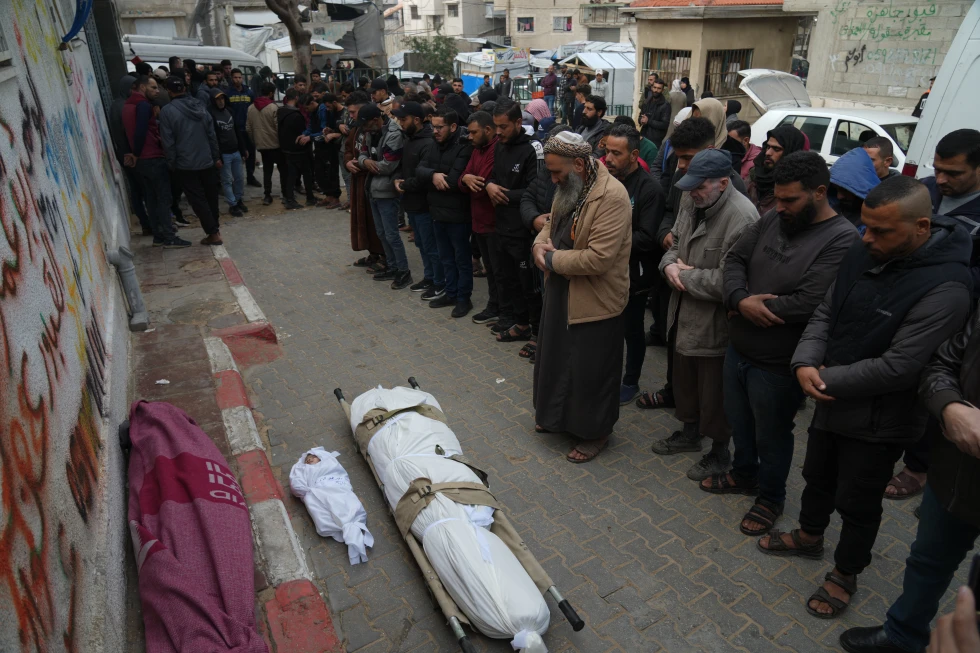
Early Wednesday, Israeli troops fired on a building in the Tuffah neighborhood of northern Gaza, killing at least 11 people, most of them from the same extended family, according to Shifa Hospital, which received the bodies. Hospital officials said the dead included two parents, their 10-day-old baby girl, her 5-month-old cousin and their grandmother. The strike added to the toll of civilians killed in residential areas since the ceasefire began, a pattern that has drawn repeated condemnation from humanitarian groups.
The Israeli military said aircraft and armored units returned fire after militants began shooting at troops in the area. It did not provide details about the militants targeted or comment on the civilian casualties reported by hospital officials. As with many recent incidents, independent verification of events on the ground was not immediately possible.
Additional strikes across Gaza pushed the death toll higher. In the southern city of Khan Younis, a strike hit a family’s tent, killing three people, including a 12-year-old boy, according to Nasser Hospital, which received the bodies. Elsewhere, tank shelling in Gaza City’s eastern Zaytoun neighborhood killed three more Palestinians, including a husband and wife, Shifa Hospital officials said.
The cumulative effect of these incidents has shaken confidence in the ceasefire among Gaza’s 2.3 million residents, many of whom have been displaced multiple times and are living in overcrowded shelters or makeshift camps. While large-scale bombardments have subsided compared with earlier phases of the war, Palestinians say daily life remains marked by fear, insecurity and sudden violence.
Mediators involved in brokering the truce have criticized the attacks and urged restraint. Hamas has accused Israel of repeatedly breaching the agreement, while Israel says Hamas and other militant groups continue to stage attacks on its forces, leaving the military little choice but to respond. The competing narratives have complicated efforts to stabilize the ceasefire and move toward broader talks on ending the conflict.
Since the war began, more than 71,800 Palestinians have been killed, according to Gaza’s Health Ministry. The ministry does not distinguish between civilians and combatants in its public counts, but it maintains detailed casualty records that United Nations agencies and independent experts generally view as credible. Israel disputes some of the figures but has not released comprehensive data of its own on Palestinian casualties.
The latest violence comes amid growing international concern that the ceasefire could collapse entirely. Diplomats say the truce was always fragile, built on narrow understandings rather than a comprehensive political framework. Without progress on issues such as humanitarian access, prisoner exchanges and a path toward governance in Gaza, analysts warn that sporadic violence could easily spiral back into full-scale war.
Beyond the immediate bloodshed, the ongoing strikes highlight deeper questions about the sustainability of ceasefires in asymmetrical conflicts where one side maintains overwhelming military superiority and the other operates through dispersed militant networks. Israeli officials argue that even limited militant attacks pose unacceptable risks to their troops and civilians, while Palestinians and human rights groups say the cost is borne disproportionately by civilians in Gaza.
The humanitarian implications are stark. Hospitals in Gaza, already strained by shortages of fuel, medicine and staff, continue to receive casualties despite the ceasefire. Doctors say treating repeated waves of wounded civilians while lacking basic supplies has become a grim routine. Aid groups warn that without a genuine halt to hostilities, rebuilding Gaza’s shattered infrastructure will remain impossible.
Politically, the rising death toll threatens to undermine U.S. and regional efforts to position the ceasefire as a stepping stone toward a longer-term settlement. Public anger in Gaza, coupled with hardline positions in Israel, narrows the space for compromise. Each new incident hardens attitudes and reinforces mutual distrust, making it harder for mediators to convince either side that restraint serves their interests.
For Palestinians like those mourning families in Tuffah, Khan Younis and Zaytoun, the debate over violations and responses feels distant from daily reality. Many say the promise of a ceasefire has been overshadowed by continued loss, leaving them to question whether the war has truly paused or simply changed form.
As the truce enters another uncertain phase, the events of Wednesday stand as a stark reminder that without robust enforcement and political follow-through, ceasefires in Gaza risk becoming little more than fragile interludes in a cycle of violence that has already claimed tens of thousands of lives.
The Associated Press




