

Israeli forces on Tuesday killed four Palestinians in separate incidents across Gaza and the occupied West Bank, including a Gaza journalist struck by what health officials described as a drone-fired munition. The flare-ups added fresh strain to a fragile ceasefire that has struggled to hold since October.
Officials at Nasser Hospital in Khan Younis told The Hindu that the drone strike killed journalist Mohamed Wadi, who often used aerial footage to document conditions on the ground. His death underscored what media advocates say has been one of the most dangerous conflict periods ever recorded for Palestinian journalists, many of whom operate on front lines with limited protective gear.
Hours earlier, hospital staff at Al-Awda Medical Center reported that a Palestinian man was fatally shot near the Bureij refugee camp in central Gaza. The Israeli military did not comment on either incident but has previously said that many of its post-ceasefire engagements have occurred after militants opened fire on Israeli positions.
According to the Gaza Health Ministry, more than 350 Palestinians have been killed across the enclave since the Oct. 11 ceasefire, a figure that includes those caught in crossfire, targeted raids and confrontations along front-line zones. Both Hamas and Israel accuse the other of violating the ceasefire’s terms.
WEST BANK SEES PARALLEL SURGE IN CLASHES
While southern Gaza absorbed the brunt of the day’s strikes, the West Bank saw its own flashpoints. Israel’s military said troops north of Ramallah shot a Palestinian who allegedly stabbed two soldiers near the settlement of Ateret. The military said the suspect was killed when he continued to advance despite warnings. Israel’s Magen David Adom rescue service said the soldiers sustained light injuries.
The Palestinian Health Ministry confirmed the death of an 18-year-old in the same area but could not immediately say whether it was the same incident.
Farther south, near Hebron, the army said it shot a Palestinian teenager accused of carrying out a car-ramming attack that injured a soldier. The military said the 17-year-old attempted to flee during his arrest and posed a threat to forces. The Palestinian Health Ministry identified the youth as a resident of Hebron.
Hamas issued a statement praising the Hebron attack as a “legitimate response” to ongoing Israeli raids, though it did not claim responsibility. Israeli operations across the West Bank intensified after Hamas’ October 2023 assault ignited the Gaza war. Palestinians and rights groups say civilians, protesters and bystanders have increasingly been among the dead.
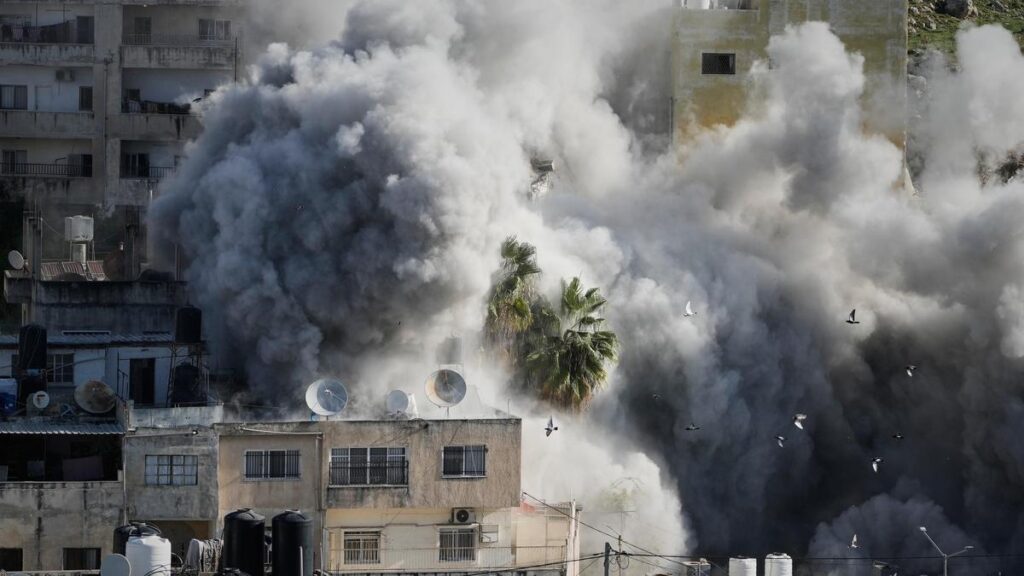
In Nablus, Israeli forces demolished the home of Abdul Karim Sanoubar, a detainee Israel accuses of planting bombs on buses in central Israel earlier this year. Troops cleared nearby homes before the explosion, sending a plume of smoke above the city.
SETTLER VIOLENCE ESCALATES; PROPERTY TARGETED
Palestinian officials reported new settler attacks on Tuesday as well. Al Jazeera said Israeli settlers torched a tractor in Burqa and attempted to ignite a vehicle while scrawling graffiti on a nearby home. The Palestinian news agency Wafa reported that settlers in Khirbet al-Deir laid down an informal road to access a freshwater spring — an area Palestinians say has been increasingly taken over by outposts.
International courts, including the International Court of Justice, have reaffirmed that Israeli settlements in the occupied West Bank and East Jerusalem violate international law, a position Israel rejects.
DIPLOMACY MOVES SLOWLY AS CEASEFIRE PRESSURE BUILDS
As violence simmered, Qatar said it was working to push Hamas and Israel into a second phase of negotiations aimed at stabilizing the ceasefire. Foreign Ministry spokesperson Majed al-Ansari said mediators hope talks will soon expand to address the status of Hamas fighters still in tunnel networks inside Israeli-controlled areas of Gaza.
But on the ground, tensions show little sign of easing. Israel conducted another round of strikes in southern Lebanon on Tuesday, continuing a steady pattern of fire with Hezbollah despite a U.S.-brokered truce last year.
A TRUCE UNDER SEVERE STRESS
The day’s events offered a stark reminder of how easily the ceasefire can fray. Although neither side has declared the agreement void, the accumulation of killings, raids and retaliatory attacks has eroded public confidence that the pause in formal hostilities will hold.
Security analysts say the rise in settler violence, targeted demolitions and Israeli arrest operations in the West Bank mirrors earlier patterns that have historically preceded larger escalations. In Gaza, the killing of a journalist — especially one working with drone footage — may increase international scrutiny over Israel’s rules of engagement and the vulnerability of noncombatants in combat-adjacent zones.
Diplomatically, Qatar’s push for a new negotiation phase suggests mediators believe the window for further progress is narrowing. Any additional spike in casualties risks collapsing talks entirely, which would likely widen the conflict beyond Gaza and the West Bank.
For now, Israeli officials, Palestinian factions and mediators are attempting to keep the ceasefire intact. Yet each new death — whether from a drone strike, a raid or a street confrontation — pushes the truce closer to the limits of political endurance.
Sources: TheHindu/Aljazeera




