

WASHINGTON — The Justice Department returned a photograph depicting President Donald Trump to its public Epstein files database Sunday after officials determined the image contained no identifiable victims, concluding a brief controversy that had fueled accusations of political interference and cover-up.
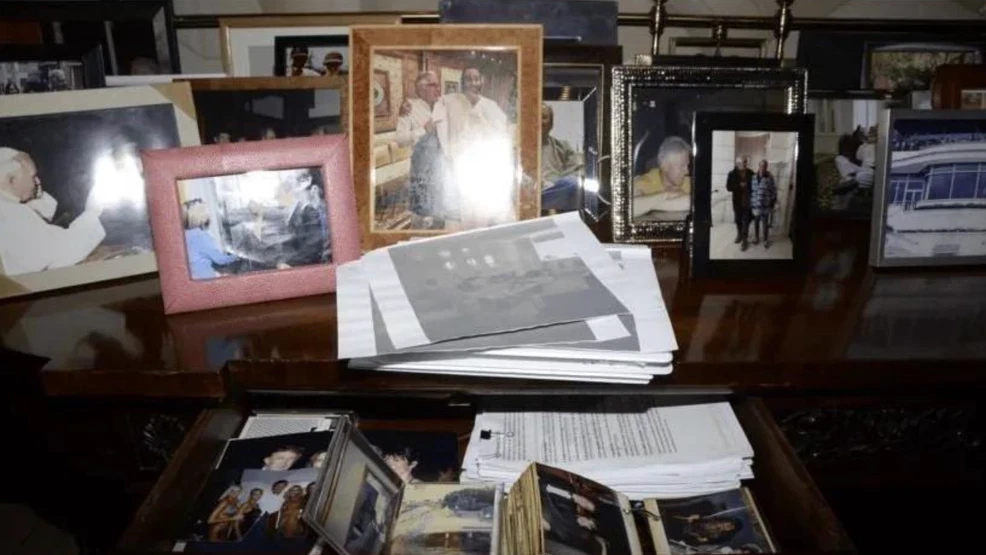
The photograph, showing a desk drawer containing an image of Trump with various women, was flagged Saturday by the Southern District of New York for review to protect potential victims, Reuters confirmed. Officials restored the image without alteration or redaction after completing their examination.
“After the review, it was determined there is no evidence that any Epstein victims are depicted in the photograph, and it has been reposted without any alteration or redaction,” the Justice Department stated on X Sunday.
Deputy Attorney General Todd Blanche addressed the removal Sunday morning, emphasizing that concerns about women depicted in the photograph—not the president’s presence—prompted the temporary takedown. “It has nothing to do with President Trump,” Blanche said during an appearance on NBC’s “Meet the Press with Kristen Welker.”
The restoration follows intense criticism from Democrats and transparency advocates who questioned why the photograph vanished within 24 hours of the Justice Department’s Friday document release. Up to 16 images, including the desk drawer photograph, were removed Saturday from the department’s website, The New York Times, NPR and the Associated Press reported, though Reuters could not independently verify all removals.
The department said Sunday it acted with abundant caution after receiving requests from alleged victims and their attorneys to remove potentially identifying information. The explanation did little to quell concerns among congressional Democrats, who view the episode as emblematic of broader transparency failures in the Epstein file release.
Democratic House Minority Leader Hakeem Jeffries called Sunday for a comprehensive investigation into why the document production fell short of legal requirements. Speaking to ABC News, Jeffries questioned whether the Justice Department fulfilled its congressional mandate to provide complete transparency about Epstein’s crimes and the investigative failures that allowed them to continue.
The controversy illuminates the delicate balance the Justice Department faces between protecting victim privacy and satisfying public demands for accountability in one of the most scrutinized criminal cases in recent memory. While victim protection represents a legitimate government interest, the lack of communication about Saturday’s removals created an information vacuum that opposition politicians and transparency advocates filled with speculation about political motivations.
Trump has not been accused of wrongdoing in connection with Epstein and has consistently denied knowledge of the financier’s criminal activities. The restored photograph shows Trump alongside Epstein, Melania Trump and Epstein’s longtime associate Ghislaine Maxwell, though the image’s context and date remain unclear.
The Justice Department released thousands of documents Friday related to Jeffrey Epstein, the convicted sex offender who died by suicide in 2019 while awaiting federal sex trafficking charges. The release has drawn criticism from across the political spectrum over extensive redactions and sparse documentation of Trump’s well-publicized friendship with Epstein.
Online speculation intensified Saturday when the files disappeared without government explanation or public notification, compounding long-standing intrigue about Epstein and the powerful figures in his orbit. Democrats on the House Oversight Committee highlighted the missing Trump photograph in a social media post, writing: “What else is being covered up? We need transparency for the American public.”
The episode deepened concerns that emerged from the Justice Department’s highly anticipated document release. The tens of thousands of pages made public offered limited fresh insight into Epstein’s crimes or the prosecutorial decisions that allowed him to avoid serious federal charges for years, while omitting closely watched materials including FBI interviews with victims and internal Justice Department memoranda on charging decisions.
Critical records remain absent from the Justice Department’s initial disclosures. Missing are FBI interviews with survivors and internal department analyses examining charging decisions—documents that could illuminate how investigators assessed the case and why Epstein was permitted in 2008 to plead guilty to a relatively minor state-level prostitution charge rather than face federal sex trafficking prosecution.
The gaps extend beyond investigative records. Materials required for release under recent congressional legislation barely reference several prominent figures long associated with Epstein, including Britain’s former Prince Andrew, renewing questions about who faced scrutiny and whether the disclosures genuinely advance public accountability.
Among limited revelations: insight into the Justice Department’s decision to abandon an investigation into Epstein in the 2000s, which enabled his state-level guilty plea, and a previously unseen 1996 complaint accusing Epstein of stealing photographs of children.
The releases emphasize images of Epstein’s properties in New York City and the U.S. Virgin Islands, alongside photographs of celebrities and politicians. Never-before-seen images of former President Bill Clinton appeared throughout the documents, though Trump photographs remained scarce. Both presidents have been associated with Epstein but have since disavowed those relationships. Neither has been accused of wrongdoing in connection with Epstein, and nothing indicates the photographs played any role in criminal cases brought against him.
Despite a Friday congressional deadline to make materials public, the Justice Department announced it would release records on a rolling basis, attributing delays to the time-intensive process of obscuring survivors’ names and other identifying information. The department has not specified when additional records might become available.
This approach angered Epstein accusers and congressional members who championed legislation forcing departmental action. Rather than concluding a years-long transparency battle, Friday’s document release marked the beginning of an indefinite wait for a comprehensive picture of Epstein’s crimes and investigative responses.
“I feel like again the DOJ, the justice system is failing us,” said Marina Lacerda, who alleges Epstein began sexually abusing her at his New York City mansion when she was 14.
Federal prosecutors in New York brought sex trafficking charges against Epstein in 2019, but he died by suicide in jail following his arrest. The recently released documents represent a fraction of potentially millions of pages in departmental possession. Deputy Attorney General Blanche stated that Manhattan federal prosecutors hold more than 3.6 million records from sex trafficking investigations into Epstein and Maxwell, though many duplicate material already provided by the FBI.
Many released records had appeared previously in court filings, congressional releases or Freedom of Information Act requests, though they were now centralized in one searchable repository. New materials often lacked necessary context or were heavily redacted. A 119-page document marked “Grand Jury-NY,” likely from federal sex trafficking investigations leading to charges against Epstein in 2019 or Maxwell in 2021, was entirely blacked out.
Trump’s Republican allies focused on Clinton images, including photographs of the Democrat with singers Michael Jackson and Diana Ross, as well as pictures of Epstein with actors Chris Tucker and Kevin Spacey, and television newscaster Walter Cronkite. The photographs lacked captions and contained no explanation for the documented associations.
The most substantive records released showed that federal prosecutors possessed what appeared to be a compelling case against Epstein in 2007 yet declined to pursue charges. Transcripts of grand jury proceedings, made public for the first time, included FBI agent testimony describing interviews with multiple girls and young women who reported being paid to perform sex acts for Epstein. The youngest was 14 and in ninth grade.
One victim told investigators about sexual assault by Epstein when she initially resisted his advances during a massage. Another, then 21, testified before the grand jury about Epstein hiring her at 16 to perform sexual massages and subsequently recruiting other girls for similar purposes.
“For every girl that I brought to the table he would give me $200,” she testified. They were mostly acquaintances from high school, she said. “I also told them that if they are under age, just lie about it and tell him that you are 18.”
The documents contain a transcript of an interview Justice Department attorneys conducted more than a decade later with U.S. Attorney Alexander Acosta, who oversaw the case, about his decision not to bring federal charges. Acosta, who served as labor secretary during Trump’s first term, cited concerns about whether jurors would believe Epstein’s accusers.
He also suggested the Justice Department might have been reluctant to pursue federal prosecution in a case straddling the legal boundary between sex trafficking and soliciting prostitution, typically handled by state prosecutors.
“I’m not saying it was the right view,” Acosta acknowledged, adding that contemporary society would likely view the survivors differently. “There’s been a lot of changes in victim shaming,” he said.
Jennifer Freeman, an attorney representing Epstein accuser Maria Farmer and other survivors, said Saturday that her client feels vindicated after the document release. Farmer sought for years documentation supporting her claim that Epstein and Maxwell possessed child sexual abuse images.
“It’s a triumph and a tragedy,” Freeman said. “It looks like the government did absolutely nothing. Horrible things have happened and if they investigated in even the smallest way, they could have stopped him.”
The photograph restoration resolves one immediate controversy but leaves broader questions unanswered about the Justice Department’s document release process, victim protection protocols, and commitment to transparency in cases involving powerful figures. As additional records emerge on the department’s rolling release schedule, scrutiny will likely intensify over what materials remain withheld and whether the public receives a complete accounting of investigative failures that allowed Epstein’s crimes to continue for decades.
Reuters/AP




