

The identities of 177 worshippers abducted during coordinated attacks on three churches in Kurmin Wali, a rural community in Kaduna State’s Kajuru Local Government Area, Nigeria, have been made public, sharply intensifying scrutiny of official denials and deepening fears in a region already battered by mass kidnappings.
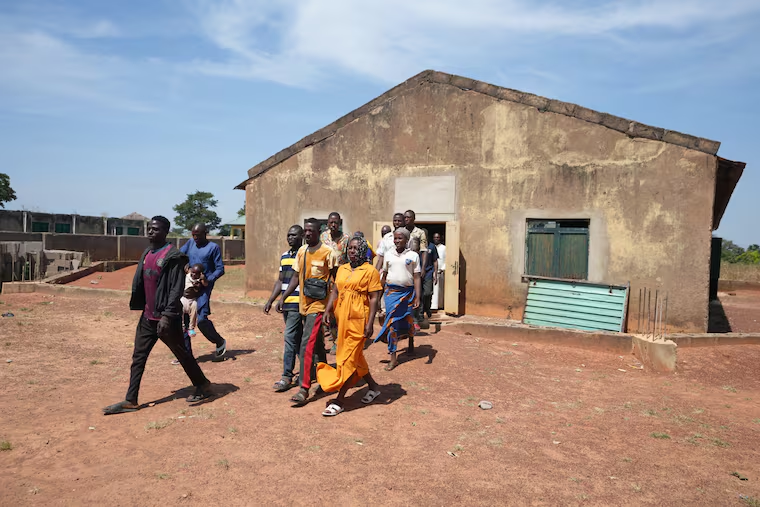
The names, obtained by Vanguard, detail how gunmen swept through ECWA Church and Cherubim and Seraphim Churches 1 and 2 during Sunday services, hauling away entire families and leaving the community virtually deserted. Community leaders, church officials and rights advocates say the disclosure directly challenges claims by state authorities and police that no mass abduction occurred.
An examination of the list reveals that households were taken wholesale, underscoring the scale of the trauma. Twelve members of the Jonathan family were abducted, along with 13 from the Amos family, 10 from the Markus/Makudi household, seven each from the Ishaya and Danisa families, six from the Bawa family, and five each from the Danjuma and Musa families. Other families lost between two and four relatives in the raid.
The oldest victim identified is 71-year-old Augustina Matthew. The youngest is Salvation Idris, 6. Several other children under 10 were also named, including Likita Amos, 6; Jumota Idris, 7; Tessy Amos, 8; Yahaya Joshua, 9; and multiple 10-year-olds, among them Sussana Idris, Synthah Amos, Hezibah Jonathan and Hezikaiah Jonathan.
Residents say the abductions have hollowed out Kurmin Wali. By Monday, the village stood largely empty, with survivors fleeing to nearby towns to shelter with relatives. Those injured while escaping into surrounding forests were still in shock, locals said, while poor mobile network coverage and lost phones made it difficult to contact many victims’ families.
The attack came barely a week after the same community reportedly raised 2.6 million naira to secure the release of 20 residents kidnapped in an earlier incident, Vanguard reported, adding to a growing sense of despair over repeated ransom demands.
Although Kaduna State officials initially dismissed reports of a mass abduction, a police situation report obtained by Vanguard confirms that the attack took place during church services. The internal report states that information was received at about 5:45 p.m. Sunday indicating that the assault occurred around 11:25 a.m., when an unspecified number of armed assailants stormed the churches, firing sporadically and forcing worshippers to flee into nearby forested areas.
The report describes the attackers as “bandits armed with sophisticated weapons” and notes that the village is located in a remote area with poor road access, complicating a rapid security response. It adds that the Divisional Police Officer in Kajuru mobilized other security agencies and the military, and that efforts were under way to rescue the victims and apprehend those responsible.
Rights groups say official denials in the immediate aftermath have fueled mistrust. Christian Solidarity Worldwide Nigeria accused security personnel of obstructing independent verification of the attack. Its research and press officer, Reuben Buhari, said the group’s team was turned back by a military convoy while attempting to enter Kurmin Wali shortly after the incident, despite presenting identification.
“They later refused to allow our team entry, despite repeated pleas,” Buhari said, adding that the group was escorted back to the main road.
CSW-N said attackers arrived on motorcycles and on foot, split into three groups and struck the churches simultaneously. The organization said elderly women and young children were later released, while 11 people managed to escape, leaving at least 167 in captivity at the time it spoke with community sources.
The chairman of the Christian Association of Nigeria in the 19 northern states and the Federal Capital Territory, the Rev. Joseph Hayab, accused security agencies of failing to pursue the attackers promptly, allowing them to retreat with large numbers of captives.
“Had they pursued the attackers immediately, instead of arguing over whether anyone had been kidnapped, they would have chased them away,” Hayab said, contending that the delay enabled the gunmen to hide their victims and prepare ransom demands.
International reaction followed swiftly after the names emerged. U.S. Rep. Riley Moore described the abductions as “horrific news” and urged Nigerian authorities to secure the victims’ safe return. Former presidential candidate Peter Obi also condemned the incident, calling it unacceptable and pointing to a recurring pattern of mass abductions across the country.
“Can we continue waking up to news of mass abductions, disputed figures and denials while citizens live in fear?” Obi asked, urging swift action and stronger protection for communities.
The controversy unfolded as Kaduna police reiterated earlier denials. In a joint statement with local government officials, the state police commissioner described reports of abductions as false, challenging anyone to publish the names of victims — a demand now met by the disclosure of the 177 identities. A BBC report noted that while police dismissed the claims, a local official and a community leader in Kurmin Wali had confirmed to the broadcaster that gunmen abducted dozens of worshippers, with 11 escaping.
The mass abduction followed another kidnapping earlier Sunday in nearby Kujama community, where gunmen seized a nursing mother, another woman and a child, demanding a combined ransom of 150 million naira, according to relatives who spoke to Vanguard. Police said they were investigating those claims.
The release of the names marks a pivotal moment in Kaduna’s latest kidnapping crisis. By putting identities to disputed numbers, community leaders have effectively shifted the debate from whether the abduction occurred to how authorities respond. The presence of entire families on the list underscores a tactic increasingly seen in northern Nigeria: mass seizures designed to maximize ransom leverage and devastate communities.
The conflicting narratives — official denials versus police documents, community testimony and now named victims — highlight a chronic trust deficit between rural populations and security institutions. Analysts say such gaps not only delay rescue efforts but also embolden criminal networks that exploit confusion and fear.
Beyond Kurmin Wali, the episode reflects a broader national challenge. Nigeria has witnessed a surge in mass kidnappings affecting both Christians and Muslims, often in remote areas with limited security presence. While ransom payments sometimes secure releases, they also reinforce the economics of abduction, creating a cycle that communities struggle to escape.
For families awaiting news of loved ones, the publication of names offers grim validation rather than closure. Whether it also forces a more coordinated and transparent security response may determine not just the fate of the 177 abducted worshippers, but the confidence of countless other vulnerable communities watching closely.
Vanguardngr




