

(AP) — At least nine people were killed and about two dozen others wounded Sunday after hundreds of demonstrators tried to breach the U.S. Consulate in Pakistan’s largest city, authorities said, in unrest triggered by the killing of Iran’s Supreme Leader Ayatollah Ali Khamenei in joint U.S.-Israeli strikes.
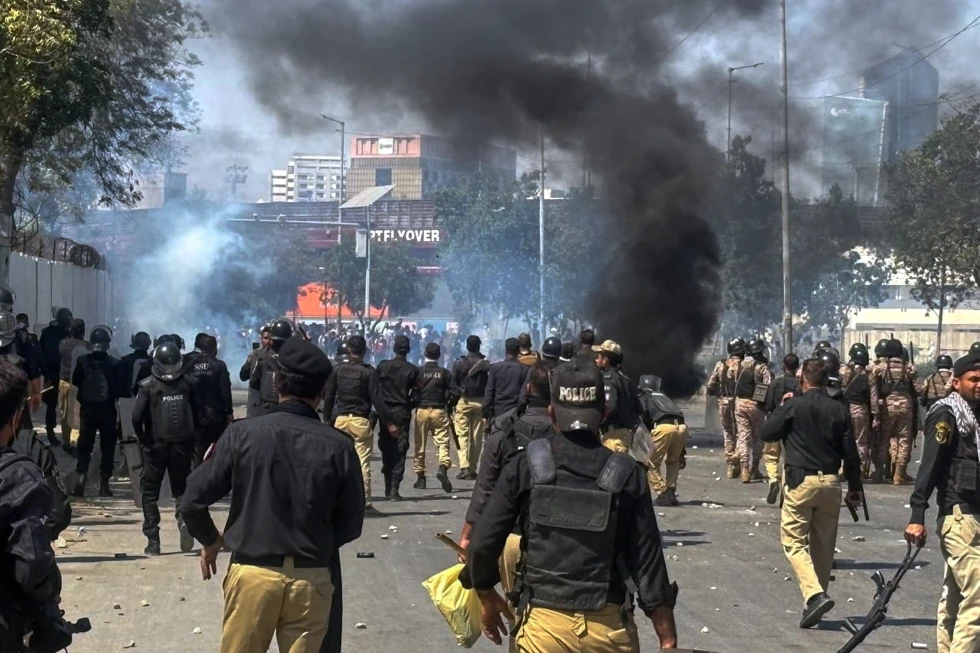
Clashes erupted before dawn in Karachi when protesters, many identifying with Pakistan’s Shiite community, converged on the diplomatic compound on Mai Kolachi Road. Security forces responded with force after crowds hurled stones, torched a nearby police post and attempted to damage the outer security perimeter, senior police official Irfan Baloch said.
Hospital officials confirmed the mounting toll. Dr. Summaiya Syed Tariq, a police surgeon at Karachi’s main government hospital, said six bodies were initially brought to the facility. Three critically injured people later died of their wounds, raising the death toll to nine. At least 25 others were treated for injuries, several in critical condition, The Associated Press reported.
The violence followed confirmation from Iranian state media that Khamenei had been killed in airstrikes on Tehran. The United States and Israel have acknowledged carrying out coordinated operations targeting Iranian military and leadership sites. Khamenei’s death has sparked demonstrations across parts of the Muslim world.
The U.S. Embassy in Pakistan said in a message posted on X that it was monitoring reports of demonstrations near consulates in Karachi and Lahore and noted calls for additional protests outside the U.S. Embassy in Islamabad and the consulate in Peshawar. The embassy urged American citizens to remain vigilant, avoid large gatherings and keep travel registrations current.
Karachi, capital of southern Sindh province and home to more than 20 million people, saw streets around the consulate transformed into what witnesses described as a conflict zone. Dozens of young men, some with faces covered, threw stones at law enforcement officers and chanted slogans condemning Washington and Israel. Rangers and paramilitary forces were deployed in large numbers to secure the diplomatic enclave.
Authorities rejected online claims that the consulate building had been set ablaze. Baloch said no part of the main structure was damaged, though protesters set fire to a nearby police post and shattered windows along the compound’s perimeter before security forces restored control.
Interior Minister Mohsin Naqvi appealed for restraint, calling Khamenei’s death “a day of mourning for the Muslim Ummah” while urging citizens to protest peacefully and refrain from taking the law into their own hands. The Sindh provincial government issued a similar appeal, warning that violence would not be tolerated.
Elsewhere in Pakistan, rallies ranged from peaceful to volatile. In Multan, in Punjab province, Shiite demonstrators gathered without incident, chanting anti-Israel and anti-U.S. slogans. Mamoona Sherazi, who attended the rally, described Khamenei as a spiritual leader and voiced solidarity with Iran.
In Lahore, hundreds assembled outside the U.S. Consulate, though police prevented demonstrators from breaching security barriers. Witness Aqeel Raza told Reuters that officers stopped some protesters from damaging a security gate without using force.
Protests also flared in the northern Gilgit-Baltistan region, where demonstrators set fire to a United Nations office building in Skardu. Local government spokesperson Shabbir Mir told Reuters that the structure was burned but no casualties were reported.
Beyond Pakistan, demonstrations spread across the region. In Baghdad, hundreds attempted to approach the U.S. Embassy compound despite heavy security deployment. Iraq’s top Shiite cleric, Grand Ayatollah Ali Sistani, urged unity and calm as Iraq declared a three-day mourning period. In Indian-administered Kashmir, thousands joined emotionally charged but largely peaceful marches in Srinagar, chanting slogans critical of Washington and Israel.
Pakistan’s Shiites, who constitute roughly 15% of the country’s population of 250 million, have historically staged demonstrations against perceived injustices toward Shiite communities abroad. However, confrontations resulting in multiple fatalities at diplomatic sites are rare.
The scale of Sunday’s violence reflects the intense emotions surrounding Khamenei’s killing, which Iranian state media characterized as martyrdom. Analysts note that Pakistan’s complex sectarian landscape and its strategic ties with both the United States and regional Muslim-majority countries make such incidents particularly sensitive.
Security has been heightened around American diplomatic facilities nationwide. Pakistani officials said additional police and paramilitary units have been deployed to prevent further unrest.
The unrest underscores how the fallout from the strikes in Iran extends far beyond Tehran. Pakistan maintains diplomatic and economic ties with both Washington and Tehran, and its leadership faces the delicate task of balancing domestic sentiment with international obligations.
Public anger in Karachi and other cities signals potential diplomatic strain. While Pakistan’s federal government has not directly condemned the United States, officials have framed Khamenei’s death as a moment of shared grief with Iran, reflecting domestic pressures.
The protests also illustrate the symbolic weight Khamenei carried among segments of Shiite communities beyond Iran’s borders. His role as a leading Shiite cleric for more than three decades elevated him to a figure of transnational religious authority.
From a security perspective, the storming of a U.S. diplomatic compound raises concerns about the vulnerability of foreign missions amid rapidly escalating regional tensions. Diplomatic facilities often become focal points for demonstrations during geopolitical crises, but the lethal clashes in Karachi highlight the risk of spontaneous violence.
Economically, sustained unrest in Pakistan’s commercial capital could disrupt business activity and further strain a fragile economy already grappling with inflation and fiscal challenges. International observers are closely watching whether protests subside or intensify in the coming days.
As night fell Sunday, security forces maintained a heavy presence around the Karachi consulate and other diplomatic sites. Authorities said investigations were underway into the circumstances surrounding the deaths, including the use of force by police.
The events mark one of the deadliest protests at a U.S. diplomatic facility in Pakistan in recent years and underscore how the reverberations of the Iran conflict are rapidly reshaping the security landscape across South Asia.




