

NAIROBI, Kenya (BN24) — Kenyans disillusioned with President William Ruto have launched a mounting campaign to hold him accountable for what they call a trail of broken promises, economic hardship, and deepening repression just three years into his presidency.
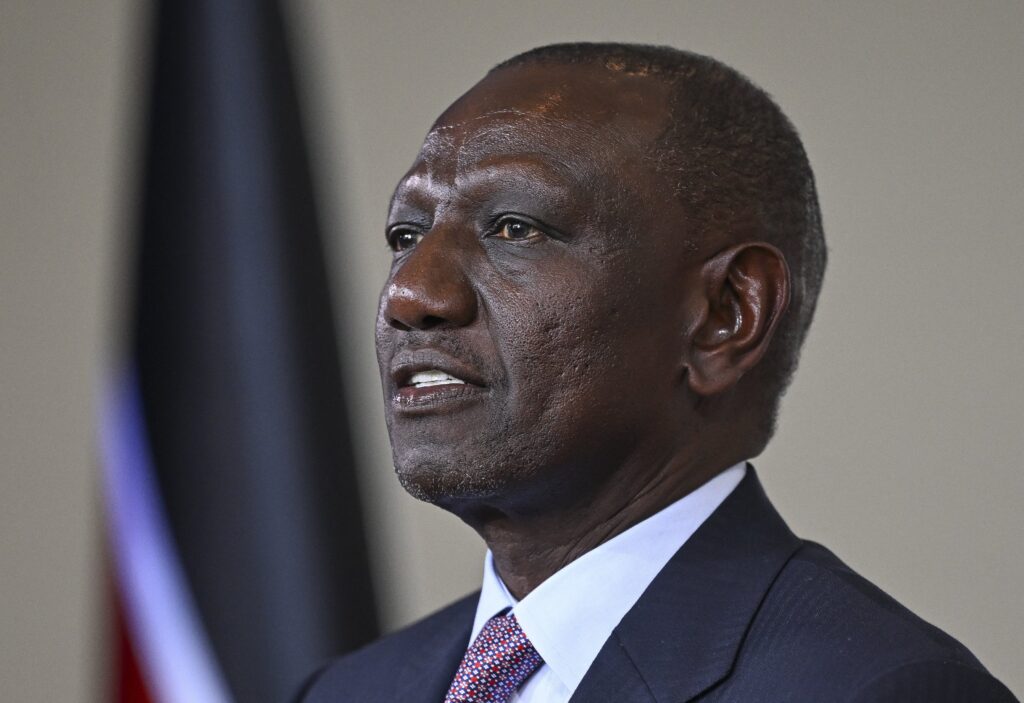
Ruto, who won the 2022 election by narrowly defeating opposition leader Raila Odinga, once billed himself as the champion of the so-called “hustler nation,” pledging to lift up struggling workers. But his aggressive tax policies, controversial spending decisions, and a widening crackdown on dissent have fueled anger that now threatens to define the rest of his term.
Protests have gained momentum under the slogan “WANTAM”—a rallying cry declaring Ruto a “one-term” president. Demonstrators, many of them young Kenyans grappling with joblessness and high living costs, raise their index fingers in the air to signal their demand he step down when his term ends in 2027—or sooner.
Ruto’s approval has plummeted since he introduced sweeping tax hikes last year, claiming they were necessary to stabilize Kenya’s public finances and keep government operations afloat. The measures triggered nationwide demonstrations, culminating in the storming and attempted burning of Parliament in Nairobi, where security forces killed at least 22 people.
Though the protests eventually ebbed, public resentment never disappeared. A new wave of outrage erupted after the death of a prominent blogger in police custody—a case that many Kenyans saw as emblematic of what they describe as Ruto’s heavy-handed rule.
“He has control of the institutions, but he doesn’t have control of the people,” said Karuti Kanyinga, a development studies professor at the University of Nairobi. “The level of public confidence is so low that he is probably the most hated man in Kenya.”
Opposition politicians and civil society groups accuse the president of entrenching a culture of corruption and impunity. Many refer to him derisively as “Zakayo,” a nod to the biblical tax collector Zacchaeus, or simply as “mwizi,” Kiswahili for “thief.”
The public also recoiled at revelations that Ruto’s administration pursued a multibillion-dollar deal to hand control of Nairobi’s main airport to India’s Adani Group—a plan terminated only after it became a flashpoint for protests.
Despite public outrage, Ruto has shown no sign he plans to back down. “If we go this route, we will not have a country,” he said in a recent speech responding to the anniversary of last year’s anti-tax demonstrations. “The country does not belong to William Ruto. The country belongs to all of us. And if there’s no country for William Ruto, there’s no country for you.”
His warnings underscored a climate of fear that critics say has chilled free expression. “You can disappear the moment you say something about the government,” said Eileen Muga, who is unemployed in Nairobi.
Interior Minister Kipchumba Murkomen has also vowed to take a hard line against demonstrators, pledging a forceful response to future unrest.
Analysts warn that violence could escalate further as protesters, opposition groups, and frustrated citizens attempt to press for change. “Until we ourselves become the change we want, nothing will happen,” said Peter Kairu, a 21-year-old student.
Ruto’s critics point to his history of ruthless political maneuvering to consolidate power. As deputy president, he publicly clashed with then-President Uhuru Kenyatta, reportedly growing so angry that he once threatened to slap his boss. Their relationship soured in their second term, as Kenyatta tried to curb Ruto’s influence over government institutions.
After defeating Odinga, Ruto swiftly moved to co-opt him as a political ally, sidelining a potential rival ahead of the next election. Within two years, he also fell out with his own deputy, Rigathi Gachagua, who was impeached by ruling-party lawmakers in a process Gachagua insisted was engineered by the president.
“He did to Gachagua what Kenyatta chose not to do to him,” said political analyst Macharia Munene. “It just shows that Ruto is intolerant and cannot be trusted.”
While Ruto’s economic policies were initially pitched as a strategy to rescue Kenya from crushing debt, many believe they have instead punished ordinary Kenyans while enriching political elites. His removal of fuel subsidies and aggressive tax increases have left many struggling to afford basic necessities.
“I think it’s a question of overpromising and underdelivering,” said Eric Nakhurenya, an attorney and government policy analyst. “That’s why Kenyans are angry.”
With protests gathering steam and discontent deepening, Ruto now faces the prospect of spending the rest of his presidency fighting to salvage his legitimacy—and to keep a lid on a movement determined to make him a one-term leader.




