

(AP) — Israeli officials said Saturday that Iran’s Supreme Leader, Ayatollah Ali Khamenei, was killed during a sweeping military operation carried out by Israel and the United States, a development that could profoundly destabilize Iran’s leadership and intensify an already expanding regional war.
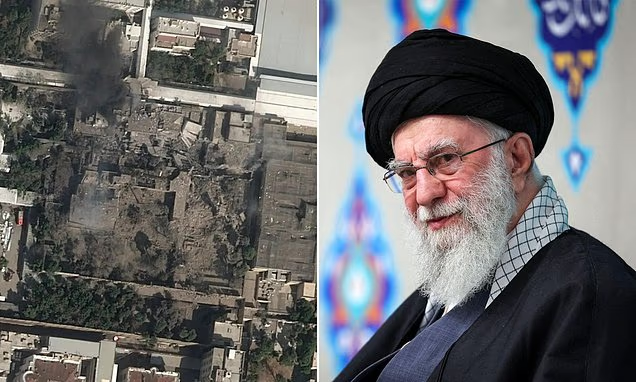
Two Israeli officials, speaking on condition of anonymity ahead of a formal announcement, told The Associated Press that Israel had confirmed Khamenei’s death after strikes hit his compound early Saturday. Israeli Prime Minister Benjamin Netanyahu, in a nationally televised address, cited “growing signs” that Khamenei had been killed when Israeli forces targeted his residence in Tehran.
There was no immediate confirmation from U.S. officials or from Iran. Earlier in the day, Iran’s foreign minister, Abbas Araghchi, told NBC News that Khamenei and President Masoud Pezeshkian were alive “as far as I know,” describing the assault as “unprovoked, illegal and absolutely illegitimate.”
Khamenei, 86, succeeded Ayatollah Ruhollah Khomeini following the 1979 Islamic Revolution and held ultimate authority over Iran’s government, military and judiciary. As supreme leader, he commanded the powerful Islamic Revolutionary Guard Corps and shaped all major policy decisions in the Islamic Republic. No successor had been publicly designated.
President Donald Trump, who earlier confirmed that U.S. forces had begun “major combat operations in Iran,” urged Iranians to rise against their ruling clerics.
“When we are finished, take over your government,” Trump said in a video message. “It will be yours to take. This will be probably your only chance for generations.”
The United States military reported roughly 12 hours after the first strikes that there were no American casualties and minimal damage to U.S. installations despite what it described as “hundreds of Iranian missile and drone attacks.” U.S. targets in Iran included Revolutionary Guard command facilities, missile and drone launch sites, air defense systems and military airfields.
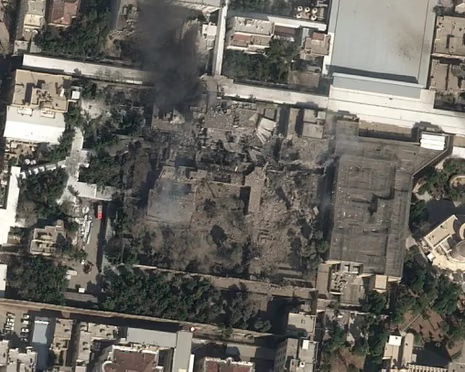
Iranian state media, citing the Red Crescent, said at least 201 people had been killed and more than 700 wounded nationwide. In southern Iran, a girls’ school was struck, leaving at least 85 dead, according to a local governor speaking on state television. The U.S. Central Command said it was aware of the reports and reviewing them.
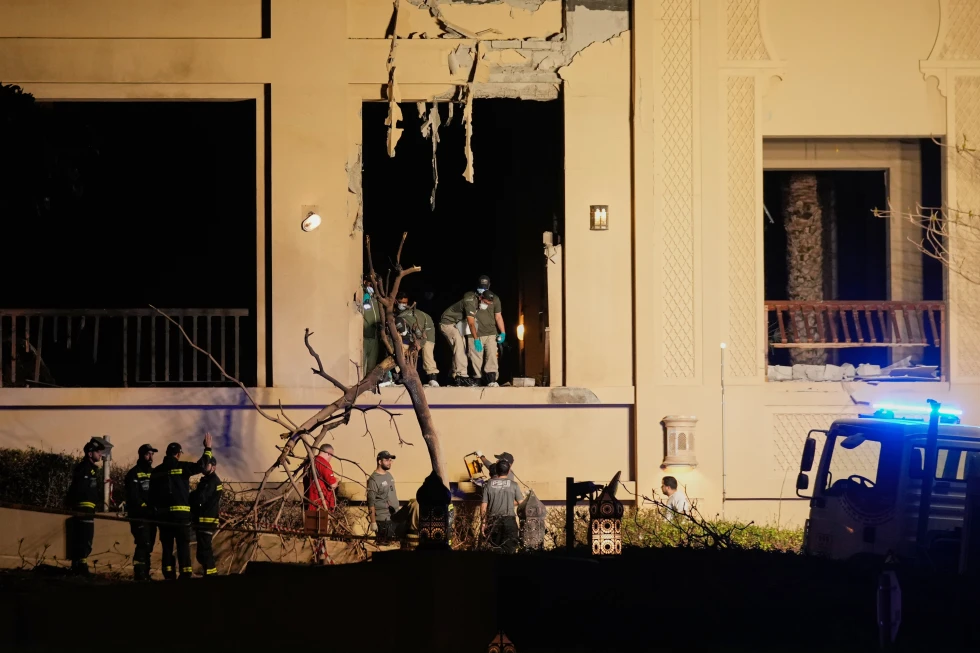
Iran retaliated with missile and drone strikes against Israel and U.S. facilities in Bahrain, Kuwait and Qatar. Israel’s military said Iran launched “dozens” of missiles, many of which were intercepted. Emergency service Magen David Adom reported 89 people lightly injured.
Saudi Arabia said an Iranian attack targeting its capital and eastern region was repelled. Bahrain reported damage to buildings near the U.S. Navy’s 5th Fleet headquarters in Manama. Kuwait’s civil aviation authority said a drone struck near its main airport, injuring several employees, and Jordan said it intercepted 49 drones and ballistic missiles.
Israel said it killed several senior Iranian officials in addition to Khamenei, including the commander of the Revolutionary Guard Corps and Iran’s defense minister. The Israeli military also said the secretary of Iran’s Security Council was among those killed. Neither the United States nor Iran publicly confirmed those claims.
The U.N. Security Council scheduled an emergency meeting Saturday afternoon. The International Atomic Energy Agency said on X that it was closely monitoring developments and had detected “no evidence of radiological impact.”
Iran requested an urgent session of the IAEA Board of Governors over what it described, through a letter posted by the semiofficial Tasnim news agency, as threats to safeguarded nuclear facilities.
The operation unfolded during the holy month of Ramadan and marked the second time in eight months that the Trump administration has ordered direct military action against Iran amid stalled nuclear negotiations. The most recent round of talks collapsed Thursday.
Flights were disrupted across the Middle East, and air defense systems were activated over several capitals. Air traffic slowed across the Persian Gulf, raising concerns over the safety of shipping lanes, particularly the Strait of Hormuz, through which roughly a third of the world’s seaborne oil exports passed in 2025.
If confirmed, Khamenei’s death would represent the most consequential decapitation of Iranian leadership since the founding of the Islamic Republic. Unlike the targeted killing of military commanders in past confrontations, the elimination of the supreme leader strikes at the core of Iran’s theocratic structure.
Iran’s constitution provides for an Assembly of Experts to appoint a new leader, but the absence of a clearly identified successor could ignite internal power struggles between clerical authorities and the Revolutionary Guard. The Guard, already central to Iran’s security and economic systems, may assert greater authority in the transition.
Even so, regime change is not assured. Iran’s leadership has historically consolidated power during external crises, and nationalist sentiment could blunt calls for uprising despite Trump’s appeal. Analysts note that previous domestic protest movements were met with harsh crackdowns. The Human Rights Activists News Agency has documented thousands of deaths in recent unrest, underscoring the risks for demonstrators.
Regionally, Iran retains influence through allied militias in Lebanon, Iraq, Syria and Yemen. Retaliatory strikes may expand beyond direct missile exchanges, potentially targeting energy infrastructure or maritime routes. Any sustained disruption to the Strait of Hormuz could reverberate through global energy markets.
Diplomatically, the joint U.S.-Israel campaign marks a dramatic shift from containment to overt confrontation. Oman’s Foreign Minister Badr al-Busaidi, who has mediated nuclear talks, said on X that renewed military action undermined active negotiations and warned that neither U.S. interests nor global peace would benefit.
Domestically in the United States, some Democrats criticized Trump for proceeding without congressional authorization, while White House spokesperson Karoline Leavitt said Republican and Democratic leaders had been briefed in advance.
As night fell, Israeli forces said new strikes were underway against missile launchers and air defense systems in central Iran. Exchanges of fire continued, signaling that the fallout from Saturday’s operation may shape the Middle East’s political landscape for years to come.




