

LAGOS, Nigeria — An early morning inferno swept through the Elegushi Model Market complex in the Lekki area, Lagos, Nigeria, on Sunday, destroying at least 48 shops before emergency responders contained the blaze and prevented it from engulfing neighboring structures, authorities confirmed, highlighting persistent fire safety challenges that plague commercial centers across Nigeria’s most populous city.
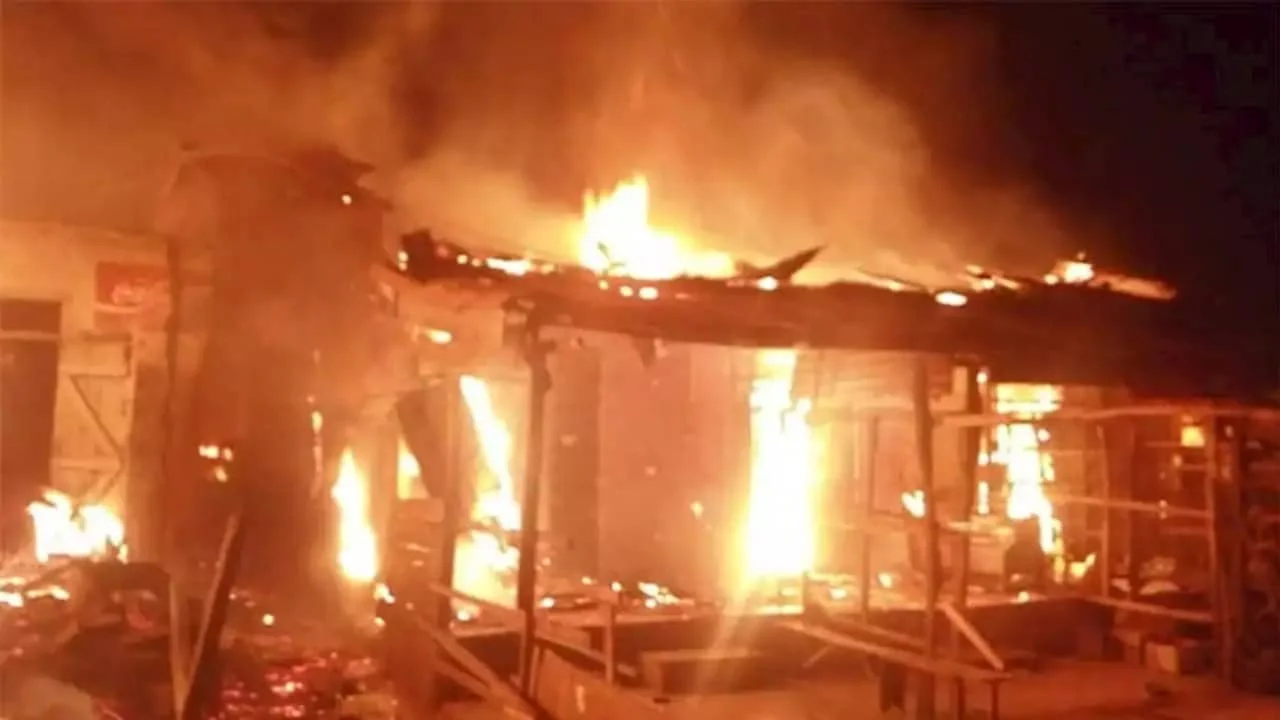
The Permanent Secretary of the Lagos State Emergency Management Agency (LASEMA), Olufemi Oke-Osanyintolu, disclosed details of the incident in a statement released Sunday afternoon. The agency received an emergency alert around 2 a.m. and promptly deployed response teams to the scene, where the market complex was already engulfed in flames that illuminated the pre-dawn darkness.
Oke-Osanyintolu explained that the emergency response team worked swiftly to contain the fire and prevent further destruction to the surrounding commercial district. The coordinated firefighting effort involved multiple agencies working in tandem to suppress the rapidly spreading flames before they could reach adjacent buildings in the densely packed market area.
Preliminary investigations conducted by LASEMA’s Shark Response Team indicated that the fire originated from a makeshift stall within the market compound before spreading to the main building structure. The exact cause remained undetermined as of Sunday afternoon, though investigators continued examining the burn patterns and collecting evidence to establish how the conflagration began.
Fortunately, no casualties or injuries were reported in the incident, a remarkably positive outcome given the scale of destruction and the early morning timing when security personnel or night watchmen might have been present. The absence of fatalities suggests the fire may have started after any overnight workers had departed or that early detection enabled complete evacuation before flames became life-threatening.
“The fire started from one of the makeshift stalls within the market compound and rapidly escalated to the main building. The exact cause is yet to be determined. Thankfully, no lives were lost, and no one was injured,” Oke-Osanyintolu emphasized. “Coordinated efforts by all stakeholders ensured the fire was completely extinguished and prevented it from affecting neighbouring structures,” he added, crediting the multi-agency response for limiting the disaster’s scope.
A post-disaster assessment confirmed that 48 shops sustained damage from the blaze, representing significant economic losses for the affected traders who now face the daunting prospect of rebuilding their businesses. The assessment process involved systematically examining each affected structure to document the extent of damage for insurance purposes and to inform rebuilding efforts.
The Permanent Secretary stressed the critical importance of fire prevention and preparedness measures for market traders operating in Lagos’s commercial centers. “Traders were sensitised on fire safety measures. The market union was advised to strategically position fire extinguishers to manage minor incidents before they escalate,” Oke-Osanyintolu conveyed, outlining immediate steps to reduce future risks.
Shop owners received specific guidance to install smoke detectors and fire alarms while remaining vigilant against potential fire outbreaks, particularly given the prevalence of electrical connections, flammable merchandise, and cooking activities that characterize many Lagos market operations. The recommendations reflect broader efforts by emergency management officials to address systemic fire safety deficiencies.
Authorities continue assessing the full extent of the damage and working with market officials to enhance fire safety measures and prevent similar incidents in the future. The collaborative approach involves market union leadership, individual traders, and government agencies developing comprehensive protocols that balance commercial operations with safety requirements.
Daily Post documented that a late-night inferno on Thursday, December 12, tore through the Berger Trailer Park, popularly known as Berger Suya, located in the Olodi-Apapa area of Ajegunle, Lagos.
That incident destroyed several trailers, container shops, and heaps of abandoned tyres, demonstrating the recurring pattern of fire emergencies affecting various commercial areas across the sprawling metropolis.
Punch elaborated that LASEMA received the emergency alert at approximately 2 a.m. on Sunday and, upon arrival at the scene, discovered the market complex engulfed in flames. The emergency response team immediately worked to contain the fire to prevent it from causing further damage beyond the initial affected structures.
Oke-Osanyintolu noted that preliminary investigations revealed the fire emanated from a makeshift stall within the market complex before spreading to the main building, though the specific ignition source remained unknown at the time of the initial report.
“Preliminary investigations conducted by the Shark Response Team revealed that the fire started from one of the makeshift stalls within the compound of the market and quickly escalated to the main building. The cause of the fire was not known at the time of this report,” he detailed.
“No life was lost, and no injuries were sustained as a result of the incident,” Oke-Osanyintolu confirmed. “Collaborative efforts by all stakeholders ensured coordinated firefighting to completely extinguish the fire and prevent it from spreading to adjoining buildings,” he emphasized, highlighting the effectiveness of Lagos’s emergency response infrastructure when properly mobilized.
He stressed that the post-disaster assessment revealed 48 shops were affected by the fire, quantifying the economic impact on individual traders and the broader market community. “Forty-eight shops were affected by the fire.
The market union executives were advised to place fire extinguishers in strategic locations to enable them to arrest or control minor fires before they escalate and spread,” the Permanent Secretary elaborated.
“Shop owners were also advised to be more conscious of fire outbreaks and fire prevention measures. Smoke detectors and fire alarms are to be installed within the premises,” Oke-Osanyintolu concluded, outlining specific technical interventions that could provide early warning of future fire emergencies before they develop into major conflagrations.
Punch further observed that Lagos markets are notorious for fire incidents, often caused by overcrowding, unsafe practices, and a lack of fire management protocols among traders.
This systemic challenge reflects broader urban planning issues where commercial activities concentrate in areas lacking adequate fire safety infrastructure, emergency vehicle access, or proper electrical installations.
The Elegushi Market fire represents the latest in a persistent pattern of commercial fire emergencies that have plagued Lagos for decades. Markets across the city experience frequent fires due to multiple contributing factors including illegal electrical connections, use of open flames for cooking or lighting, storage of flammable materials, inadequate spacing between structures, and limited access routes that hamper firefighting equipment deployment.
The prevalence of makeshift stalls, as identified in this incident’s ignition point, exemplifies how informal commercial structures proliferate within official market boundaries without proper safety oversight.
These temporary structures often utilize substandard construction materials, lack proper electrical installations, and create fire hazards that threaten not only the makeshift shops themselves but adjacent permanent structures as well.
Lagos State authorities have implemented various fire safety initiatives over the years, including public awareness campaigns, mandatory fire extinguisher installations, and periodic safety inspections. However, enforcement remains inconsistent, and many traders view safety investments as burdensome expenses rather than essential protections for their livelihoods and lives.
The economic impact of market fires extends beyond the immediate losses suffered by affected traders. Supply chain disruptions, temporary displacement of commercial activities, reconstruction costs, and loss of inventory during peak trading periods create cascading effects throughout local economies.
For many small-scale traders operating on thin profit margins, a single fire can represent complete financial devastation with limited insurance coverage or governmental compensation to facilitate recovery.
The timing of the Elegushi Market fire during early morning hours when the market was closed likely prevented casualties that might have occurred during business hours when hundreds of traders, customers, and workers populate the commercial space.
This fortunate timing underscores how fire prevention measures and early detection systems become even more critical during operating hours when evacuation challenges multiply exponentially.
LASEMA’s Shark Response Team, which conducted the preliminary investigation, represents a specialized unit within the emergency management structure focused on rapid assessment and initial response to disasters.
The team’s ability to quickly determine the fire’s origin point and contain its spread demonstrates the value of specialized training and equipment for managing urban emergencies in densely populated commercial areas.
The collaborative response involving multiple agencies reflects Lagos’s evolved emergency management approach where LASEMA coordinates with the state fire service, local government officials, police, and other stakeholders to mount comprehensive disaster responses. This multi-agency model has proven more effective than earlier systems where individual agencies operated independently without unified command structures.
As Lagos continues experiencing rapid urbanization and commercial expansion, the challenge of maintaining fire safety standards across thousands of markets, shops, and informal commercial centers grows increasingly complex.
The Elegushi Market incident serves as another reminder that sustained investment in fire prevention infrastructure, trader education, and enforcement mechanisms remains essential to protecting both lives and livelihoods in Africa’s largest city.
DailyPost/Punch




