

Libyan authorities will put on trial a suspected member of a criminal network accused of human trafficking after investigators linked the group to a mass grave containing the remains of 21 migrants, the country’s attorney general’s office announced Friday, underscoring the persistent dangers faced by people transiting the country in hopes of reaching Europe.
In a statement posted on Facebook, the attorney general’s office said the suspect had been referred to court on a charge of human trafficking. Prosecutors said evidence showed the criminal group organized illegal migration operations and trafficked people in the southeastern city of al-Kufra and in Ajdabiya, in eastern Libya. The statement did not identify the suspect or name the criminal network.
Authorities said the case emerged from an investigation into a trafficking ring accused of detaining migrants, torturing them and extorting ransoms from their families. Prosecutors said 195 migrants were freed from captivity during the operation. One member of the group was arrested, while other suspects remain at large and are being pursued, according to the attorney general’s office.
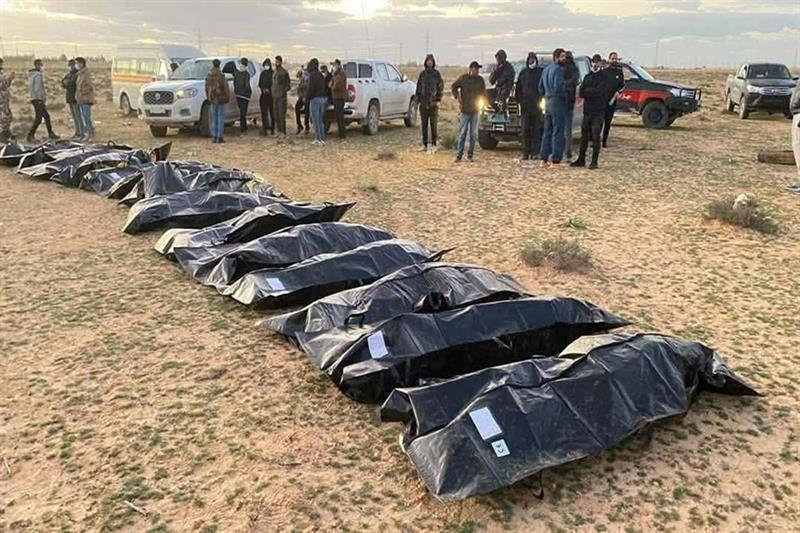
The investigation also uncovered a mass grave containing the bodies of 21 migrants, though officials did not specify when or exactly where the remains were found, nor did they detail how or when the victims died. Images released by the attorney general’s office showed bodies wrapped in black plastic bags, with some remains partially buried under dirt. The Associated Press said it could not immediately and independently verify the images.
Libya has long been a major transit point for migrants fleeing conflict, persecution and poverty across Africa and the Middle East. Many attempt to cross the Central Mediterranean by sea toward Europe, often relying on smugglers who operate with near impunity amid years of political instability and weak law enforcement.
The country has struggled to regain stability since a 2011 uprising toppled and killed longtime ruler Moammar Gadhafi. In the years since, armed groups, traffickers and militias have flourished, particularly in remote desert regions such as al-Kufra, which sits near Libya’s borders with Sudan and Chad and has become a hub for smuggling routes.
Human rights organizations and international agencies have repeatedly documented widespread abuses against migrants in Libya, including arbitrary detention, forced labor, sexual violence and torture aimed at extorting money from families abroad. The attorney general’s statement said the freed migrants in the latest case had been subjected to torture, consistent with earlier reports of abuse by trafficking networks.
Deaths along the migration route continue to mount. Most recently, at least 42 people went missing and were presumed dead after a boat carrying migrants capsized off Libya’s coast, according to the International Organization for Migration. The incident added to a growing toll in one of the world’s deadliest migration corridors.
The IOM’s Missing Migrants Project said more than 1,000 people have died in the Central Mediterranean since the beginning of 2025, including more than 500 off the coast of Libya. The figures underscore how dangerous the journey remains, despite years of international efforts to curb smuggling and reduce crossings.
Libya’s fragmented political landscape has complicated those efforts. Since Gadhafi’s fall, the country has effectively been split between rival administrations in the east and west, each backed by armed groups and foreign allies. The western government, led by Prime Minister Abdul-Hamid Dbeibah, is based in Tripoli, while the eastern administration, headed by Prime Minister Ossama Hammad, governs areas including Ajdabiya.
The attorney general’s office did not specify which authorities carried out the arrests or where the trial would be held, though the announcement suggested coordination across regions. Prosecutors have increasingly sought to demonstrate progress in pursuing traffickers, even as critics question whether isolated prosecutions can dismantle entrenched criminal networks.
The decision to bring a trafficking suspect to trial in connection with a migrant mass grave highlights both a measure of accountability and the scale of the challenge Libya faces in addressing abuses along migration routes. While the prosecution signals a willingness by authorities to confront traffickers, it also exposes the extreme brutality that has become commonplace in an environment shaped by conflict, weak governance and economic desperation.
Al-Kufra’s role in the case is particularly telling. The remote desert city has long served as a gateway for migrants entering Libya from sub-Saharan Africa, making it a strategic choke point for smuggling networks. Control over such routes often translates into significant profits, fueling competition among armed groups and complicating enforcement efforts.
International actors, including European governments, have invested heavily in border control initiatives aimed at reducing departures from Libya. Critics argue that these measures, while lowering arrivals in Europe at times, have trapped migrants in Libya, where they remain vulnerable to abuse by traffickers and militias. The discovery of mass graves reinforces concerns that containment strategies may inadvertently increase risks for migrants.
The rising death toll in the Central Mediterranean also suggests that smugglers continue to adapt, using increasingly dangerous routes and overcrowded vessels. For many migrants, the lack of legal pathways leaves little alternative but to rely on criminal networks, despite the known dangers.
Libya’s divided governance further complicates accountability. Prosecuting one suspect may offer some measure of justice, but dismantling networks that operate across vast territories and exploit political fragmentation will require sustained coordination, resources and political will. Without broader reforms and stability, experts warn that trafficking rings are likely to regenerate even after individual arrests.
For the families of the 21 migrants found in the mass grave, the trial may represent a first step toward answers. For Libya and the international community, it is another stark reminder that migration through the country remains a humanitarian crisis marked by violence, exploitation and loss of life.
AP




