

U.S. military forces captured Venezuelan President Nicolás Maduro following months of meticulous preparation that included constructing a replica of his Caracas compound and conducting extensive surveillance of his daily routines, culminating in a predawn raid Saturday that deployed more than 150 aircraft launched from 20 bases across the Western Hemisphere.
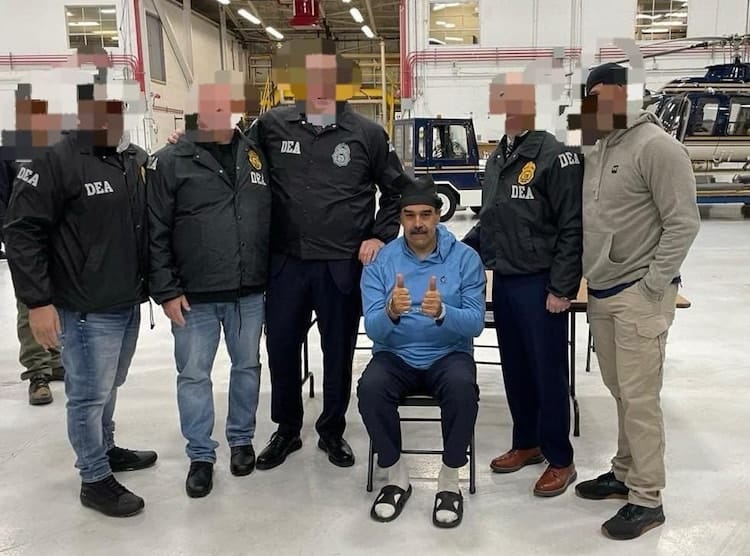
President Trump and Gen. Dan Caine, chairman of the Joint Chiefs of Staff, provided extraordinary operational details about the mission—designated Operation Absolute Resolve—during a Saturday afternoon news conference at Trump’s Mar-a-Lago estate in Florida. The unprecedented disclosure of tactical information about a sensitive special operations raid reflected the administration’s desire to publicize what Trump characterized as a “brilliant operation” and demonstrate American military capability.
Trump gave final approval for the mission Friday at 10:46 p.m. Eastern Time, telling military leaders “Good luck and godspeed,” Caine revealed to reporters. The green light came after U.S. forces had maintained readiness since early December, waiting for optimal weather conditions, intelligence confirmation of Maduro’s location, and circumstances that would minimize civilian casualties while maximizing surprise.
CBS reports that throughout Friday night aircraft launched from 20 bases across the Western Hemisphere converging on Venezuela in what Caine described as one of the most complex air operations the U.S. military has executed in recent years. The mission involved more than 150 aircraft including helicopters carrying assault teams, fighter jets providing air superiority, bombers conducting strikes against Venezuelan air defenses, and remotely piloted drones conducting surveillance and electronic warfare.
“As the night began, the helicopters took off with the extraction force, which included law enforcement officers, and began their flight into Venezuela at 100 feet above the water,” Caine stated, describing how assault helicopters flew just above ocean surface to evade Venezuelan radar detection. The extremely low-altitude flight path, while tactically advantageous for avoiding detection, required exceptional piloting skills given darkness, weather conditions, and the precision needed to maintain formation while navigating using night vision equipment.
The inclusion of law enforcement officers alongside military special operations forces reflected the operation’s dual nature as both combat raid and arrest warrant execution. FBI agents reportedly participated in the compound breach to establish law enforcement presence that administration officials argued provided legal justification for what might otherwise constitute purely military action against a foreign head of state.
As helicopters approached the Venezuelan coastline, they received protection from other aircraft including drones, bombers, and fighter jets flying at higher altitudes. U.S. forces dismantled and disabled Venezuela’s air defense systems as the helicopters neared Caracas, according to Caine, who stated that American aircraft deployed weapons “to ensure the safe passage of the helicopters into the target area.”
The strikes against Venezuelan air defenses explained the multiple explosions that Caracas residents reported hearing across the capital during the early morning hours. The suppression of enemy air defenses—standard procedure in U.S. military operations entering contested airspace—created the conditions for transport helicopters to penetrate Venezuelan territory without facing surface-to-air missile threats that could have destroyed aircraft carrying assault teams.
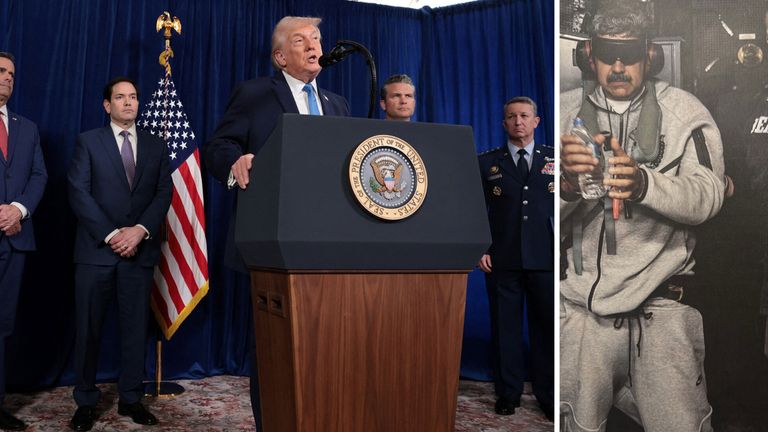
Trump noted that lights across Caracas had largely gone dark “due to a certain experience that we have,” cryptically referencing either cyberattacks or kinetic strikes against electrical infrastructure that U.S. forces conducted to create chaos and degrade Venezuelan command and control capabilities during the raid. The power outages that multiple Caracas residents described to CNN corresponded with Trump’s acknowledgment of deliberate infrastructure targeting.
“As the force crossed the last point of high terrain where they’d been hiding in the clutter, we assessed that we had maintained totally the element of surprise,” Caine stated, indicating that U.S. helicopters used mountainous terrain surrounding Caracas to mask their approach until the final moments before reaching Maduro’s downtown compound. The successful maintenance of surprise despite the operation’s scale suggested either that Venezuelan military surveillance proved inadequate or that U.S. electronic warfare capabilities effectively blinded Venezuelan sensors.
Once helicopters arrived at the compound, they immediately came under fire from Venezuelan security forces defending the presidential residence, though the aircraft remained operational despite taking hits. “It was a lot of gunfire,” Trump stated, describing the intensity of combat exchanges between Venezuelan defenders and U.S. assault forces establishing perimeter security while Delta Force operators breached the compound.
According to CBS, U.S. forces and FBI agents eventually entered the residential compound where Maduro and his wife “gave up” and were taken into custody, Caine reported. However, Trump provided more dramatic details suggesting Maduro attempted escape as American forces penetrated the building, contradicting the characterization of passive surrender.
“He was trying to get into a safe place,” Trump told reporters, describing how Maduro fled toward a fortified panic room as U.S. operators stormed through his residence. “The safe place is all steel, and he wasn’t able to make it to the door because our guys were so fast.” The president’s account suggested Delta Force operators cornered Maduro before he could seal himself inside the armored room that might have enabled him to communicate with Venezuelan military commanders or buy time for loyalist forces to mount rescue attempts.
“It was a very thick door, a very heavy door,” Trump elaborated. “He made it to the door. He was unable to close it,” describing what appeared to be seconds-long chase through the compound as Maduro desperately attempted to reach safety while American commandos pursued. The dramatic narrative painted a picture of the Venezuelan president’s panic as he realized U.S. forces had penetrated his supposedly secure residence.
Trump added that even if Maduro had successfully sealed himself inside the safe room, military forces possessed explosive breaching capabilities to destroy the steel door in approximately “47 seconds.” The specific timeframe suggested either that U.S. intelligence knew the door’s construction specifications and had calculated required explosive charges, or that Trump received real-time briefings from on-scene commanders who assessed breaching options.
After Maduro and his wife were apprehended, extraction helicopters returned to the compound to evacuate captured prisoners along with the assault force. Fighter aircraft and drones provided protective cover during the withdrawal as U.S. forces departed Venezuelan airspace. Caine confirmed there were “multiple self-defense engagements” during the exfiltration, indicating that Venezuelan forces attempted to interdict departing American aircraft.
“The force successfully exfiltrated and returned to their afloat launch bases, and the force was over the water at 3:29 a.m. Eastern Standard Time with indicted persons onboard,” Caine stated, confirming that helicopters carrying Maduro and his wife reached international waters and rendezvoused with U.S. naval vessels approximately ninety minutes after initial compound breach. The quick timeline from capture to international waters reflected planning that prioritized rapid extraction before Venezuelan military could organize effective response.
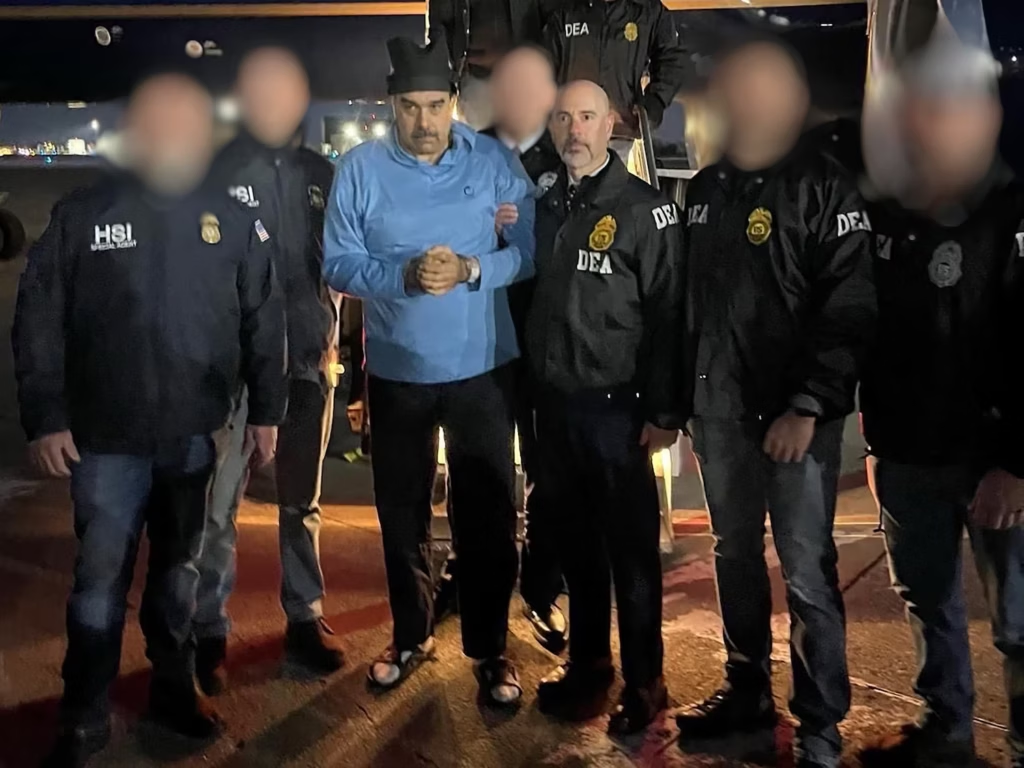
One U.S. helicopter sustained damage from Venezuelan gunfire, and some American soldiers were injured during the raid, though officials characterized casualties as non-life-threatening. The acknowledgment of aircraft damage and personnel injuries underscored that Operation Absolute Resolve involved genuine combat rather than unopposed law enforcement action, with U.S. forces fighting through armed resistance to accomplish their mission.
Trump watched the mission unfold via live video feed from Mar-a-Lago as soldiers from the Army’s elite Delta Force—officially designated 1st Special Forces Operational Detachment-Delta—dropped into Maduro’s compound and breached defenses shortly after 2 a.m. local time. The president’s real-time observation of the raid echoed President Obama’s monitoring of the 2011 operation that killed Osama bin Laden, though Trump’s subsequent public disclosure of tactical details exceeded what the Obama administration revealed about that mission.
The U.S. began planning Operation Absolute Resolve months earlier, with intelligence agencies working to “find Maduro and understand how he moved, where he lived, where he traveled, what he ate, what he wore, what were his pets,” Caine explained. The comprehensive intelligence collection effort reflected standard special operations methodology that seeks to understand targets’ patterns, vulnerabilities, and psychology to inform tactical planning.
Intelligence agencies constructed a full-scale replica of Maduro’s compound, allowing Delta Force operators to rehearse the raid multiple times before execution. The practice facility enabled assault teams to perfect entry routes, breaching techniques, room-clearing procedures, and extraction choreography until operations could execute with precision even under combat stress and darkness. Special operations forces routinely build target replicas for high-priority missions, with the bin Laden raid similarly involving extensive rehearsals at a mock compound in North Carolina.
The surveillance of Maduro’s daily habits enabled planners to predict his location and schedule, reducing the risk that U.S. forces would raid an empty residence or encounter unexpected complications. A source told NBC News that CIA maintained a small clandestine team on the ground in Venezuela starting in August that provided “extraordinary insight” into Maduro’s movements, suggesting human intelligence sources close to the Venezuelan president either voluntarily cooperated with U.S. agencies or were compromised through recruitment operations.
The operation had been ready to execute since early December, but U.S. commanders waited for optimal conditions to minimize civilian harm and maximize surprise, Caine stated. The mission was also weather-dependent, with low clouds and precipitation over Venezuela repeatedly forcing postponements despite the assault force maintaining readiness for weeks.
“Last night, the weather broke just enough, clearing a path that only the most skilled aviators in the world could maneuver through — ocean, mountain, low clouds, ceilings,” Caine explained, describing challenging conditions that still presented significant risks but fell within acceptable parameters for highly trained special operations pilots flying advanced helicopters equipped with sophisticated navigation and sensors.
The massive scale of Operation Absolute Resolve—involving 150 aircraft launched from 20 bases—demonstrated both the priority the Trump administration assigned to capturing Maduro and the military resources required to execute a opposed raid deep into a hostile nation’s capital against a defended compound while maintaining sufficient combat power to defeat Venezuelan military responses. The operation likely represented one of the largest U.S. special operations missions since the Iraq and Afghanistan wars, though officials declined to provide casualty figures for Venezuelan forces or confirm how many American personnel participated in the assault.
The successful capture of a sitting head of state through military raid represents unprecedented modern American military action with potential implications for international law, future special operations doctrine, and how other nations calculate security for their leadership given demonstrated U.S. capabilities to penetrate even capital cities and extract targeted individuals despite armed resistance.
A CBS story




