

A Malaysian court convicted imprisoned former Prime Minister Najib Razak on Friday on 25 corruption charges related to more than $700 million channeled from the scandal-plagued 1MDB state investment fund into his personal bank accounts, marking a major milestone in one of history’s largest financial fraud cases.
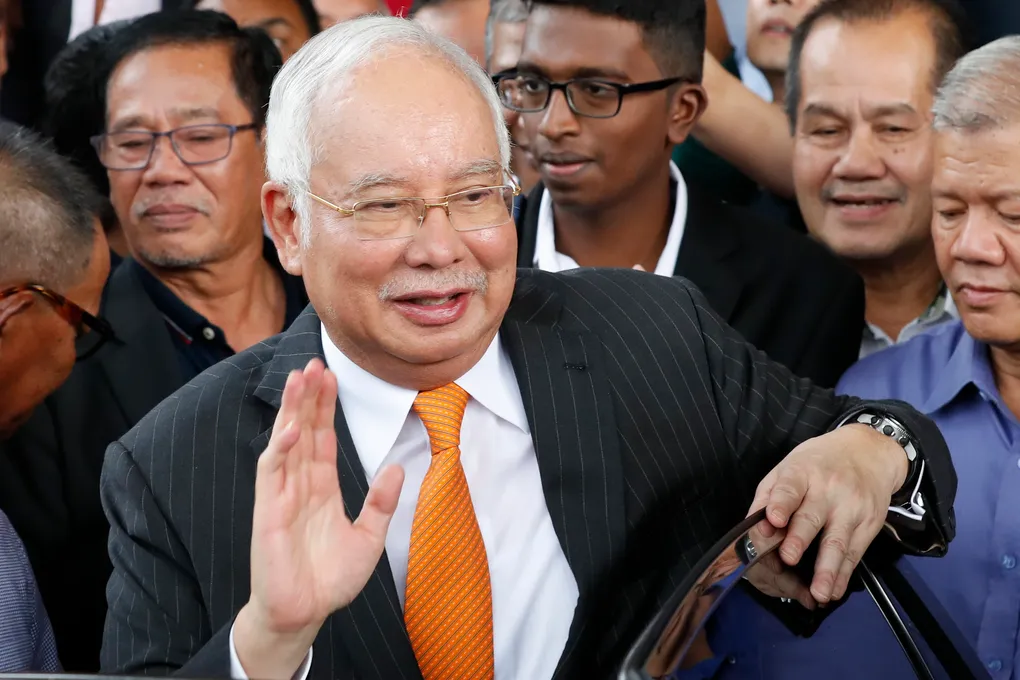
The High Court found Najib, 72, guilty on four counts of abuse of power and 21 charges of money laundering following a trial directly linking him to the multibillion-dollar looting that triggered investigations across multiple continents and ultimately toppled his government in 2018.
Justice Collin Lawrence Sequerah spent five hours delivering the ruling, systematically dismantling Najib’s defense that the funds represented a political donation from Saudi Arabia and that he had been deceived by rogue financiers led by Low Taek Jho. Low, believed to be the scandal’s architect, remains at large despite international arrest warrants.
“The accused was no country bumpkin,” Sequerah stated. “Any attempt to paint the accused as an ignoramus who was hopelessly unaware of the misdeeds going around him must therefore, fail miserably.”
The judge characterized Najib’s claim of a Saudi donation as “incapable of belief.” Four letters purportedly from the Saudi donor were forged, and evidence conclusively demonstrated the funds originated from 1MDB, he stated.
Sequerah rejected defense arguments portraying Najib as an unwitting victim duped by former 1MDB officials and Low. Witness testimonies revealed an “unmistakable bond” between Najib and Low, who played a pivotal role in the scandal and operated as “the proxy, the conduit, the intermediary and the facilitator” for Najib regarding 1MDB matters, the judge said.
The judge noted that Najib failed to verify the origin of the massive funds or take action against Low. Instead, Najib utilized the money despite its suspicious origins and took steps to protect his position, including removing the attorney general and anti-corruption chief investigating the case, Sequerah stated.
Dressed in a blue suit, Najib appeared composed throughout the lengthy ruling and occasionally wrote in his notebook. His defense team was expected to present mitigation arguments before sentencing later Friday.
Najib, who served as prime minister from 2009 to 2018, currently is serving a prison sentence after conviction in an earlier case linked to the 1MDB scandal. He was sentenced to 12 years in prison in 2020 for abuse of power, criminal breach of trust and money laundering involving 42 million ringgit ($10.3 million) channeled into his accounts from SRC International, a former 1MDB unit.
He began serving that sentence in August 2022 after exhausting appeals, becoming Malaysia’s first former leader imprisoned. The Pardons Board, which advises rulers on granting clemency, halved his sentence and sharply reduced his financial penalty in 2024. He is scheduled for release in August 2028 under the reduced sentence.
Najib established the 1Malaysia Development Berhad fund shortly after assuming office in 2009. He chaired 1MDB’s advisory board and wielded veto power as finance minister while simultaneously serving as prime minister, creating conflicts of interest that facilitated the massive fraud.
Between 2009 and 2014, top executives and associates of Najib looted over $4.5 billion from the fund, laundering proceeds through countries including the United States, Singapore and Switzerland, according to the U.S. Justice Department. Authorities alleged the stolen funds financed Hollywood films and extravagant purchases including hotels, a luxury yacht, artwork and jewelry. Then-U.S. Attorney General Jeff Sessions characterized the scheme as “kleptocracy at its worst.”
The scandal’s tentacles reached Wall Street, where Goldman Sachs faced billions in fines for its role raising money for 1MDB. The investment bank’s involvement in bond offerings for the fund drew scrutiny after evidence emerged suggesting Goldman officials knew or should have known about the fraudulent nature of the transactions.
The scion of a prominent political family, Najib was long perceived as untouchable until public fury over 1MDB contributed to the historic 2018 election defeat of his ruling United Malays National Organization, which had governed Malaysia since independence from Britain in 1957.
Friday’s conviction followed a Monday High Court ruling rejecting Najib’s bid to serve his remaining sentence under house arrest. The court determined that a purported royal order issued by the nation’s former king was invalid because it wasn’t made according to constitutional requirements.
Judge Alice Loke ruled Monday that while the addendum order’s existence was undisputed, the house arrest option wasn’t raised or discussed at the January 29, 2024 Pardons Board meeting chaired by then-King Sultan Abdullah Sultan Ahmad Shah. The king’s clemency prerogative must be exercised based on Pardons Board advice under the constitution and cannot be made independently, as that would “invite arbitrary decision,” she stated.
Najib displayed minimal emotion during Monday’s ruling. His lawyer, Muhammad Shafee Abdullah, described the decision as “shocking” and indicated plans to appeal, arguing the ruling had diluted royal powers.
The conviction carries severe potential penalties. Najib faces up to 20 years imprisonment for each abuse of power count and up to five years for each money laundering charge, potentially adding decades to his current sentence if the court imposes consecutive rather than concurrent terms.
The ruling represents vindication for Malaysian citizens who demanded accountability for the massive theft of public funds. The 1MDB scandal dominated Malaysian politics for years, exposing systemic corruption at the highest levels of government and demonstrating how political elites could exploit state institutions for personal enrichment.
For international observers, the conviction affirms that even powerful political figures can face consequences for corruption, though the lengthy legal process—with trials beginning in 2019 and continuing through 2024—illustrates the challenges of prosecuting complex white-collar crimes involving sophisticated money laundering schemes across multiple jurisdictions.
The scandal’s international dimensions highlighted vulnerabilities in global financial systems that enabled massive sums to move across borders with insufficient scrutiny. Money laundering through luxury real estate purchases, art acquisitions and entertainment industry investments demonstrated how criminals exploit legitimate business sectors to disguise illicit proceeds.
Najib’s wife, Rosmah Mansor, was sentenced to 10 years in prison and assessed a substantial fine in 2022 in a separate corruption case. She has been released on bail pending appeal, adding another dimension to the legal saga surrounding Malaysia’s former first family.
Despite his conviction and imprisonment, Najib retains influence within the United Malays National Organization, which currently participates in Prime Minister Anwar Ibrahim’s unity government formed after 2022 elections. This continued political relevance complicates efforts to fully reckon with the 1MDB scandal’s legacy and raises questions about whether Malaysian politics has truly moved beyond the culture of corruption the case exposed.
The trial also spotlighted the role of Low Taek Jho, the fugitive financier known as Jho Low, whose whereabouts remain unknown despite international efforts to locate him. Low’s continued freedom frustrates investigators and victims who view him as the scandal’s primary architect. Reports have placed him variously in China, Macau and other locations, though none have been confirmed.
As sentencing proceedings continue, attention will focus on whether the court imposes penalties severe enough to serve as meaningful deterrent to future corruption while acknowledging Najib’s age and existing prison term. The judge’s remarks during the conviction—particularly characterizing Najib as sophisticated and aware rather than deceived—suggest skepticism toward lenient sentencing arguments.
The 1MDB scandal’s resolution through Malaysian courts, while incomplete given Low’s continued absence and ongoing asset recovery efforts, demonstrates that even in countries with corruption challenges, judicial systems can ultimately hold powerful figures accountable when public pressure, international cooperation and dedicated prosecutors align to pursue justice despite political obstacles and elite resistance.
AP




