

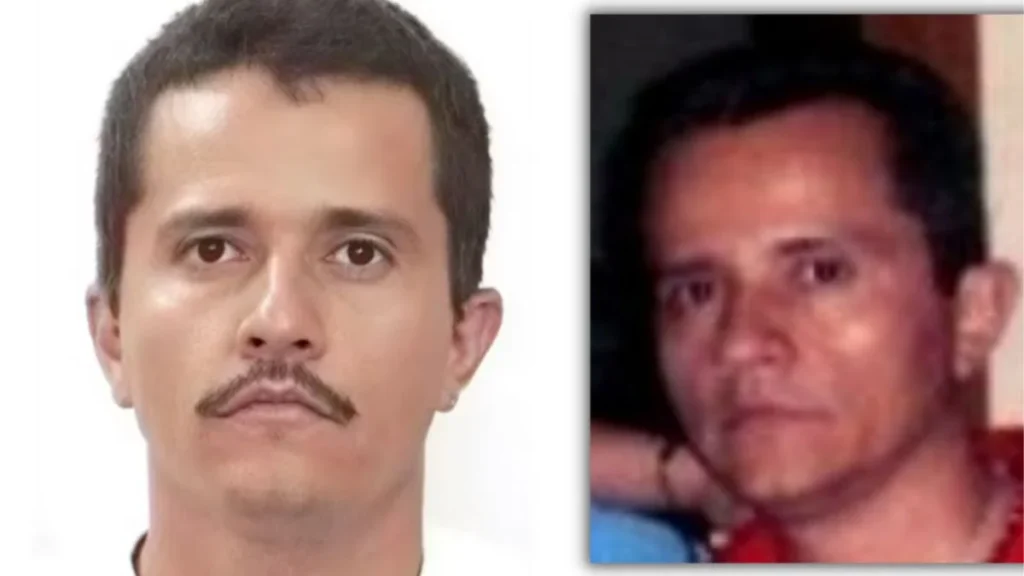
(AP/LATimes) — The Mexican army has killed Nemesio Rubén Oseguera Cervantes, the longtime leader of the powerful Jalisco New Generation Cartel, during a military operation in the western state of Jalisco, a federal official with knowledge of the mission told the Los Angeles Times and The Associated Press on Sunday.
The official, who spoke on condition of anonymity because they were not authorized to discuss operational details publicly, indicated that Oseguera Cervantes — widely known as “El Mencho” — was fatally shot during a coordinated security action carried out by Mexican armed forces.
The Associated Press first disclosed the development, citing the same federal source. The Los Angeles Times also carried the account, referencing a federal official familiar with the operation.
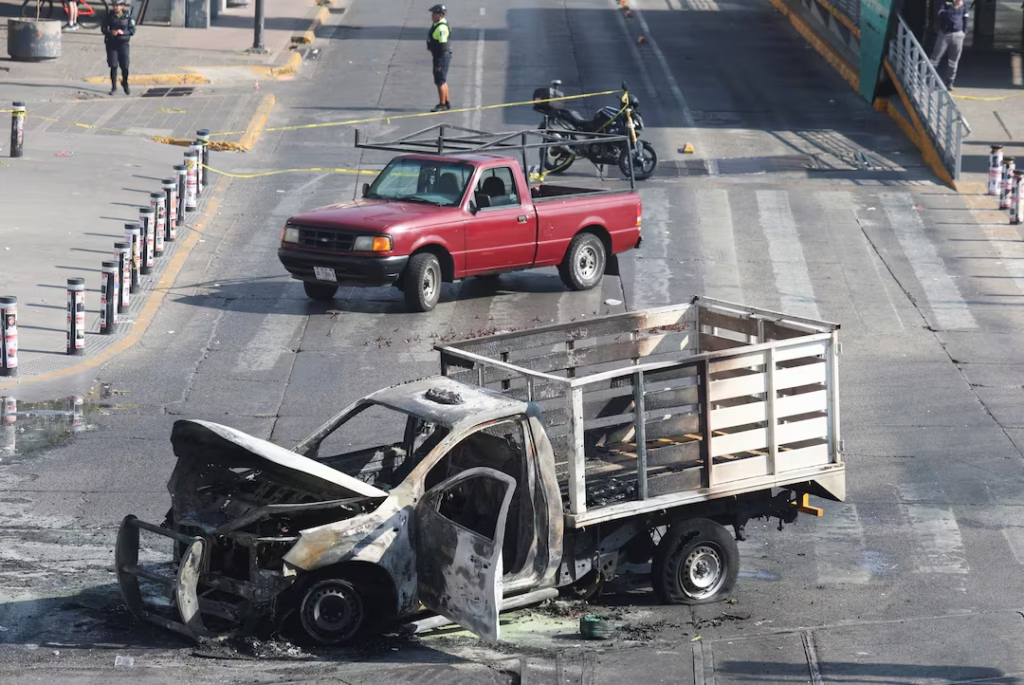
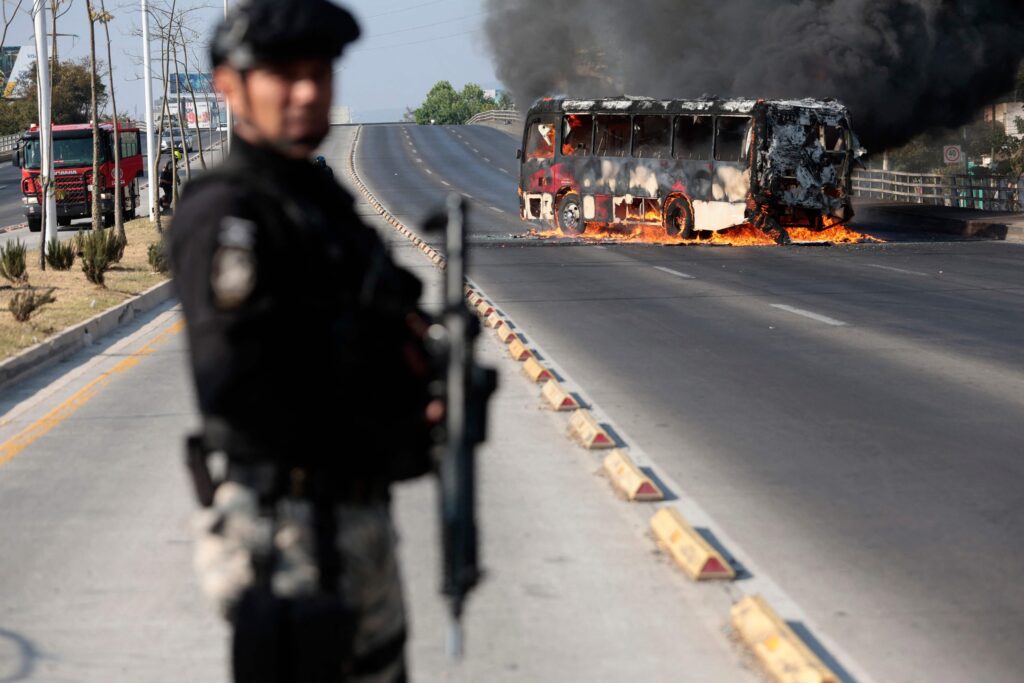
The military action unfolded after several hours of violent disruptions across parts of Jalisco and neighboring states. Armed groups erected roadblocks and set vehicles ablaze in what security analysts describe as a common tactic used by cartels to hinder troop movements and create diversions during sensitive operations.
Images shared on social media appeared to show heavy smoke rising over Puerto Vallarta, one of Jalisco’s largest cities and a major Pacific coast tourist hub. Other footage suggested scenes of alarm at the airport serving the state capital, where travelers were seen rushing through terminals amid the unfolding security crisis.
Air Canada announced Sunday afternoon that it was suspending flights to Puerto Vallarta “due to an ongoing security situation” and advised customers not to proceed to the airport. The airline did not provide further detail.
Oseguera Cervantes had long been one of the most sought-after drug traffickers in the world. The U.S. State Department had offered a reward of up to $15 million for information leading to his capture, underscoring his standing as a top priority for American law enforcement agencies.
In February, the administration of President Donald Trump formally designated the Jalisco New Generation Cartel as a foreign terrorist organization, a move aimed at expanding U.S. legal tools to disrupt the cartel’s finances and international operations.
Founded around 2009, the Jalisco New Generation Cartel, often referred to by its Spanish acronym CJNG, rapidly evolved into one of Mexico’s most formidable criminal networks. U.S. authorities and Mexican security officials have described the organization as among the fastest-growing and most aggressive cartels in the country.
The cartel has been linked to brazen attacks against Mexican security forces, including assaults on military helicopters. It has also been accused of deploying explosives via drones and planting improvised explosive devices — tactics that signaled a shift toward more militarized confrontation with the state.
In 2020, CJNG operatives carried out a high-profile assassination attempt in Mexico City against the capital’s then police chief, who now oversees federal security operations. Attackers used grenades and high-powered rifles in the ambush, an incident that shocked the nation and highlighted the cartel’s operational reach.
The U.S. Drug Enforcement Administration has assessed that the cartel rivals the Sinaloa cartel in scope and influence. American authorities contend that CJNG maintains a footprint in all 50 U.S. states, where it oversees the distribution of cocaine, methamphetamine and fentanyl. Like the Sinaloa cartel, it has generated billions of dollars from synthetic drug production, particularly fentanyl and methamphetamines.
Court records show that since 2017, Oseguera Cervantes had been indicted multiple times in the United States District Court for the District of Columbia. A superseding indictment filed April 5, 2022, accused him of conspiracy to manufacture and distribute controlled substances — including methamphetamine, cocaine and fentanyl — intended for illegal importation into the United States. Prosecutors also charged him with using firearms in connection with drug trafficking crimes and directing a continuing criminal enterprise under the Drug Kingpin Enforcement Act.
Mexican authorities have not immediately released additional details regarding casualties, arrests or the precise sequence of events during Sunday’s operation. It remains unclear whether other senior cartel figures were detained or killed.
The death of Oseguera Cervantes represents one of the most consequential blows to organized crime in Mexico in more than a decade. Yet security experts caution that the removal of a cartel leader does not necessarily translate into a lasting reduction in violence.
Historically, the targeting of high-profile kingpins has sometimes fractured criminal organizations, triggering internal power struggles that lead to further instability. In other cases, successors have quickly consolidated control, allowing operations to continue with minimal disruption. Whether CJNG fragments or regroups will likely depend on the strength of its command structure and the loyalty of regional lieutenants.
The designation of CJNG as a foreign terrorist organization earlier this year adds another layer of complexity. That classification broadens U.S. prosecutorial authority and could expose individuals or entities that provide material support to severe penalties. However, it also risks escalating diplomatic tensions between Washington and Mexico if cross-border enforcement actions intensify.
Economically, the immediate fallout in Jalisco underscores the cartel’s entrenched influence. The temporary suspension of flights to Puerto Vallarta — even if brief — demonstrates how security operations can ripple into tourism and commerce. For a region reliant on international visitors, such disruptions carry both symbolic and financial weight.
On the geopolitical stage, the killing may bolster cooperation between Mexican authorities and U.S. agencies, particularly as fentanyl trafficking remains a central political issue in Washington. At the same time, analysts note that cartel resilience has historically outpaced enforcement gains, raising questions about long-term impact.
For now, Mexican officials are likely to frame the operation as a decisive strike against organized crime. Whether it reshapes the narcotics trade or simply marks another chapter in a protracted conflict remains to be seen.




