

Western Mexico plunged into violent chaos Sunday as drug cartel gunmen launched coordinated retaliatory attacks across multiple states following a military raid that killed Nemesio “El Mencho” Oseguera Cervantes, the feared leader of the Jalisco New Generation Cartel, trapping tourists in resort hotels and sending panicked travelers fleeing through one of the nation’s busiest airports.
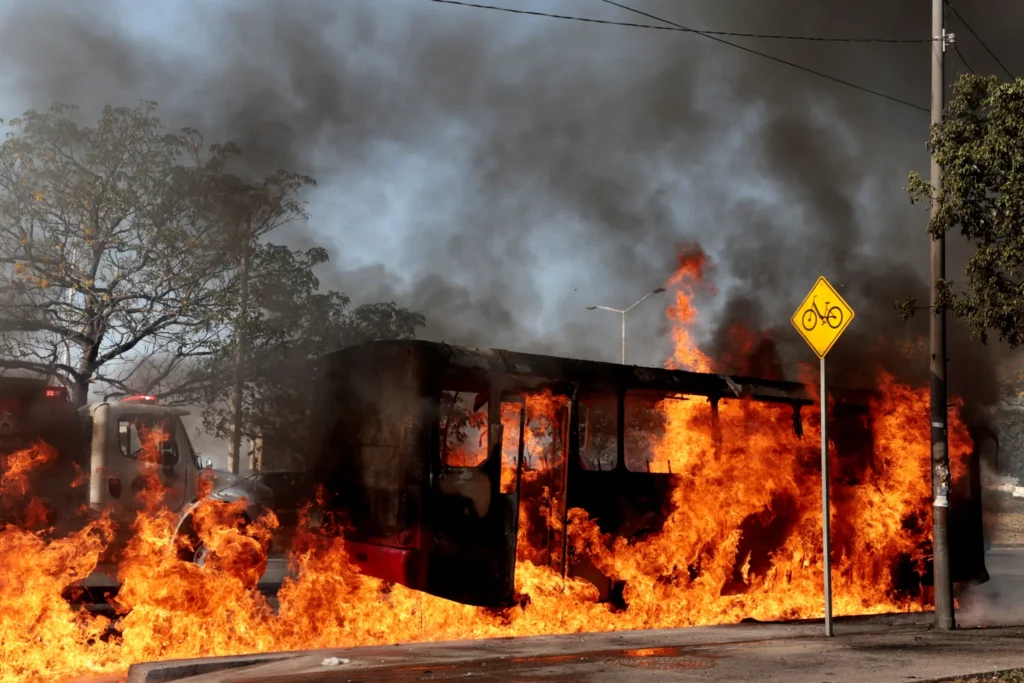
Authorities warned residents and visitors to shelter indoors throughout the state of Jalisco as narco gangs ignited vehicles, erected burning barricades, and engaged security forces in response to Oseguera Cervantes’s death during a confrontation with Mexican army personnel in Tapalpa.
The 53-year-old drug kingpin, who commanded one of Mexico’s most powerful and brutal criminal organizations, died while being transported by helicopter to Mexico City after sustaining injuries during the military operation.
“Federal forces carried out an operation in Tapalpa a few hours ago, which has led to clashes in the area,” Jalisco Governor Pablo Lemus Navarro announced via social media platform X. “Also as a result of said operation in various points of that region and in other parts of Jalisco, individuals have burned and blocked vehicles with the aim of hindering the actions of authorities.”
The governor declared much of Jalisco under “code red” emergency status and implored residents to remain home as violence spread. “We reiterate the recommendation to avoid leaving your homes,” Navarro warned. “The clashes are occurring in several federal entities.”
The U.S. State Department issued urgent advisories instructing American citizens to shelter in place, while some tourists reported finding themselves trapped as the security situation deteriorated throughout western Mexico’s popular vacation destinations.
Scott Posilkin, a 36-year-old marketing technology professional from Colorado stranded in Puerto Vallarta, described terrifying scenes as violence erupted across the resort city. “It looked like the whole city was on fire,” Posilkin told The Post, conveying the scope of destruction visible from his location.
“We saw a bus in the middle of the road with people running out of it,” he recounted. “At first we thought it was an accident, but then a man with a gun came around the other side of the bus and waved it at us and told us to go back.”
Posilkin and other stranded tourists awaited guidance from American diplomatic authorities while remaining confined to their accommodations. “We’re all processing. I think we’re all a little anxious. We’re just waiting to hear what the State Department tells us to do,” he said. “Right now we’re sheltering in place, and we’re all just happy to be together and be safe.”
Another tourist posted online from a hotel in Puerto Vallarta’s tourist zone: “Staying put until we get the all clear. All of the businesses in the area have closed.”
The message captured the widespread lockdown affecting Mexico’s fourth-largest tourism destination, where thousands of international visitors found their vacations transformed into survival situations.
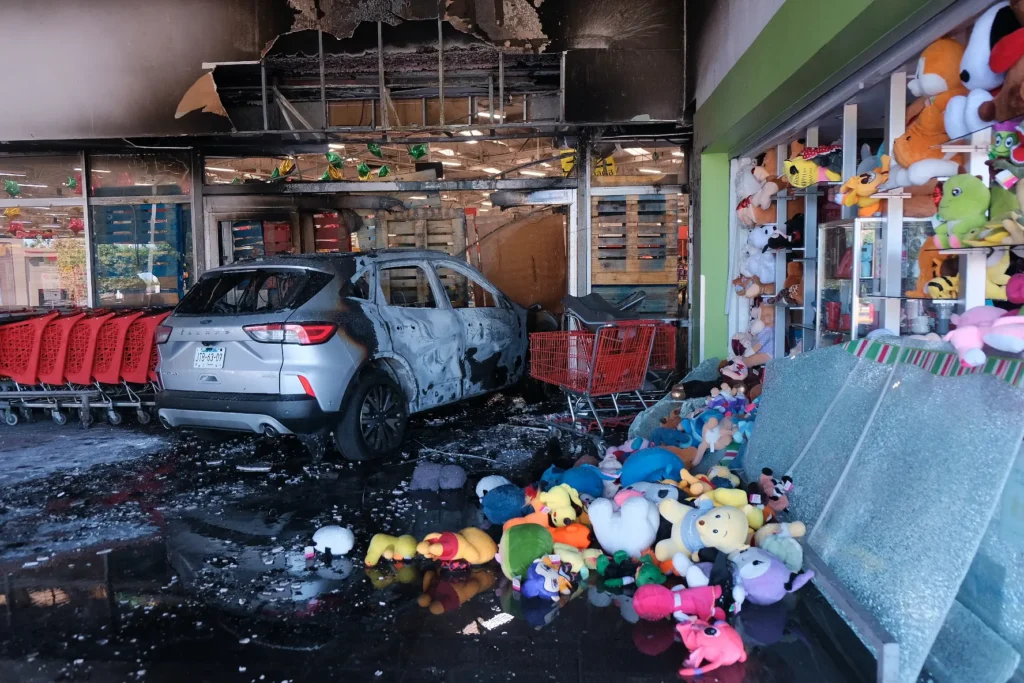
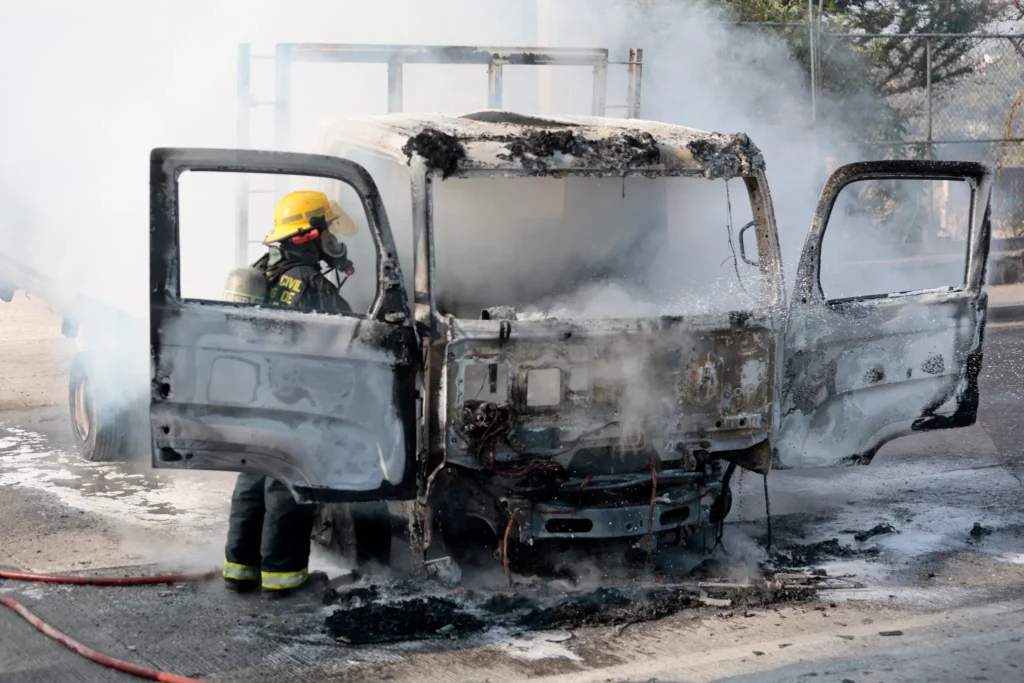
Spanish-language news outlet El Universal confirmed that cartel operatives systematically ignited fires throughout Jalisco to impede federal forces during and after the military raid, creating widespread infrastructure damage and public terror. Black smoke billowed from burning vehicles and barricades well into Sunday evening as authorities struggled to restore order.
Dramatic video footage obtained by The Post showed dozens of luggage-carrying passengers running through Guadalajara International Airport—Mexico’s third-busiest aviation facility serving 18.7 million travelers annually—while others crouched behind counters seeking protection.
The chaotic scenes illustrated how panic spread beyond immediate conflict zones to critical transportation hubs as frightened travelers attempted to escape the deteriorating situation.
The Pacific Airport Group, which operates Guadalajara International Airport, issued a statement acknowledging deployment of Mexican National Guard personnel to the facility while insisting operations continued normally. “It is important to clarify that no incidents have been reported inside the facilities, and there is no risk to passengers, staff or visitors,” the organization declared.
“The information and material circulating on social media do not correspond with any danger at the terminals, rather to the panic among passengers,” the statement continued, attributing airport chaos to fear rather than actual violence within the terminal complex. However, the massive security response and passenger evacuation footage suggested genuine concerns about potential cartel attacks on the aviation facility.
Air Canada canceled scheduled flights into Puerto Vallarta “due to an ongoing security situation,” advising passengers to remain at their departure locations rather than attempt traveling to airports. The cancellations reflected international carriers’ assessments that western Mexico had become too dangerous for normal commercial aviation operations.
The violence paralyzed a vast, heavily populated region encompassing multiple Mexican states. Beyond Jalisco, cartel gunmen launched assaults in Michoacán, Tamaulipas, Colima, Guanajuato, Aguascalientes, and Veracruz—a coordinated campaign demonstrating the Jalisco New Generation Cartel’s extensive geographic reach and organizational capacity to mobilize armed forces across hundreds of miles.
Merchants shuttered businesses throughout affected regions as uncertainty about security conditions made commercial activity impossible. Jalisco government officials announced school closures for Monday and indefinitely postponed all large community events until authorities could guarantee public safety. The disruptions will impose substantial economic costs on regions heavily dependent on tourism and commerce.
Mexican defense officials confirmed that military personnel conducting the Tapalpa operation came under attack, prompting defensive engagement that killed four Jalisco New Generation Cartel members at the scene.
Three additional cartel operatives sustained serious injuries and died during helicopter evacuation to Mexico City—a group that included Oseguera Cervantes himself.
“During this operation, military personnel were attacked, so in defense of their integrity, they repelled the aggression, resulting in four members of the CJNG criminal group being killed at the scene and three seriously injured who lost their lives during their transfer by air to Mexico City,” Mexican defense authorities stated, using the cartel’s Spanish acronym.
Oseguera Cervantes rose from modest origins—a sixth-grade dropout who briefly worked as a police officer—to become Mexico’s most feared cartel boss following the arrest and conviction of Joaquín “El Chapo” Guzmán by American authorities.
His Jalisco New Generation Cartel gained notoriety for extreme violence, territorial expansion, and sophisticated operations spanning drug trafficking, extortion, kidnapping, and fuel theft.
President Donald Trump designated the cartel as an international terrorist organization last year, pressuring Mexican authorities to intensify enforcement operations against the organization.
The United States maintained a $15 million reward for information leading to Oseguera Cervantes’s capture—one of the highest bounties ever offered for a drug trafficker.
American prosecutors indicted Oseguera Cervantes multiple times in Washington, D.C., since 2017, most recently in April 2022 on charges including conspiracy and distribution of controlled substances for illegal importation into the United States.
The indictments detailed his leadership of a criminal enterprise responsible for flooding American communities with methamphetamine, fentanyl, heroin, and cocaine while corrupting Mexican institutions through bribery and intimidation.
Sunday’s military operation represents a significant victory for Mexican security forces that have struggled for years to combat the Jalisco New Generation Cartel’s expansion across the country.
However, the immediate violent backlash demonstrates the organization’s capacity to inflict severe disruption even after losing its supreme leader, raising questions about whether Oseguera Cervantes’s death will weaken the cartel or simply trigger succession battles that could prove even more violent.
Historically, Mexican cartel decapitation strategies—removing top leaders through arrest or killing—have produced mixed results. While eliminating experienced leadership can disrupt operations temporarily, power vacuums frequently trigger internal conflicts as lieutenants compete for control, often escalating violence as rival factions battle for supremacy.
The Jalisco New Generation Cartel’s extensive resources, territorial control, and military capabilities suggest it will remain a formidable threat regardless of leadership changes.
The coordinated retaliatory attacks across multiple states indicate the organization maintains robust command-and-control structures capable of rapidly mobilizing forces in response to leadership losses.
This operational resilience suggests the cartel will continue functioning under new leadership, potentially with intensified violence as it seeks to demonstrate strength and deter further government operations.
For tourists trapped in Puerto Vallarta and other affected regions, the immediate priority involves safely evacuating once Mexican authorities restore sufficient order to guarantee secure passage to airports and border crossings.
The State Department will likely coordinate with Mexican counterparts to establish protected corridors enabling foreign nationals to depart conflict zones without encountering cartel violence.
The incident highlights persistent security challenges confronting Mexico as powerful drug trafficking organizations maintain quasi-military capabilities rivaling government forces in affected regions. Despite substantial American financial and intelligence support, Mexican authorities continue struggling to establish territorial control in areas where cartels operate with near-impunity, corrupting local officials and intimidating civilian populations into silence.
As smoke continued rising from burning barricades Sunday evening and federal reinforcements deployed across western Mexico, the full consequences of Oseguera Cervantes’s death remained uncertain.
Whether his elimination reduces the Jalisco New Generation Cartel’s power or simply initiates a violent transition to new leadership will determine whether Sunday’s military operation ultimately enhances Mexican security or merely shuffles criminal hierarchies while civilians continue suffering the consequences of narco violence that has claimed hundreds of thousands of lives across two decades of drug war.
NYPost




