

(AP) — The widening war between Iran and a U.S.-Israeli coalition intensified Monday as Iranian missiles and drones struck across Israel and several Arab states, regional militias entered the fray, and key Gulf energy infrastructure came under attack, rattling global markets and deepening fears of a prolonged regional conflict.
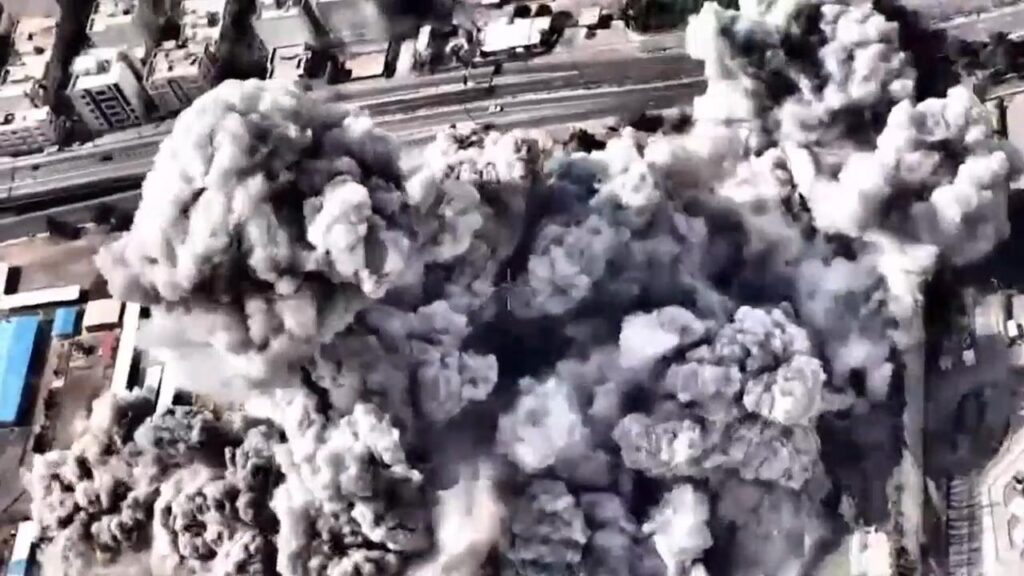
Iranian and Iranian-aligned forces launched projectiles toward Israel and U.S.-linked sites across the Gulf, while Israeli and American aircraft continued sustained bombardments inside Iran. Smoke rose from within the U.S. Embassy compound in Kuwait City, and Saudi Arabia confirmed a drone strike targeting one of the world’s largest oil refineries.
The U.S. military said Kuwait “mistakenly shot down” three American F-15E Strike Eagles during an active combat mission as Iranian aircraft, ballistic missiles and drones were operating in the same airspace. U.S. Central Command said all six American pilots ejected safely and were in stable condition. Kuwaiti authorities acknowledged the episode, and U.S. officials expressed appreciation for Kuwaiti defense forces amid what they described as an ongoing and fluid battlefield environment.
Iranian state television asserted that Iranian forces had struck U.S. aircraft but offered no operational specifics. Before the incident at the embassy compound, U.S. officials in Kuwait urged American citizens to shelter in place and advised others to avoid the area.
Casualties mounted on multiple fronts. The Iranian Red Crescent Society said at least 555 people have been killed across Iran since the U.S.-Israeli campaign began, with more than 130 cities hit by airstrikes. Israeli authorities confirmed 11 deaths in Israel, including nine killed when a missile struck a synagogue in Beit Shemesh. Lebanon’s Health Ministry reported 31 fatalities after Israeli retaliatory strikes following rocket fire from Hezbollah.
Lebanon’s government moved swiftly to distance itself from Hezbollah’s actions. Prime Minister Nawaf Salam declared the group’s overnight missile launches into Israel “illegal” and insisted that decisions of war and peace rest solely with the Lebanese state. He directed the Lebanese army to prevent further projectile launches and detain those responsible.
Hezbollah said it fired missiles in response to the killing of Iran’s Supreme Leader, Ayatollah Ali Khamenei, during the joint U.S.-Israeli offensive. Israel countered with heavy strikes in southern Lebanon and Beirut. Maj. Gen. Rafi Milo, head of Israel’s Northern Command, said operations would intensify, underscoring what he described as Hezbollah’s entry into the broader confrontation.
The conflict’s economic dimension became unmistakable Monday when Iranian-aligned attacks targeted Gulf energy infrastructure. Saudi Arabia’s Ras Tanura refinery, with capacity exceeding 500,000 barrels per day, was hit by a drone. Saudi defenses intercepted the incoming aircraft, but debris ignited fires, prompting a temporary shutdown, Saudi state media said. Thick black smoke was visible above the facility near Dammam.
Oman’s state news agency said a bomb-laden drone boat struck a Marshall Islands-flagged oil tanker in the Gulf of Oman, killing one crew member from India. In Kuwait, debris from intercepted drones injured two workers at the Ahmadi refinery, the KUNA news agency reported.
Energy analysts said the targeting of oil infrastructure marked a strategic escalation. Torbjorn Soltvedt of Verisk Maplecroft described the Ras Tanura strike as a turning point that placed Gulf energy assets “squarely in Iran’s sights.” Sascha Bruchmann of the International Institute for Strategic Studies told The Associated Press that Tehran’s apparent objective is to generate global backlash by threatening energy flows, though he noted the destruction so far has not crippled core facilities.
Iran has also signaled it could disrupt shipping in the Strait of Hormuz, a chokepoint through which roughly one-fifth of global oil supplies transit. Several commercial vessels have reported incidents in recent days, heightening shipping insurance rates and driving crude prices upward.
In Tehran, multiple airstrikes shook the capital Monday afternoon. Senior Iranian official Ali Larijani declared on social media that negotiations with Washington were off the table. Iran’s ambassador to the International Atomic Energy Agency, Reza Najafi, accused the United States and Israel of striking the Natanz nuclear enrichment facility and rejected allegations that Iran seeks nuclear weapons, calling such claims “a big lie.” Neither Washington nor Jerusalem immediately confirmed attacks at Natanz.
President Donald Trump vowed retaliation for the deaths of three U.S. service members killed in Kuwait and predicted additional casualties. “Sadly, there will likely be more before it ends,” Trump said in remarks released Sunday, adding that combat operations would continue “in full-force” until American objectives are met. He said B-2 stealth bombers had struck Iranian ballistic missile sites and asserted on social media that several Iranian warships were destroyed.
Britain, France and Germany signaled readiness to cooperate with Washington to curb further Iranian attacks. Cyprus confirmed that an unmanned aircraft struck a British air base on the island, causing limited damage, shortly after British Prime Minister Keir Starmer said the United Kingdom would support U.S. operations.
The war’s rapid expansion underscores how the killing of Khamenei — who led Iran for more than three decades — has reshaped the strategic landscape. His death has created a leadership vacuum within Iran’s political and religious hierarchy, raising questions about succession and internal stability. Analysts warn that power struggles within Tehran could complicate diplomatic off-ramps while emboldening hardline factions.
At the same time, Iranian proxy groups in Iraq have stepped up attacks. The Shiite militia Saraya Awliya al-Dam claimed responsibility for a drone strike targeting U.S. forces at Baghdad’s airport and previously claimed an attack on a U.S. base in Irbil. U.S. and Iraqi authorities have not publicly addressed those assertions.
In Gulf cities once viewed as insulated from regional warfare, debris from intercepted missiles has caused civilian casualties in the United Arab Emirates, Kuwait and Bahrain. Officials in those countries confirmed damage outside U.S. bases, indicating the conflict’s spillover effect.
The World Health Organization called for strict adherence to international humanitarian law. Regional director Hanan Balkhy urged all parties to safeguard civilians and medical facilities, stressing that healthcare protection “must be absolute.”
Original analysis suggests the war has entered a dangerous phase characterized not only by direct state-to-state confrontation but by attacks on global energy arteries and the mobilization of proxy forces. By expanding the battlefield beyond Israel and Iran into the broader Gulf, Tehran appears intent on internationalizing the costs of the conflict. Meanwhile, Washington and Jerusalem show no indication of scaling back operations, suggesting a protracted struggle with unpredictable economic and geopolitical consequences.
As airstrikes continue and regional actors weigh their options, the Middle East faces its most volatile moment in years — one with ramifications extending far beyond its borders.




