

Two traffic police officers and a civilian died Wednesday when an explosive device detonated in Moscow, Russian investigators announced, marking the latest deadly blast in the capital just days after a car bomb killed a high-ranking general in the same area.
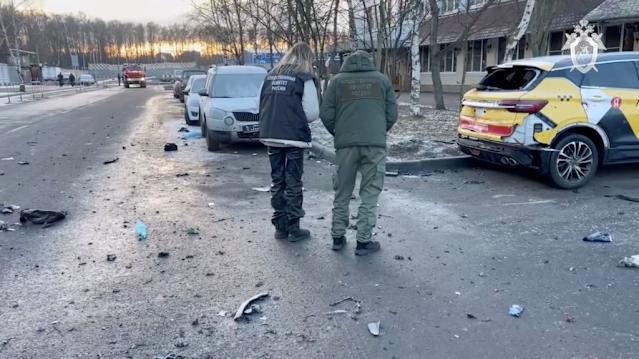
The two officers were approaching a “suspicious individual” when the explosive detonated, Investigative Committee spokesperson Svetlana Petrenko stated. The officers and another person standing nearby succumbed to their injuries at the scene.
Investigators and forensic experts were working at the location Wednesday, Petrenko said. The incident occurred in the same section of southern Moscow where Lt. Gen. Fanil Sarvarov was killed by a car bomb Monday morning.
Sarvarov, head of the Operational Training Directorate of the Russian Armed Forces’ General Staff, died when an explosive device detonated beneath his vehicle. Investigators stated Ukraine may have been behind the attack, which represented the third assassination of a senior military officer in just over a year.
“Investigators are pursuing numerous lines of enquiry regarding the murder. One of these is that the crime was orchestrated by Ukrainian intelligence services,” Petrenko said following Monday’s attack.
The Defense Ministry indicated Sarvarov had previously fought in Chechnya and participated in Moscow’s military campaign in Syria.
The geographic proximity and temporal clustering of the two explosions—separated by just days and occurring in the same Moscow district—raise questions about potential connections between the incidents, though Russian authorities have not explicitly linked Wednesday’s blast to Monday’s targeted assassination.
On December 17, 2024, Lt. Gen. Igor Kirillov, chief of the military’s nuclear, biological and chemical protection forces, was killed by a bomb hidden on an electric scooter outside his apartment building. Kirillov’s assistant also perished in the blast. Ukraine’s security service claimed responsibility for the attack.
An Uzbek man was quickly arrested and charged with killing Kirillov on behalf of Ukrainian intelligence services. Russian President Vladimir Putin characterized Kirillov’s assassination as a “major blunder” by Russia’s security agencies, stating they should learn from the incident and improve their efficiency.
In April, another senior Russian military officer, Lt. Gen. Yaroslav Moskalik, a deputy head of the main operational department in the General Staff, was killed by an explosive device placed in his car parked near his apartment building just outside Moscow. A suspected perpetrator was quickly arrested following that attack.
Since Moscow deployed troops into Ukraine nearly four years ago, Russian authorities have blamed Ukraine for multiple assassinations of military officers and public figures within Russia. Ukraine has claimed responsibility for some operations while remaining silent on others. Ukrainian officials have not yet commented on Monday’s Sarvarov killing or Wednesday’s explosion that killed the police officers.
The pattern of targeted killings represents a significant escalation in what amounts to a shadow war being waged inside Russian territory. The attacks demonstrate Ukraine’s apparent capability to conduct sophisticated operations deep within Russia, penetrating security measures designed to protect senior military leadership.
The assassinations serve multiple strategic purposes from Ukraine’s perspective. They eliminate experienced military commanders involved in prosecuting the war against Ukraine, create psychological pressure on Russian military leadership, demonstrate vulnerability of targets previously considered secure, and send a message about Ukraine’s operational reach despite being the conventionally weaker party in the conflict.
For Russia, the series of successful attacks exposes serious security failures despite Putin’s criticism following Kirillov’s death. The continued success of assassination operations suggests either inadequate protection protocols for senior officers, penetration of Russian security services by Ukrainian intelligence, or both. The attacks also raise uncomfortable questions about whether additional officers may be targeted and whether Russian security agencies can effectively protect high-value personnel.
The use of different attack methods—car bombs, scooter bombs, and Wednesday’s device triggered by approaching police—indicates operational flexibility and adaptation by those conducting the operations. Each method demonstrates technical sophistication in explosive device construction, intelligence gathering to identify targets and their patterns, and operational security sufficient to evade detection before attacks occur.
Wednesday’s explosion presents a different profile than previous assassinations. Rather than targeting a specific high-ranking military officer, the device detonated when police approached a suspicious individual, suggesting either a failed assassination attempt against another target, a bomb intended for later deployment, or potentially an ambush targeting security personnel investigating suspicious activity.
The death of two traffic police officers—typically not involved in counterintelligence or high-level security operations—raises questions about whether they inadvertently interrupted preparation for another attack or whether someone deliberately targeted routine law enforcement. The presence of a third victim described as a civilian standing nearby suggests the explosion occurred in a public area rather than a secured military or government facility.
Moscow has blamed Ukraine for numerous bombings and other attacks within Russia throughout the nearly four-year conflict. These include strikes on infrastructure, alleged sabotage operations, and the targeted assassinations of military and civilian figures associated with the war effort. The Kremlin characterizes these operations as terrorism, while Ukraine frames them as legitimate military actions against combatants prosecuting an illegal invasion.
The international legal status of such operations remains contested. Ukraine argues that targeting military commanders engaged in armed conflict constitutes lawful military action under international humanitarian law. Russia contends that assassinations conducted by intelligence services against targets in non-combat zones constitute terrorism regardless of the victims’ military status.
The frequency of successful attacks—three senior generals killed in 13 months, plus Wednesday’s explosion—suggests either expanding Ukrainian operational capacity within Russia or deteriorating Russian counterintelligence effectiveness. Each successful operation likely emboldens Ukrainian services while simultaneously forcing Russian security agencies to divert resources from offensive intelligence operations to defensive protection of potential targets.
The psychological impact on Russian military leadership cannot be understated. Senior officers must now consider personal security threats even when operating far from the front lines, potentially affecting their willingness to assume prominent roles or move freely within Moscow. This represents a strategic success for Ukraine even beyond the immediate tactical value of eliminating specific commanders.
As investigators examine Wednesday’s explosion scene and attempt to determine connections to Monday’s assassination, Russian security services face mounting pressure to prevent future attacks while identifying and neutralizing Ukrainian intelligence networks operating within Russia. The challenge is substantial: protecting dozens or hundreds of potential targets while maintaining operational security and prosecuting a war that shows no signs of imminent conclusion.
The coming weeks will reveal whether Wednesday’s explosion represents an isolated incident, a failed operation, or the continuation of a systematic campaign targeting Russian military and security personnel in Moscow.
For Ukrainian intelligence services, demonstrated capability to conduct operations in the Russian capital serves strategic messaging purposes regardless of individual tactical outcomes. For Russian security agencies, each successful attack compounds pressure to demonstrate improved protective capabilities and operational security.




