

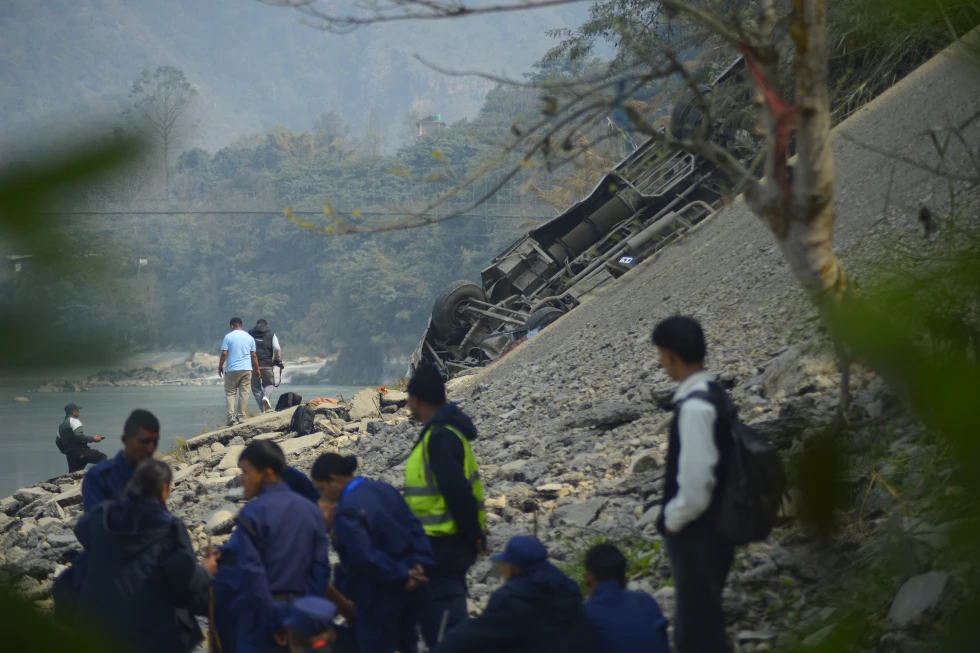
(AP) — A passenger bus carrying dozens of travelers veered off a mountain highway in central Nepal shortly after midnight Monday, tumbling down a steep slope before coming to rest along the banks of the Trishuli River, killing 19 people and injuring at least 25 others, authorities said.
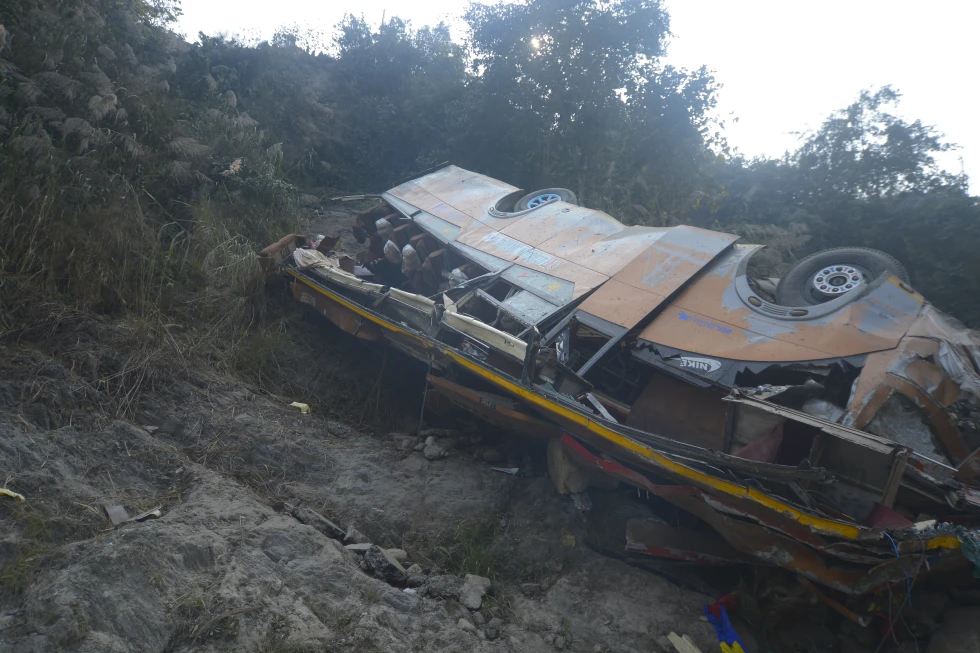
The bus was traveling from the lakeside resort city of Pokhara to the capital, Kathmandu, when it left the Prithvi Highway near Benighat in Dhading district, roughly 80 kilometers (50 miles) west of Kathmandu, police confirmed. Rescue crews arrived at the crash site soon after the accident and worked through the darkness to pull survivors from the wreckage.
District police identified one of the victims as a 24-year-old British national. Officials said nine of the 19 fatalities had been formally identified by Monday afternoon, while efforts were underway to confirm the identities of the remaining victims.
Among the injured were a Chinese national receiving treatment at the National Trauma Center in Kathmandu and a 27-year-old woman from New Zealand who sustained minor injuries and was being treated at a nearby hospital. China’s official Xinhua News Agency, citing the Chinese Embassy in Nepal, indicated earlier that another Chinese national had been reported missing.
Government administrator Mohan Prasad Neupane said emergency responders transported the injured to area hospitals after extracting them from the damaged vehicle. Police have launched an investigation to determine what caused the bus to leave the roadway.
The Prithvi Highway, a critical link between Kathmandu and Pokhara, winds through steep hills and narrow corridors carved into mountainous terrain. Accidents along the route are not uncommon, particularly during nighttime travel when visibility is reduced and fatigue may be a factor. Officials have not yet indicated whether weather, road conditions, mechanical failure or driver error contributed to Monday’s crash.
Nepal’s rugged topography poses persistent challenges for transportation. Much of the Himalayan nation is defined by sharp gradients, tight curves and roads that cling to cliffsides above fast-moving rivers. Infrastructure constraints, aging vehicles and inconsistent enforcement of safety standards have compounded risks for travelers.
The crash site near the Trishuli River carries painful resonance. In 2024, two buses carrying 65 people plunged into the same river during separate incidents, leaving most of those aboard dead or missing. The wreckage of one of those vehicles was discovered only this year, buried beneath deep sand deposits along the riverbank.
Authorities have not released the total number of passengers on Monday’s bus but described it as heavily occupied. Survivors were treated for fractures, lacerations and internal injuries, hospital officials said, though they declined to provide further details pending family notification.
Nepal has struggled for years to reduce its rate of road fatalities. Government data show that traffic accidents claim hundreds of lives annually, with buses frequently involved because they remain the primary mode of long-distance transport for many residents and tourists alike.
Pokhara, the departure point of the ill-fated bus, is one of Nepal’s most visited destinations, known for its lakes, trekking routes and proximity to the Annapurna mountain range. The highway connecting it to Kathmandu is a lifeline for commerce and tourism, but it is also notorious for congestion and hazardous conditions.
Police said forensic teams were examining the wreckage to determine whether mechanical malfunction played a role. Investigators are also reviewing the driver’s background and travel logs.
While authorities focus on determining the immediate cause of the crash, the broader safety concerns facing Nepal’s transportation system are again in the spotlight.
Road infrastructure development in the country has lagged behind growing demand. As tourism rebounds and domestic travel increases, highways such as the Prithvi corridor are seeing heavier traffic volumes. Yet many sections remain narrow, uneven and vulnerable to landslides, especially during the monsoon season. Although Monday’s accident occurred outside the peak rainy period, geological instability and aging guardrails remain ongoing hazards.
Enforcement of vehicle maintenance standards has also been inconsistent. Transport unions and safety advocates have long called for stricter inspections of commercial buses, citing worn brake systems and overloading as recurring issues. Previous crash investigations have highlighted similar factors.
International visitors are often among those affected. Nepal’s adventure tourism sector attracts travelers from Europe, Asia and Oceania, and bus travel is frequently the most accessible way to move between cities. Fatalities involving foreign nationals can carry diplomatic sensitivities, prompting embassies to coordinate closely with local authorities.
The Trishuli River tragedies in 2024 prompted renewed pledges from officials to strengthen oversight, including proposals to install more protective barriers along high-risk stretches and introduce digital monitoring of bus routes. However, implementation has been gradual.
Transportation analysts note that mountainous countries face inherent constraints, but policy measures — including improved driver training, regulated driving hours and enhanced roadside emergency response systems — can significantly reduce fatalities.
Monday’s crash may intensify pressure on policymakers to accelerate reforms. Public frustration often spikes after high-casualty incidents, though momentum for long-term structural change has historically waned over time.
For families awaiting identification of victims, immediate concerns are more personal. Officials in Dhading district said support services were being coordinated for relatives, and foreign embassies were notified regarding their citizens.
As investigations proceed, authorities have urged motorists traveling the Prithvi Highway to exercise caution and comply with traffic advisories. The government has not yet announced whether additional inspections or temporary restrictions will be imposed along the corridor.
The accident stands as another stark reminder of the risks inherent in navigating Nepal’s dramatic terrain — a landscape that draws visitors from around the world, yet demands sustained investment to ensure safer passage for those who travel its winding roads.




