

At least two people were killed and several others were injured Saturday evening after a building under construction collapsed along Ngong Road in Nairobi’s Karen area, prompting a large-scale rescue operation and renewing scrutiny of construction safety standards in Kenya’s capital.
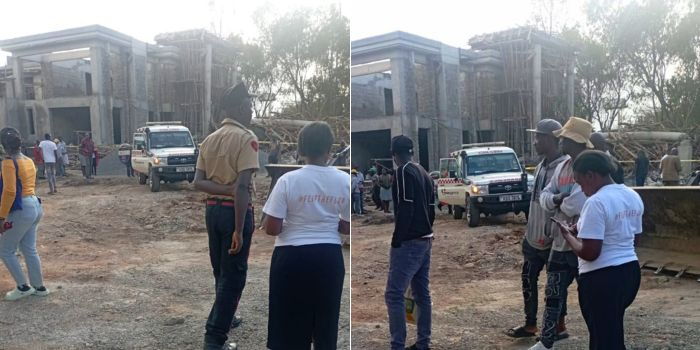
Emergency responders rushed to the scene opposite Karen Community Church shortly after the structure gave way at about 5 p.m., trapping workers beneath concrete and twisted metal. By around 6 p.m., the Kenya Red Cross said it had evacuated three critically injured people as rescuers worked against fading daylight to search for survivors.
Police said preliminary findings indicate the structure had reached the first-floor level when the slab suddenly collapsed, crushing workers who were on site at the time. Two builders were pronounced dead at the scene, while seven others were pulled from the debris and taken to hospital for treatment. Rescue teams continued operations late into the night amid uncertainty over whether more people remained trapped.
Confusion persisted over the exact number of fatalities. Former Nairobi Gov. Mike Sonko, who confirmed the incident through a public statement, said three bodies had been recovered. “Another building has just collapsed in Karen near KCB. Several people are trapped inside. Three dead bodies have already been confirmed,” Sonko said. Authorities, however, had not independently verified that figure as of publication.
Police and the National Construction Authority had yet to issue an official briefing on the collapse, though officers from the Directorate of Criminal Investigations were among those at the scene gathering evidence and questioning witnesses. Investigators were expected to focus on structural integrity, compliance with approved building plans and whether safety protocols were followed during construction.
Emergency officials said it was still unclear how many workers were on site when the building failed. Rescue teams, including volunteers and medical personnel, continued carefully removing debris to avoid triggering further collapse.
The Nairobi County government and the National Disaster Management Unit had not released statements on the incident by the time of publication, leaving residents and families of workers anxiously awaiting confirmation of casualties and accountability measures.
The Karen collapse comes less than two weeks after another building failure in Nairobi’s South C estate, where a 12-storey structure under construction collapsed, killing two people. That incident had already intensified public concern over lax oversight in the city’s rapidly expanding construction sector.
Urban planners and safety experts say the repeated collapses point to deeper systemic problems. The Architectural Association of Kenya has repeatedly warned that a significant number of buildings in Nairobi are unsafe for occupation, citing weak enforcement of regulations, corruption in approvals and widespread use of substandard construction materials.
Figures cited by built-environment professionals show inspections conducted by the National Building Inspectorate found that only about 15 percent of assessed buildings were structurally sound. The remaining 85 percent were classified as unsafe, requiring major structural intervention or posing potential risks to occupants and the public.
Those statistics underscore what experts describe as a crisis fueled by rapid urbanization, rising land values and pressure to cut costs. Developers, engineers and contractors often operate in a fragmented system where oversight is split among county authorities, national regulators and professional bodies, creating gaps that can allow unsafe practices to go unchecked.
Saturday’s collapse again raised questions about whether lessons from past disasters have translated into meaningful reform. In previous incidents, investigations have identified failures ranging from poor foundation work and unauthorized design changes to the use of counterfeit or low-grade materials.
Beyond the immediate human toll, the incident is likely to intensify calls for tougher enforcement and accountability. Construction accidents have eroded public trust in regulatory agencies, particularly when investigations stall or fail to result in prosecutions.
For residents of Karen and surrounding neighborhoods, the collapse also highlighted broader safety concerns. Ngong Road is a major artery lined with homes, churches, schools and businesses, meaning construction failures pose risks not only to workers but also to passersby.
Emergency responders said crowd control was necessary at the site as onlookers gathered, complicating rescue efforts. Authorities urged the public to keep a safe distance to allow heavy machinery and medical teams to operate.
The tragedy has reignited debate over the responsibilities of developers and professionals involved in construction projects. Under Kenyan law, developers, architects, engineers and contractors can all be held liable if negligence or regulatory violations are found to have contributed to a collapse.
As investigations proceed, families of the victims are likely to press for answers and justice. Worker advocates have long argued that laborers on construction sites often face the greatest risks, sometimes without adequate safety equipment, insurance or clear records of employment.
While rescue operations continued, analysts noted that the Karen collapse adds to mounting pressure on authorities to act decisively. Without sustained reform, they warn, Nairobi risks seeing similar tragedies repeat as the city continues to grow vertically to accommodate its expanding population.
For now, emergency teams remain focused on the immediate task of locating survivors and accounting for all workers who were on site when the building came down. Officials have said more information will be released once rescue operations conclude and investigators establish the full circumstances behind the collapse.
Kenyans.co




