

ATLANTA (BN24) — Rapper and entrepreneur Nicki Minaj sharply criticized California Gov. Gavin Newsom this week after a speaking engagement in Georgia, contending that his remarks to attendees were patronizing and disrespectful toward Black voters.
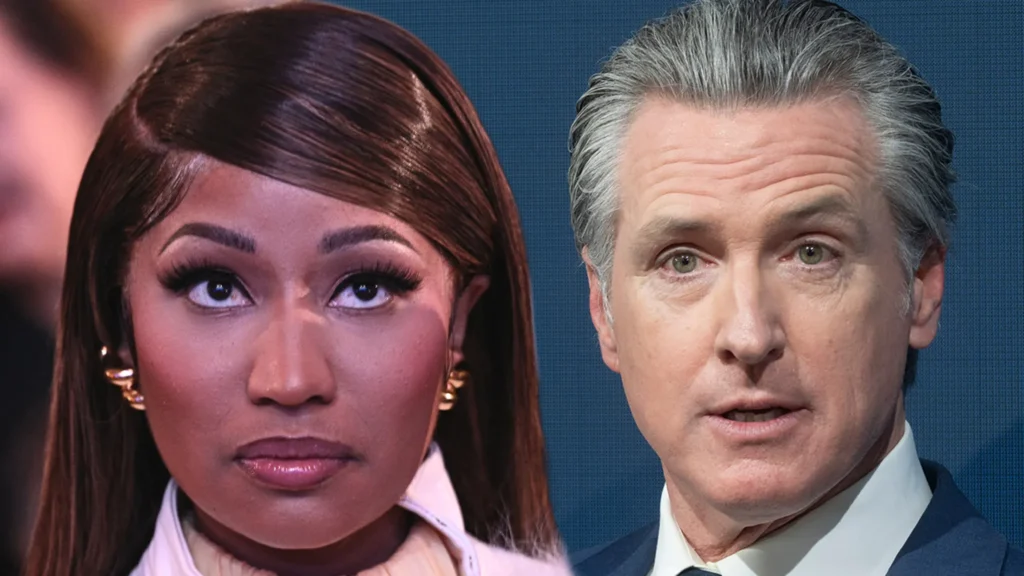
In a series of posts on X, the artist known for chart-topping hits including “Super Bass” took aim at Newsom’s tone during the event, arguing that his attempt to connect with the audience came across as condescending.
“His way of bonding with black ppl is to tell them how stupid he is & that he can’t read,” Minaj wrote in one post shared with her millions of followers.
She followed with another message intensifying her criticism: “He’s not just TELLING them that they’re probably stupid & probably can’t read, he’s LITERALLY SLOW-ING-DOWN-HIS-SPEECH to make them understand the words that are coming out of his mouth!!!!”
The exchange unfolded after Newsom appeared at an event in Georgia to promote his memoir, Young Man in a Hurry, which chronicles his upbringing, political trajectory and his experience living with dyslexia. During a discussion moderated by Atlanta Mayor Andre Dickens, Newsom reflected on academic struggles tied to the learning disability.
Addressing a question about how he navigated dyslexia, Newsom cited his standardized test performance as an example of overcoming adversity. “I’m like you. I’m no better than you,” he said, referencing a low SAT score as part of his personal story.
The comment drew mixed reactions online, with some social media users echoing Minaj’s assessment, while others defended the governor’s remarks as self-deprecating and intended to build rapport.
Video circulating from the venue showed a line of attendees waiting to enter the event. The footage appeared to depict a racially diverse crowd, countering some social media assertions that the audience was exclusively or predominantly Black. The clip Minaj shared, however, featured only Newsom and Dickens on stage and did not show audience members.
Newsom’s office did not immediately issue a response to Minaj’s criticism.
The California governor, widely viewed as a prominent Democratic figure, has increasingly made appearances outside his home state as speculation swirls about his national political ambitions. His memoir tour has taken him to multiple cities, where he has spoken about policy, leadership and personal resilience.
Minaj, a Grammy-nominated performer with a substantial global following, has periodically waded into political discourse. Her social media presence often blends commentary on culture, governance and public figures, drawing both praise and scrutiny.
The online clash underscores the delicate terrain political leaders navigate when addressing diverse audiences, particularly on issues of race and identity. Public figures frequently use personal anecdotes to humanize themselves and foster relatability. However, tone and delivery can become flashpoints, especially when filtered through short video clips shared widely on social media.
Political communication experts note that modern campaigns and public appearances operate in an environment where moments are rapidly dissected and reframed online. A gesture intended as humility can be interpreted by critics as diminishment, depending on context and audience perception.
In this instance, Newsom’s reference to his academic challenges appears rooted in his long-standing openness about dyslexia. He has previously described the learning disability as formative in shaping his work ethic and leadership approach. Yet Minaj’s reaction highlights how rhetorical framing particularly when referencing intelligence or literacy can carry broader cultural weight.
The debate also reflects the evolving relationship between celebrities and political leaders. Artists with massive digital platforms now function as influential commentators capable of shaping narratives beyond traditional media channels. Minaj’s posts quickly gained traction, fueling discussion across social media platforms and cable news segments.
At the same time, analysts caution against drawing sweeping conclusions from short video excerpts absent full context. The event’s moderator, Mayor Andre Dickens, who is Black, engaged Newsom in a broader conversation about education, resilience and public service. Without a complete transcript of the exchange, interpretations may hinge on selective clips.
Beyond the immediate controversy, the episode surfaces broader questions about how elected officials communicate about shared struggle. Efforts to convey solidarity often rely on parallels “I’m like you” but such phrasing can be interpreted in varying ways depending on the audience’s lived experience.
For Newsom, whose national profile has expanded in recent years, scrutiny of his messaging is likely to intensify. As political figures engage audiences across regional and cultural lines, sensitivity to nuance becomes increasingly central to maintaining trust.
For Minaj, the moment reinforces her role as a high-profile cultural voice unafraid to challenge political figures publicly. Whether the dispute has lasting political ramifications remains uncertain. However, it illustrates the power of celebrity commentary to shape public debate, particularly when questions of race and respect intersect with political ambition.
The governor’s memoir tour continues amid heightened attention, while online reaction to the exchange remains active. Neither Newsom nor Minaj signaled further engagement on the matter as of Tuesday.
The friction between Minaj and Newsom reveals a deeper tension in American political discourse: authenticity versus optics. Politicians often attempt to bridge divides by sharing personal vulnerabilities. Yet in an era dominated by viral video, tone can overshadow intent.
Moreover, discussions about literacy and intelligence intersect with historical stereotypes that have disproportionately affected Black communities. Even when unintended, rhetoric that touches on those themes can trigger strong responses. Minaj’s interpretation that slowing speech implied diminished intelligence speaks to long-standing sensitivities about how Black audiences are addressed by those in power.
The incident also underscores the strategic importance of digital literacy for public officials. Messaging once confined to a ballroom now reverberates globally within minutes. A single phrase can define coverage for days, especially when amplified by a celebrity with tens of millions of followers.
As the 2026 political landscape begins to take shape, figures like Newsom will likely face heightened examination of both policy positions and interpersonal communication. For high-profile entertainers like Minaj, weighing in on such moments can energize supporters while shaping broader cultural narratives.
In an age when politics and pop culture increasingly overlap, episodes like this demonstrate that influence flows in multiple directions from podium to platform and back again.





