

Nigeria’s Super Eagles continued their commanding run at the 2025 Africa Cup of Nations on Saturday night, overpowering Algeria 2-0 at the Stade de Marrakech to book a place in the tournament’s semi-finals and extend their status as one of the competition’s most formidable sides.
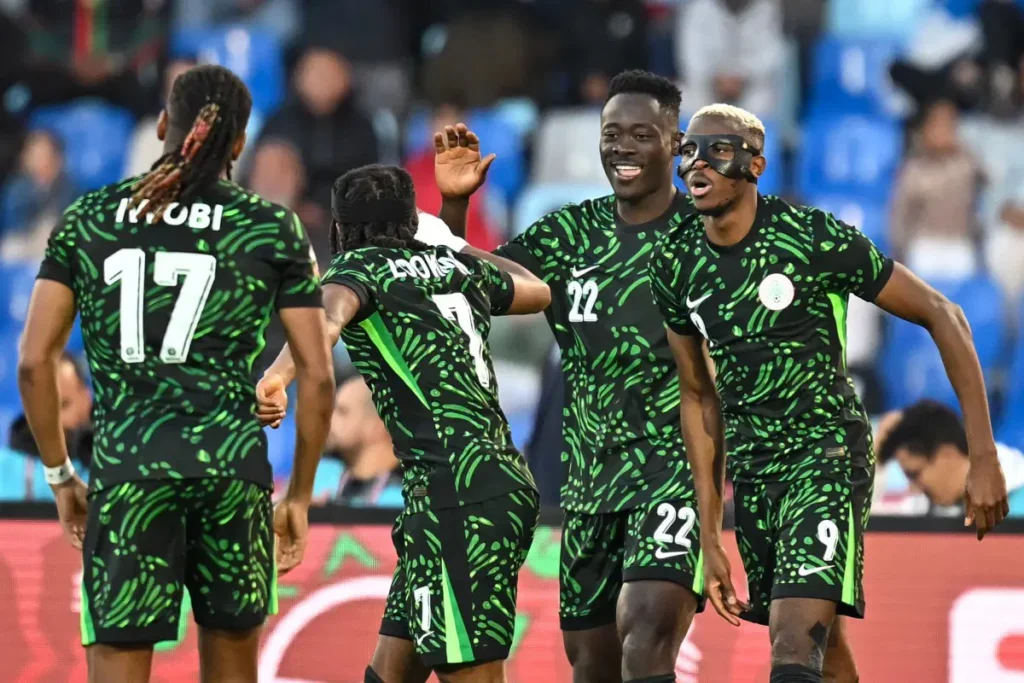
The quarter-final victory sets up a high-stakes last-four clash against tournament hosts Morocco, who advanced earlier after defeating Cameroon. For Nigeria, the result reinforced their growing momentum in the competition, while bringing an abrupt end to Algeria’s previously resilient campaign.
Nigeria entered the match buoyed by a dominant 4-0 Round of 16 victory over Mozambique and carrying the tournament’s most potent attack. The Super Eagles had scored 12 goals across four matches, a tally unmatched by any other team at the finals. Algeria, by contrast, arrived in Marrakech unbeaten, having conceded just once in the same number of games, with their defensive discipline widely viewed as their biggest strength.
From the opening whistle, Nigeria imposed themselves on the contest. The Super Eagles controlled possession, pressed aggressively high up the pitch and forced Algeria into a compact defensive shape deep inside their own half. Victor Osimhen spearheaded the attack with trademark intensity, combining physical strength and pace, while Ademola Lookman and Akor Adams provided movement and width. In midfield, Alex Iwobi dictated the tempo, linking play between defense and attack with calm authority.
Nigeria’s early dominance translated into a series of chances in the first half. Akor Adams came closest to breaking the deadlock when he raced through on goal, only to see his effort denied in a one-on-one situation. Moments later, another Nigerian attempt was dramatically cleared off the line as Algeria scrambled to keep the score level. Despite sustained pressure, the North African side remained organized at the back, with goalkeeper Luca Zidane producing key interventions to frustrate Nigeria’s forwards.
Algeria’s approach relied on absorbing pressure and seeking opportunities on the counterattack, but those moments were limited. Nigeria’s midfield shield, anchored by Wilfred Ndidi, repeatedly broke up Algerian transitions before they could develop into genuine threats. As a result, Algeria struggled to test Nigeria’s back line in the opening half, even as they reached the interval still level.
The breakthrough Nigeria had been pushing for arrived in the second half. Osimhen, who had been a constant menace, rose above his marker to power home a header, finally converting Nigeria’s territorial dominance into a deserved lead. The goal lifted the tempo further, with the Super Eagles sensing an opportunity to take full control of the contest.
Rather than retreat, Nigeria continued to dictate proceedings. Their full-backs pushed high, stretching Algeria’s defensive lines, while the wingers’ movement created space centrally. That pressure told again when Akor Adams doubled Nigeria’s advantage, finishing clinically after being set up by Osimhen, who turned provider after opening the scoring himself.
At 2-0 down, Algeria made a series of substitutions in an attempt to change the game’s momentum. However, Nigeria’s composure and defensive organization ensured the contest never drifted out of their control. Ndidi continued to disrupt Algerian build-up play, while Nigeria’s center-backs dealt confidently with aerial balls and late pressure.
As the minutes ticked down, the Super Eagles managed the game with maturity, circulating possession and limiting Algeria’s opportunities to mount a comeback. By the final whistle, Nigeria’s superiority had been emphatically underlined, with the scoreline reflecting a performance that combined attacking flair with tactical discipline.
The victory carries broader implications for the tournament. Nigeria’s attacking efficiency and balance across the pitch have made them one of the standout teams of AFCON 2025, and their ability to overcome a defensively solid Algeria side sends a strong signal to remaining contenders. With Osimhen leading the line and multiple attacking options contributing, the Super Eagles have demonstrated depth and versatility that could prove decisive in the final stages.
The semi-final against Morocco now looms as one of the tournament’s marquee matchups. Morocco, playing on home soil, will enjoy strong local support and arrive with confidence after their own quarter-final success. For Nigeria, the challenge will be to replicate the intensity and control shown against Algeria while navigating the added pressure of facing the hosts.
Beyond the immediate contest, Nigeria’s run to the semi-finals reflects a broader resurgence under a system that emphasizes high pressing, midfield control and quick transitions. The Super Eagles’ consistency across matches suggests a side growing in belief, with experienced leaders blending effectively with emerging talents.
Algeria, meanwhile, exit the competition having been undone by Nigeria’s pace and persistence. Despite their strong defensive record leading into the quarter-finals, they were ultimately unable to contain Nigeria’s sustained pressure or find a foothold in midfield. Their elimination highlights the fine margins at this stage of the tournament, where a single lapse can shift the balance decisively.
As AFCON 2025 moves toward its climax, Nigeria’s performance in Marrakech has placed them firmly among the favorites. With confidence high and a semi-final showdown against Morocco ahead, the Super Eagles remain focused on translating their impressive form into a place in the final — and potentially, continental glory.
Punchng




