

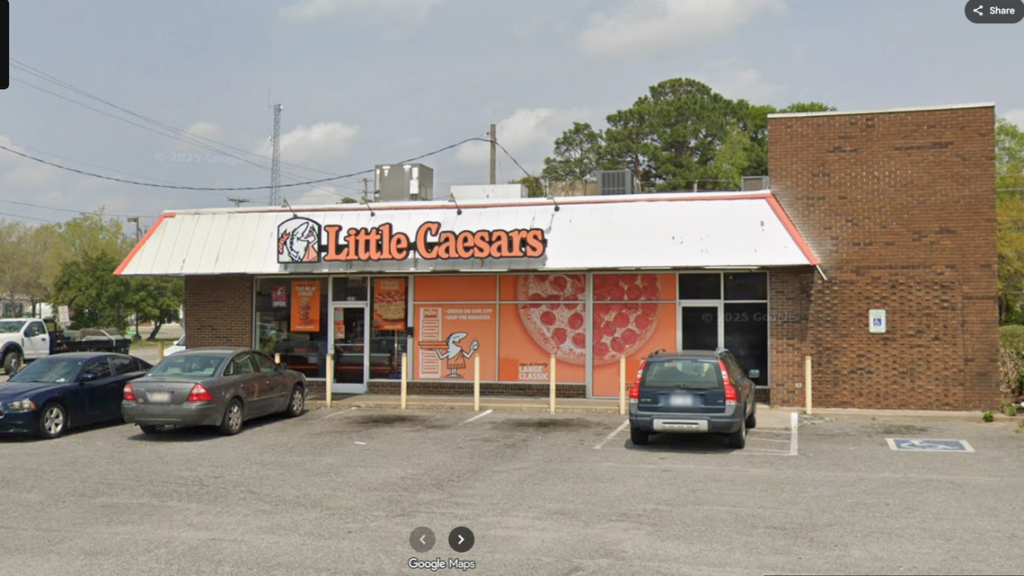
A North Carolina man is facing a string of felony and misdemeanor charges after authorities say he broke into a Little Caesars pizza restaurant after closing time, made pizzas using the store’s supplies and sold them for his own profit before attempting to return a second time, triggering a confrontation with employees.

Jonathon Hackett, 41, was arrested in Kinston after police say he unlawfully entered a Little Caesars location on two separate occasions, including one incident in which he allegedly prepared and sold pizzas while the business was closed. Hackett, who police say is a former employee of the restaurant, was later taken into custody following a second attempted entry that escalated into a physical altercation.
According to a statement from the Kinston Police Department, officers responded to a call reporting a breaking and entering at the pizza shop after being alerted by employees. Investigators determined that Hackett had gained access to the restaurant after hours and operated inside the store without authorization.
Police said Hackett kept the proceeds from the pizzas he allegedly sold, though authorities have not disclosed how many pizzas were made or how much money was taken. The department said the alleged activity amounted to multiple criminal offenses, including property and theft-related charges.
“The Kinston Police Department responded to Little Caesars in reference to a breaking and entering,” police said in a statement. “Upon arrival, officers were advised that 41-year-old Jonathon Hackett, a former employee, had unlawfully entered the business on two separate occasions.”
Investigators said Hackett’s first entry occurred while the restaurant was closed and unattended. During that incident, police say he used the kitchen equipment and ingredients to prepare pizzas and sell them to customers, presenting himself as if the business were operating normally.
While that initial incident went undetected at the time, police said Hackett returned on a subsequent occasion when the restaurant was occupied by employees. That second attempt did not end quietly.
“During the second incident, Hackett again broke into the business while it was occupied by employees,” the police statement said. “Employees attempted to prevent Hackett from entering, which resulted in a physical altercation.”
Authorities said Hackett sustained injuries during the confrontation and was transported for medical treatment before being taken into custody. The extent of his injuries was not disclosed, and police did not indicate whether any employees were hurt.
Hackett was later booked into the Lenoir County Jail. Jail records list multiple charges, including felony breaking and entering, felony obtaining property by false pretenses, felony larceny after breaking and entering, misdemeanor breaking and entering, and violation of a municipal curfew.
Police said the curfew charge stemmed from emergency restrictions imposed by the city ahead of a major winter storm that struck the area last week. The curfew, which was in effect from Jan. 31 through Feb. 2, limited nonessential movement during severe weather conditions. Authorities said Hackett’s alleged actions occurred while the curfew was active.
Information regarding Hackett’s bond status and next court appearance was not immediately available as of Wednesday. Police said further details would be released through the court system.
The unusual nature of the case — involving an alleged unauthorized operation of a fast-food restaurant — quickly drew attention online and locally, highlighting broader concerns about business security and employee access after termination.
While police did not specify how Hackett entered the building, the fact that he is a former employee raises questions about whether he retained knowledge of store access points, alarm systems or operating procedures. Law enforcement officials did not say whether the restaurant’s security systems were activated or bypassed.
Criminal justice analysts note that cases involving former employees often carry heightened risks for businesses, particularly when access credentials, keys or codes are not promptly changed after a worker leaves. Although rare, incidents in which unauthorized individuals attempt to operate or impersonate a business can create liability concerns and safety risks for both employees and customers.
From a legal standpoint, prosecutors will likely focus on whether Hackett intentionally misrepresented his authority to operate the restaurant and whether customers were deceived into believing they were purchasing food from a legitimate, open business. The felony charge of obtaining property by false pretenses typically hinges on proving that deception was used to secure money or goods.
The larceny and breaking-and-entering charges, meanwhile, reflect the alleged unauthorized use of property and unlawful entry into the building. Under North Carolina law, felony breaking and entering can carry significant prison time if a conviction is secured, particularly when combined with theft-related offenses.
Police emphasized that the investigation remains ongoing and that additional information could emerge as detectives continue to review evidence, including surveillance footage and witness statements.
The Little Caesars location involved has not publicly commented on the incident. The Independent said it had requested comment from the Kinston Police Department, but no additional statement had been released beyond the initial police summary.
For residents of Kinston, the case stands out as an unusual blend of humor and seriousness — a late-night pizza operation that nevertheless resulted in real injuries, alleged theft and multiple felony charges. Law enforcement officials stressed that, regardless of the novelty of the allegations, the offenses are being treated with the same gravity as any other break-in involving commercial property.
As Hackett awaits his next court appearance, the case is expected to move through the Lenoir County court system, where prosecutors will determine how to proceed based on the evidence gathered. Until then, police said the public should rely on official court records for updates rather than speculation circulating on social media.
TheIndependent




