

Gunmen killed three villagers and abducted 11 people, including a Catholic priest, during a predawn assault in northwestern Nigeria, church officials said Saturday, as a separate attack in central Nigeria saw suspected bandits torch homes before being driven back by security forces. The incidents highlight the widening scope of Nigeria’s security crisis, which continues to defy government pledges to restore order.
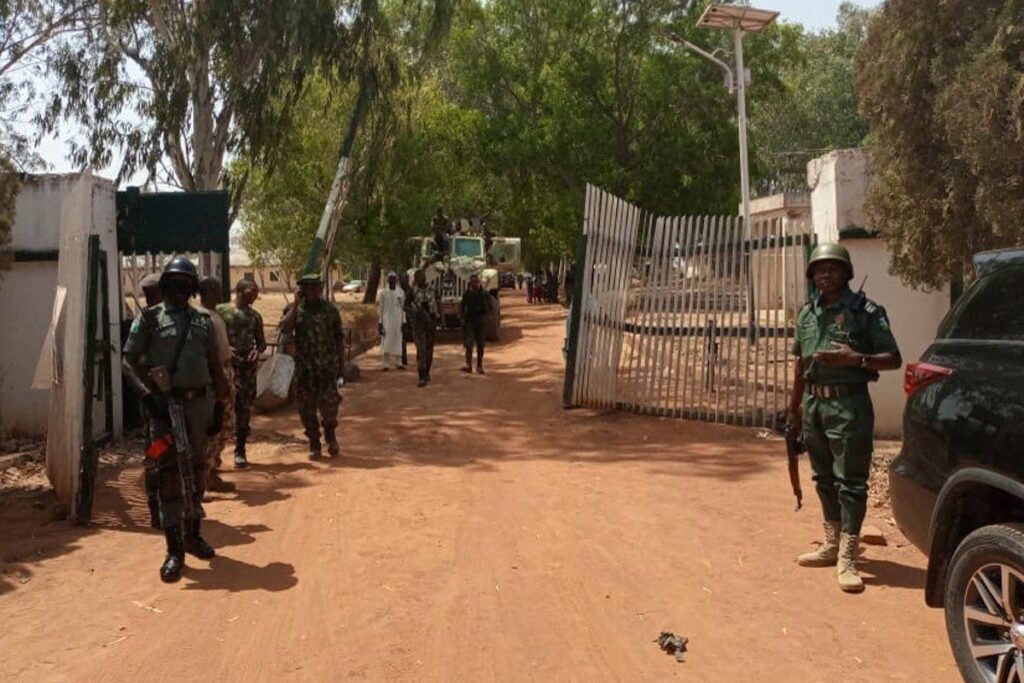
In Kaduna State, attackers struck shortly after 3 a.m. in the Kauru local government area, targeting the residence of a Catholic priest, the Diocese of Kafanchan said in a statement circulated to parishioners. The diocese described the raid as “an invasion by terrorists,” saying three villagers were killed during the assault and 11 people were taken captive.
Among those abducted was a Catholic priest whose name was not immediately released. The diocese urged prayers for the victims and called for the safe release of those being held.
Local authorities did not immediately disclose further details about the attackers or any ongoing rescue operations. Kaduna State officials also did not comment publicly on whether security forces had been deployed to pursue the assailants.
The attack came amid a sharp escalation of violence across northern Nigeria, where communities have been battered by a mix of Islamist insurgency and criminal gangs that rely on mass kidnappings for ransom. In January, more than 150 Christians were seized from three churches in another part of Kaduna State before being released earlier this week. In neighboring Kwara State, officials said at least 160 people, most of them Muslims, were killed by Islamist extremists after refusing forced indoctrination.
Security analysts say armed groups once concentrated in Nigeria’s far north have increasingly expanded southward, driven by military pressure, internal rivalries and competition over territory. Kaduna, which straddles Nigeria’s Muslim-majority north and Christian-majority south, has become a frequent flashpoint.
President Bola Tinubu, elected in 2023 after promising to crush insecurity, has faced growing criticism as attacks persist. Despite expanded military operations and intelligence efforts, kidnappings and village raids remain common, particularly in rural areas with limited state presence.
The violence has also drawn increasing international attention. The United States government has accused Nigerian authorities of failing to adequately protect religious minorities, although attacks affect both Christians and Muslims. Those concerns have contributed to closer security cooperation between Abuja and Washington, including U.S. airstrikes targeting armed groups in Nigerian territory in December and the deployment of a small contingent of American forces in an advisory role.
While the Kaduna attack underscored the dangers in the northwest, a separate incident in Benue State, in Nigeria’s central region, illustrated how quickly violence can spread to new areas.
Security operatives repelled suspected bandits who invaded Anwase village in Kwande Local Government Area on Friday, Benue State police said. The attackers set several homes ablaze before fleeing, authorities confirmed.
The Benue State Police Command spokesperson, Deputy Superintendent Udeme Edet, acknowledged the incident while responding to inquiries. She said officers were able to drive off the attackers and that no deaths were recorded during the clash.
“It is true there was an attack on Anwase, but our officers repelled them and there was no casualty,” Edet said.
Residents, however, described a chaotic scene. A local source cited by Punchng said the attackers struck around noon, injuring several villagers and burning multiple houses before security forces intervened. Anwase lies near Abande, another community that was attacked earlier this week, resulting in the deaths of six people, including a mobile police officer.
Lawrence Akerigbe, a former councillor in Kwande Local Government Area who said he visited Anwase after the attack, credited the presence of security forces with preventing further bloodshed. He said officers deployed to Abande after Tuesday’s attack were on patrol when they encountered the bandits.
“The invaders set about 11 houses on fire,” Akerigbe said. “Some people were injured, but the security operatives arrived quickly. Once the bandits saw them, they fled. That is what saved the community.”
Despite the successful repulsion, residents say fear remains high. Kwande Local Government Area has experienced repeated attacks, with Anwase itself previously targeted on Christmas Day 2024, when more than 28 people were reportedly killed.
Akerigbe said violence in the area has taken a devastating toll. “No fewer than 76 people have been killed in the past two years in this local government,” he said, adding that many communities have faced repeated raids that have displaced families and destroyed livelihoods.
Together, the attacks in Kaduna and Benue reflect a security crisis that is no longer confined to a single region or ideology. Nigeria is confronting overlapping threats: Islamist insurgents driven by extremist ideology, criminal bandit groups motivated by profit, and local militias exploiting weak governance and porous borders.
The abduction of clergy members, particularly Catholic priests, carries symbolic weight. Such kidnappings often generate international attention and can strain relations between religious communities, even when attacks are not explicitly sectarian. Church leaders say priests have increasingly become targets because they are seen as valuable hostages who can command ransom payments.
In Benue, the pattern of raids and arson points to a strategy of intimidation aimed at forcing communities to flee. Analysts say this type of violence often precedes broader criminal control of farmland, grazing routes or mineral-rich areas, deepening economic instability and food insecurity.
Despite increased defense spending, Nigeria’s security forces remain overstretched across vast rural areas. Poor infrastructure, limited intelligence networks and mistrust between civilians and authorities complicate efforts to prevent attacks or respond swiftly. While successful interventions like the Anwase patrol offer reassurance, they remain the exception rather than the rule.
The federal government’s growing reliance on foreign partnerships, including cooperation with the United States, reflects both the scale of the challenge and the limits of domestic capacity. Critics warn, however, that military solutions alone will not end the violence without parallel investments in justice, local governance and economic opportunity.
For communities across northern and central Nigeria, the immediate concern remains survival. As families mourn the dead in Kaduna and rebuild burned homes in Benue, many residents say confidence in the state’s ability to protect them continues to erode — a reality that risks perpetuating cycles of violence if left unaddressed.
AP/Punchng




