

Global oil markets convulsed Monday as crude prices surged above $115 per barrel amid mounting fears that the widening war involving Iran could severely disrupt energy production and shipping across the Middle East.
Trading in early markets sent benchmark crude soaring toward $120 per barrel before prices retreated later in the day as investors weighed emergency measures being discussed by major industrial nations.
According to reporting by The Associated Press, the international benchmark Brent crude climbed to nearly $119.50 per barrel before easing to about $106.23 later in trading. U.S. benchmark West Texas Intermediate (WTI) followed a similar trajectory, briefly reaching $119.48 before settling near $101.25.
The sharp swings come as the expanding conflict in the Middle East threatens critical energy infrastructure and maritime routes that carry a significant share of the world’s oil supply.
The war, now in its second week, has drawn in multiple countries and raised alarms about the stability of global energy flows.
Energy traders and analysts have focused particular attention on the Strait of Hormuz, a narrow waterway between Iran and Oman that serves as one of the world’s most vital oil shipping corridors.
Roughly 15 million barrels of crude oil — about 20% of global supply — typically pass through the strait each day, according to research firm Rystad Energy.
However, escalating missile threats and drone attacks have forced many tankers to halt or reroute their journeys, severely slowing maritime traffic.
Market participants say the uncertainty surrounding tanker movements has already begun to ripple through global supply chains.
Energy prices began climbing rapidly as fears mounted that the conflict could choke off shipments of oil and liquefied natural gas from the Persian Gulf — a region that supplies much of the world’s energy.
Oil traders pushed futures sharply higher, with prices briefly reaching their highest levels since mid-2022.
The surge in oil prices comes amid continued attacks on key energy infrastructure in the region.
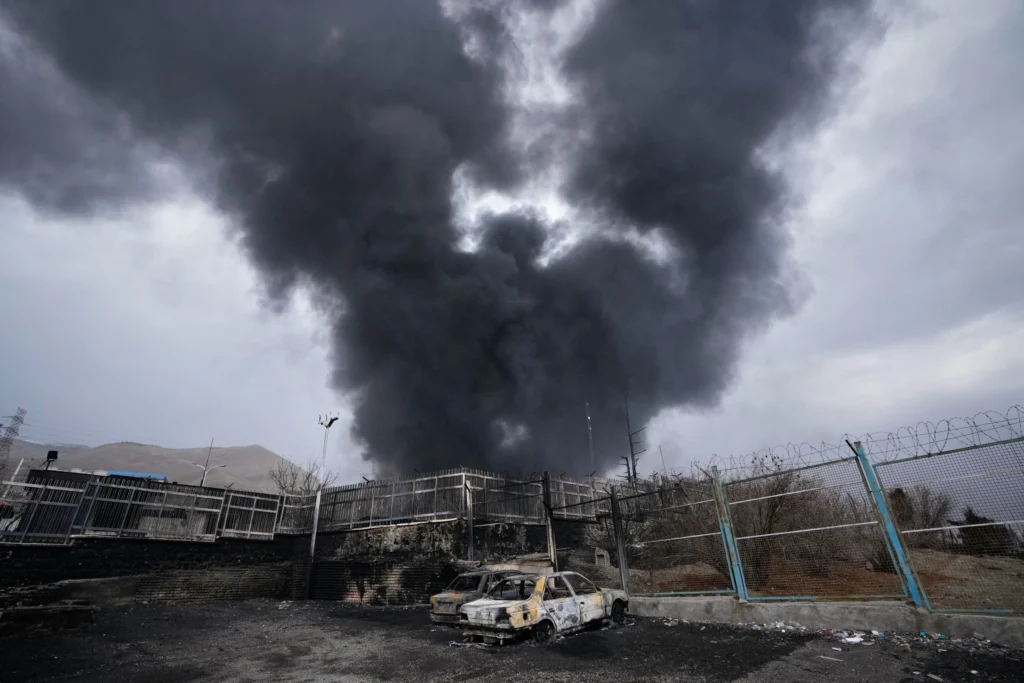
Authorities in Bahrain accused Iran of striking a desalination plant that supplies drinking water to much of the island nation, while smoke continued rising from oil depots in Tehran following overnight Israeli airstrikes.
Iranian officials indicated that the Israeli strikes targeted petroleum facilities, killing four people and igniting fires that burned through the night.
Israel’s military said the oil depots were being used by Iranian forces to store fuel for missile operations.
Additional strikes have hit refineries and storage facilities across the region since the conflict began.
Earlier in the war, a drone attack targeted a major refinery operated by Saudi Aramco in Ras Tanura, temporarily halting operations and contributing to the spike in oil prices.
These attacks have intensified fears that the war could escalate into a broader energy crisis.
Several major oil-producing countries in the Gulf have already begun trimming production as shipping bottlenecks prevent exports from leaving the region.
Iraq, Kuwait and the United Arab Emirates have reduced output after storage tanks filled up due to the slowdown in tanker traffic.
Iran, Israel and the United States have also launched strikes on oil and gas facilities during the conflict, further tightening supplies.
According to Reuters, oil prices remained more than 15% higher Monday, reflecting deep concerns among traders about prolonged disruptions to Middle Eastern supply routes.
Market volatility eased somewhat later in the day after the Financial Times reported that members of the Group of Seven (G7) were considering a coordinated release of strategic petroleum reserves to stabilize prices.
The report cited unnamed officials familiar with the discussions.
The surge in oil prices is already spilling into financial markets and consumer prices.
Stock markets across Asia tumbled Monday as investors braced for the economic fallout.
Japan’s benchmark Nikkei 225 index dropped more than 5%, while U.S. stock futures slid more than 1.5% in early trading.
Higher fuel prices are also beginning to hit consumers directly.
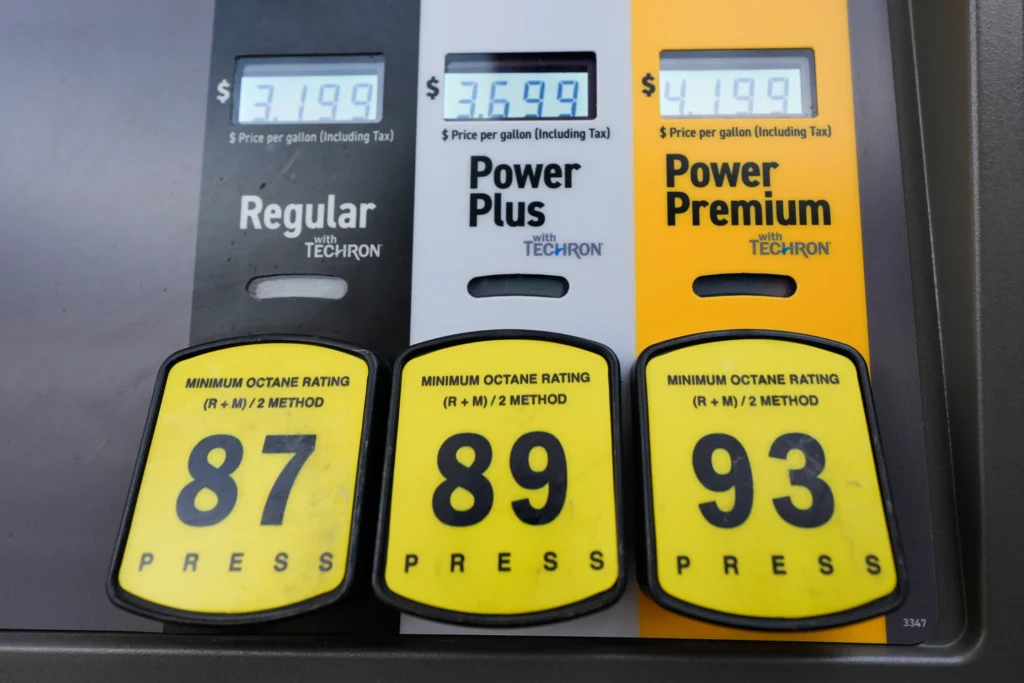
In the United States, the average price of regular gasoline climbed to $3.45 per gallon, roughly 47 cents higher than a week earlier, according to AAA. Diesel prices rose even more sharply to about $4.60 per gallon, up roughly 83 cents.
U.S. Energy Secretary Chris Wright, appearing on CNN’s “State of the Union,” suggested the spike could be temporary.
“Look, you never know exactly the time frame,” Wright said, adding that in a worst-case scenario the disruption might last “weeks, not months.”
Energy economists caution that sustained oil prices above $100 per barrel could place heavy strain on the global economy.
Higher energy costs tend to push inflation upward, eroding consumer purchasing power and dampening economic growth.
Major oil-importing economies in Asia — including Japan, South Korea and India — are particularly vulnerable because they rely heavily on crude shipments from the Persian Gulf.
Some analysts warn that prolonged disruptions to the Strait of Hormuz could trigger an even larger energy shock.
Goldman Sachs has warned that oil prices could climb as high as $150 per barrel if shipping disruptions persist and Gulf producers are forced to shut down exports entirely.
Market jitters have also intensified following the appointment of Mojtaba Khamenei as Iran’s new supreme leader after the death of his father, Ali Khamenei.
Analysts say the move signals that hard-line leadership remains firmly in control in Tehran during the war.
Commodity strategist Satoru Yoshida of Rakuten Securities told Reuters that the leadership change could complicate diplomatic efforts and heighten fears that Iran will continue targeting shipping routes or regional oil facilities.
Beyond the immediate market volatility, the crisis underscores a deeper vulnerability in the global energy system.
Nearly one-fifth of the world’s oil flows through the Strait of Hormuz — a geographic choke point that has long been considered one of the most strategically sensitive locations in the global economy.
If tanker traffic remains disrupted for weeks or months, energy markets could face supply shortages reminiscent of the oil crises of the 1970s.
The situation also highlights the growing geopolitical risks tied to energy infrastructure in conflict zones.
In recent years, drone warfare and precision missiles have made refineries, storage depots and shipping lanes far more vulnerable than in past conflicts.
Even limited strikes can ripple across global markets because oil supply chains operate with little spare capacity.
Governments are therefore likely to face mounting pressure to stabilize markets through emergency measures such as releasing strategic reserves, increasing production from non-Middle Eastern suppliers, or accelerating investments in alternative energy.
For now, traders remain focused on the war’s trajectory.
If fighting spreads further across the Gulf — or if shipping through the Strait of Hormuz remains restricted — analysts say the next surge in oil prices could arrive quickly, with potentially far-reaching consequences for the global economy.




