

UNITED NATIONS (BN24) — Palestinian President Mahmoud Abbas said he is prepared to cooperate with U.S. President Donald Trump and international powers to implement a two-state peace initiative announced by France, reiterating a vision for Palestinian statehood amid ongoing war in Gaza.
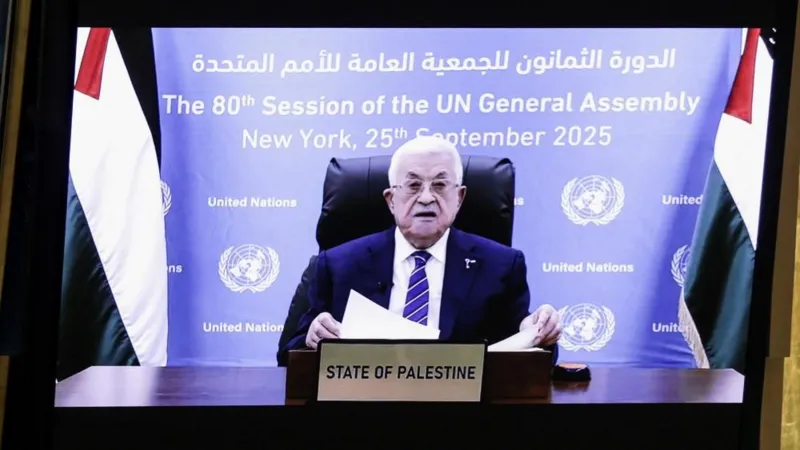
In a video address to the United Nations General Assembly, Abbas voiced strong support for the French-led proposal that includes a ceasefire in Gaza, the release of hostages held by Hamas, and the establishment of a demilitarized Palestinian state governed by the Palestinian Authority (PA), excluding Hamas. He welcomed the initiative as a “path toward a just peace and comprehensive regional cooperation,” calling on international actors, including Saudi Arabia, France, and the UN, to help realize the plan.
Though he emphasized readiness to work with Trump, the United States has so far rejected the plan, citing concerns over Hamas’s role in the October 7, 2023, attack on Israel that killed approximately 1,200 people and triggered the war. The U.S. State Department recently revoked visas for Abbas and 80 other Palestinian officials, accusing them of undermining peace efforts and seeking “unilateral recognition of a conjectural Palestinian state.”
Abbas, 89, was thus barred from traveling to New York and appeared via video from Ramallah. Despite his limited physical presence, Abbas used the platform to press for full UN membership for Palestine and urged countries that have yet to recognize Palestinian statehood to follow the recent lead of nations including Canada, Australia, the UK, Portugal, France, Belgium, and Denmark.
While condemning Israel’s ongoing military campaign in Gaza as “one of the most horrific humanitarian tragedies of the 20th and 21st Centuries,” Abbas also rejected Hamas’ actions, including its cross-border assault on Israel last year. Gaza’s Hamas-run health ministry reports more than 65,000 Palestinians have died in Israeli attacks since the conflict began, with approximately half being women and children.
The French peace framework, announced at a summit co-chaired by French President Emmanuel Macron and Saudi Arabia, proposes a phased resolution: an immediate ceasefire, the release of hostages, a transitional administration led by the PA, and the eventual establishment of an independent Palestinian state. Neither Israel nor the United States have endorsed the plan.
Despite that, Abbas pledged full Palestinian Authority responsibility for post-war governance in Gaza and called for the strip’s reintegration with the West Bank under a unified state. He also promised institutional reforms, vowing to hold presidential and parliamentary elections within one year of the war’s end, polls not seen since Hamas won legislative elections in 2006.
“We want a democratic, modern state committed to international law, rule of law, pluralism, peaceful transfer of power, and the empowerment of women and youth,” Abbas stated.
The remarks underscore growing diplomatic momentum behind Palestinian statehood, even as the conflict shows little sign of abating and internal Palestinian divisions continue. Hamas violently ousted Abbas’s Fatah party from Gaza in 2007, creating a deep political rift that still complicates prospects for unity and peace.
While key Western powers remain divided on the path forward, Abbas’s address signals a renewed push from Ramallah to position the Palestinian Authority—and not Hamas—as the legitimate interlocutor in any future resolution.





