

Pope Leo on Sunday delivered an emotional appeal for the release of more than 300 children and staff abducted from a Catholic school in northwest Nigeria, calling the mass kidnapping a profound tragedy that strikes at the heart of communities already reeling from years of violence. His plea came as Nigerian authorities and church leaders struggle to verify the scale of the attack and determine how so many victims could have been taken in a single raid.

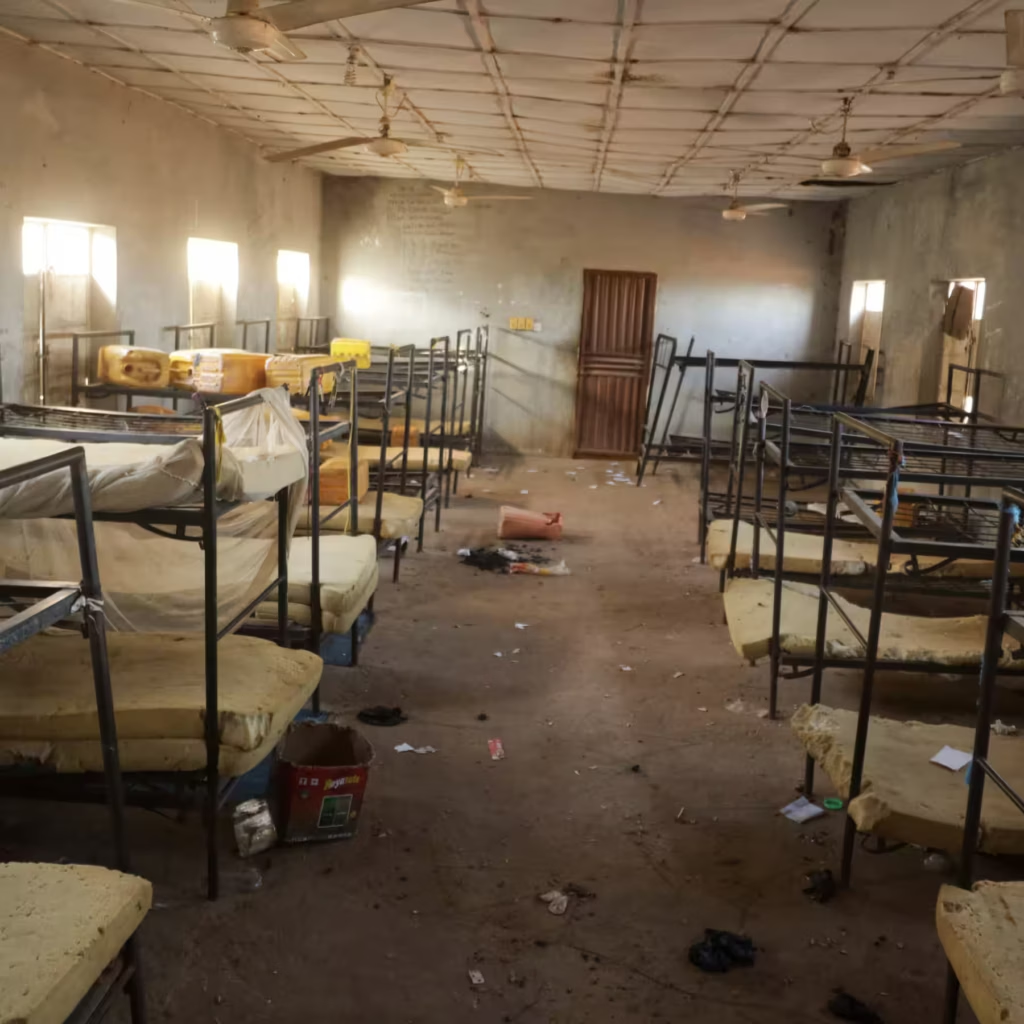
According to Reuters, the Christian Association of Nigeria (CAN), which has been coordinating information from local dioceses, confirmed Saturday that 315 students and staff were kidnapped from St. Mary’s School, raising its earlier estimate of 227 after what it described as an extensive “verification exercise.” The abductions occurred Friday when armed men stormed the school grounds, overwhelming local security and disappearing with the victims into remote forested territory where kidnappers often demand ransom.
Speaking at the conclusion of Mass in St. Peter’s Square, Pope Leo said the news reached him “with deep sorrow,” underscoring not only the magnitude of the violence but the trauma inflicted on families who still do not know whether their children are safe.
“I was deeply saddened to learn of the kidnappings of priests, faithful, and students in Nigeria and Cameroon,” Pope Leo said, addressing thousands gathered for the weekly liturgy. “I feel great pain, especially for the many young men and women who have been abducted and for their anguished families. I make a heartfelt appeal for the immediate release of the hostages and urge the competent authorities to take appropriate and timely decisions to ensure their release.”
He ended his remarks by urging the international community to join in prayer “so that churches and schools may always and everywhere remain places of safety and hope.”
A Growing Pattern of Mass Abductions
The attack on St. Mary’s School is among the largest mass kidnappings in Nigeria in recent years, reviving painful memories of previous abductions, including the 2014 Chibok schoolgirls crisis that drew global outrage. According to CAN, this latest abduction is part of a wave of attacks targeting academic institutions throughout the northwest, prompting government officials to temporarily close 47 schools in the region.
The Nigerian federal government has not yet released an updated tally of victims or announced the formation of a specialized rescue task force. The lack of immediate official clarity has fueled concern among families who gathered outside police stations and church properties over the weekend seeking news of their children. Several parents told local journalists that the attackers arrived in large numbers, firing sporadically and overwhelming the few guards on duty.
St. Mary’s is located in a region plagued by overlapping security challenges — including banditry, insurgent activity, and kidnappings-for-ransom — which have intensified despite repeated government security deployments.
Context: Nigeria’s Security Crisis at a Breaking Point
Nigeria’s northwest has seen a surge in armed group activity over the last five years. Security researchers at the Centre for Democracy and Development say the region’s violence now stems from a mix of criminal gangs, former insurgents, and opportunistic armed networks who see ransom kidnappings as one of the most profitable illicit markets in the country.
A 2024 report by SBM Intelligence estimated that ransom kidnappings generated tens of millions of dollars for armed groups nationwide, rerouting police and military resources away from counterterror operations and creating long-term security challenges. State and federal authorities have repeatedly pledged to crack down on these groups, yet analysts argue that fragmented intelligence coordination and limited rural security infrastructure have hampered efforts.
The abduction at St. Mary’s fits a pattern that security experts say has become alarmingly predictable: poorly defended schools, long response times from overextended security forces and a high likelihood that abducted children will be taken into remote territories that are difficult to access without specialized military equipment.
Economic and Social Impact of School Targeting
The economic consequences of school closures and mass kidnappings ripple far beyond local communities. According to UNESCO, northwestern Nigeria has already experienced some of the world’s fastest-growing rates of school absenteeism due to conflict-related disruptions. Every closure deepens a cycle of educational loss that affects long-term earnings potential, employment prospects and cross-generational mobility.
Parents interviewed by local Nigerian radio stations said they fear this attack may force them to keep their children home even after the government reopens schools. Some teachers in the region have already resigned, citing untenable risks.
The broader economic cost includes reduced labor force participation, declining investor confidence in the northwest and rising humanitarian needs. The United Nations Development Programme reported that insecurity in northern Nigeria reduces annual GDP growth by an estimated 1–2 percent, largely due to disruptions in agriculture and education — two sectors heavily affected by mass violence.
The Vatican’s Voice and International Pressure
Pope Leo’s remarks underscore how closely the Vatican monitors violence against Catholic institutions across Africa, a continent where Catholic schools and churches serve millions. His statement adds diplomatic weight at a moment when Nigerian officials face increasing international scrutiny.
Previous papal interventions have influenced government responses in other crises, including the release of priests abducted in Cameroon in 2023 after strong Vatican pressure. While the Nigerian government has not commented on the Pope’s statement, religious leaders in the country say global attention can accelerate negotiations, particularly in kidnappings involving faith-based institutions.
“Pope Leo’s appeal is not merely spiritual; it is diplomatic,” said Dr. Emmanuel Adesanya, a professor of African political security at the University of Lagos. “It signals that the world is watching, and that can change the calculus for both government officials and kidnappers who may wish to avoid international condemnation.”
Competitive Landscape: Armed Groups vs. State Authority
Nigeria’s northwest has become a contested space where criminal groups compete for territory, ransom income and operational control. These networks, though technically not insurgent groups, often use tactics similar to extremist organizations such as Boko Haram.
The Nigerian military faces a complex environment where armed groups frequently relocate across state borders and benefit from rugged terrain, local informant networks and the government’s limited aerial surveillance capability.
Abductions like the St. Mary’s incident highlight how armed groups exploit gaps in state authority. Negotiations often occur behind closed doors, handled by intermediaries including traditional rulers, clergy and community associations — a system that, while sometimes effective, leaves the government’s long-term security strategy fragmented.
Future Outlook: A Crisis at a Crossroads
Security analysts say Nigeria’s handling of this abduction will shape the trajectory of school safety nationwide. Should authorities move swiftly, demonstrating coordinated rescue operations and stronger deterrence, it may restore public trust. But prolonged inaction or opaque communication could deepen fears, accelerate school closures and embolden kidnappers.
There are also concerns that ransom payments — though officially discouraged — may again form part of negotiations. Without a consistent national framework for responding to mass abductions, experts warn that communities will continue to bear the burden of recovery.
International pressure is likely to grow. The European Union and African Union have repeatedly called for Nigeria to adopt more comprehensive rural security policies, including school fortification, enhanced data collection and early warning systems.
For now, families of the kidnapped wait for any confirmed updates, clinging to hope as church leaders and international bodies amplify their call for action.
Source: Reuters




