

Prince Andrew, the younger brother of King Charles III, was released under investigation Thursday evening after being arrested on suspicion of misconduct in public office in connection with allegations he shared confidential government documents with the late financier Jeffrey Epstein.
Thames Valley Police confirmed that a man in his 60s had been detained and later freed pending further inquiries. A spokesperson for the force indicated that properties in Berkshire and Norfolk were searched as part of what authorities described as an ongoing criminal investigation.
Andrew Mountbatten-Windsor, who turned 66 on Thursday and is eighth in line to the British throne, spent much of the day being questioned by detectives. The arrest marks an extraordinary moment for the monarchy, representing the first time in modern history that a senior royal has been detained on suspicion of such an offense.
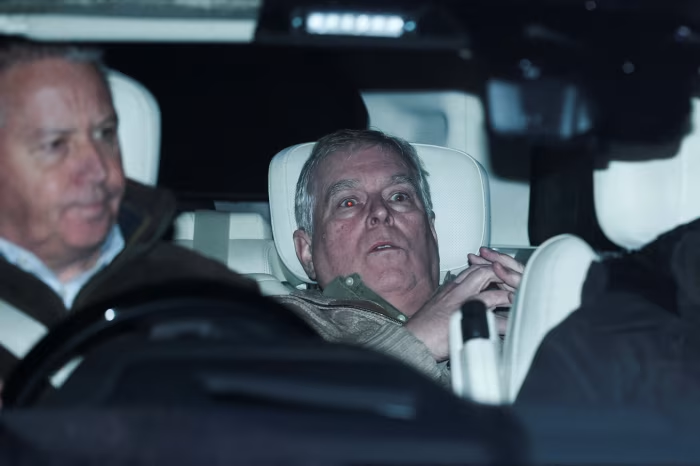
A Reuters journalist observed Andrew departing a police station in Aylsham, eastern England, shortly after 1900 GMT. Photographs taken after his release show him seated inside a vehicle, appearing shaken as cameras gathered outside.
Earlier this month, Thames Valley Police announced that officers were assessing allegations that Andrew had transmitted official briefing materials to Epstein during his tenure as the United Kingdom’s Special Representative for Trade and Investment. Assistant Chief Constable Oliver Wright said the force had initiated a formal inquiry following what he characterized as a “thorough assessment” of the claims.
“We understand the significant public interest in this case, and we will provide updates at the appropriate time,” Wright said.
Police action followed renewed scrutiny after the U.S. government released millions of pages of documents tied to its investigation into Epstein, who was convicted in 2008 of soliciting prostitution from a minor. The files suggested Andrew forwarded reports in 2010 regarding official visits to Vietnam, Singapore and other countries.
Andrew has consistently rejected allegations of wrongdoing connected to Epstein and previously expressed regret over their association. His office did not respond to requests for comment following the arrest.
Buckingham Palace indicated that it had not been informed in advance of the detention. King Charles addressed the matter in a written statement, declaring that he had learned of the development “with the deepest concern.”
“Let me state clearly: the law must take its course,” the monarch said, adding that authorities would have the royal family’s “full and wholehearted support and cooperation.” The king proceeded with a scheduled appearance at a London fashion event but refrained from further public remarks.
The BBC disclosed that detectives planned to continue searches at Royal Lodge in Berkshire, Andrew’s former residence, following his release. Officers were also present earlier at Wood Farm on the Sandringham Estate in Norfolk, where Andrew recently relocated.
An arrest in the United Kingdom requires reasonable suspicion of involvement in a criminal offense but does not constitute proof of guilt. Misconduct in public office, a common law offense not codified in statute, carries a potential maximum sentence of life imprisonment if proven in Crown Court.
The investigation is separate from a 2022 civil lawsuit in the United States brought by Virginia Giuffre, who accused Andrew of sexual abuse when she was a teenager. Andrew settled the case without admitting liability. Giuffre’s family issued a statement Thursday asserting that “no one is above the law, not even royalty.” Giuffre died by suicide last year.
The fallout has reverberated internationally. U.S. President Donald Trump described the situation as “very sad,” telling reporters it was “so bad for the royal family.” Democratic Congressman Suhas Subramanyam, who has advocated for greater transparency regarding Epstein-related documents, told the BBC that the arrest was being monitored closely in Washington.
“In the UK they’re starting to see real accountability for people like Andrew Mountbatten-Windsor,” Subramanyam said. He argued that in the United States, consequences for those named in Epstein files often unfold in the “court of public opinion” rather than through criminal proceedings. He added that Andrew’s detention could intensify calls for voluntary testimony before U.S. lawmakers, though British law does not compel him to appear before Congress.
Separately, anti-monarchy campaign group Republic has referred allegations to police asserting Andrew may have facilitated the movement of a woman to Britain in 2010. Thames Valley Police has indicated it is reviewing claims concerning travel to an address in Windsor. Essex Police confirmed it is examining questions surrounding the passage of women through Stansted Airport during the period in question, following calls from former Prime Minister Gordon Brown for further scrutiny.
Andrew’s legal jeopardy compounds a series of reputational setbacks. In 2019, he withdrew from public duties amid backlash over his association with Epstein. Last October, King Charles removed his military titles and patronages.
Historically, prosecutions of senior royals are exceedingly rare. Princess Anne was fined for speeding in 2001 and pleaded guilty in 2002 to failing to control a dog that bit two children. The last monarch tried for a serious crime was King Charles I, executed in 1649 following a conviction for treason during the English Civil War.
The arrest and subsequent release of Prince Andrew underscore a pivotal test for Britain’s constitutional monarchy. While the royal family remains insulated from political authority, its members are subject to the same criminal statutes as other citizens. King Charles’ emphasis that “the law must take its course” signals a deliberate attempt to reinforce that principle publicly.
The case also highlights the enduring transatlantic shadow cast by Epstein’s criminal enterprise. The release of extensive U.S. investigative files has revived scrutiny of figures previously associated with him, even in the absence of new charges. Legal experts note that being referenced in such documents does not in itself establish wrongdoing, yet public perception often blurs that distinction.
For the monarchy, the investigation arrives at a delicate moment. King Charles has sought to streamline royal operations and project stability following Queen Elizabeth II’s death. Renewed controversy involving his brother risks complicating that effort, particularly as republican movements intensify debate over the institution’s future.
In the United States, lawmakers continue to weigh whether additional hearings or disclosures are warranted. Subramanyam’s remarks suggest congressional interest remains active, though jurisdictional limitations persist.
Ultimately, the outcome of the British inquiry will shape both legal accountability and the monarchy’s moral authority. For now, Andrew remains free but under investigation, a status that preserves the presumption of innocence while keeping the spotlight fixed on the House of Windsor.
Reuters/BBC




