

Defense attorneys launched a psychiatric defense strategy Tuesday for a man accused of brutally killing four homeless men in Manhattan, arguing that untreated schizophrenia and commanding auditory hallucinations drove their client to commit the 2019 murders he admits carrying out.
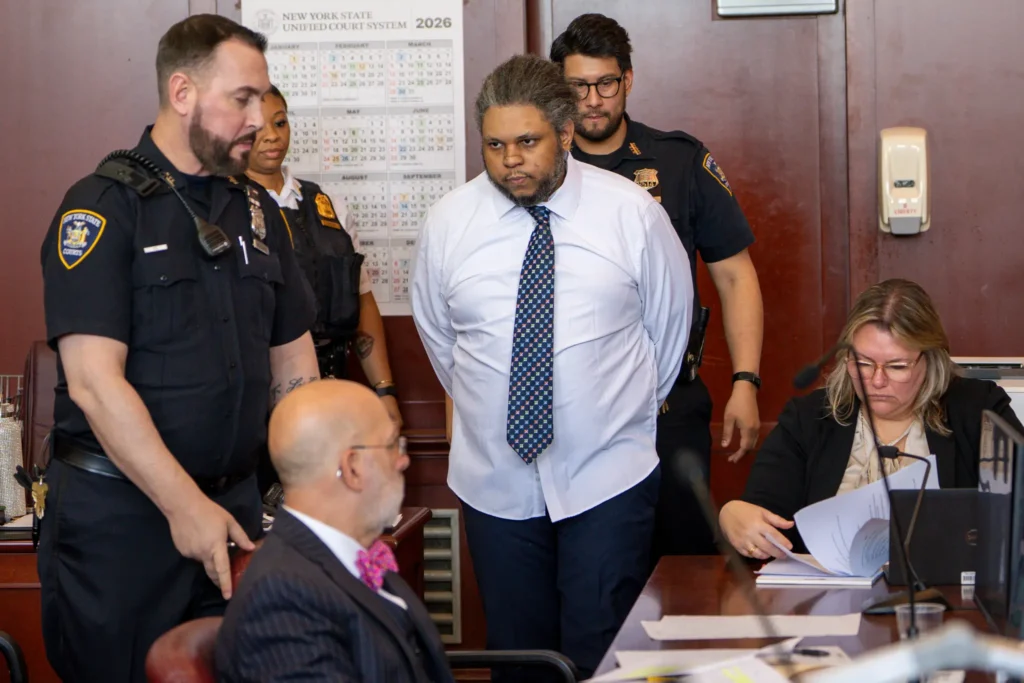
Randy Santos, now 31, heard voices instructing him to “kill 40 people” or face his own death, compelling the predawn rampage that left four vulnerable men dead and two others injured across Manhattan’s Chinatown and Chelsea neighborhoods, his attorney contended during opening statements in Manhattan Supreme Court.
The trial finally commenced nearly seven years after the October 5, 2019 attacks, where prosecutors allege Santos used a scavenged four-foot metal bar to systematically bash the skulls of sleeping homeless men in a methodical killing spree that terrorized the city’s unsheltered population. The defendant faces life imprisonment without possibility of parole if convicted on first-degree murder charges in a proceeding expected to continue for two weeks.
Defense attorney Marnie Zien of the Legal Aid Society acknowledged that her client committed the acts prosecutors describe but argued Santos cannot be held criminally responsible due to his severely compromised mental state at the time. “It was real to Randy,” Zien told jurors as Santos sat beside her with one earbud partially off his head. “He needed the voices to stop; he needed to save his life and didn’t see another way out because of the schizophrenia.”
The defense strategy centers on demonstrating that Santos operated under a “disoriented diseased mind” that prevented him from understanding the nature or wrongfulness of his actions—the legal standard for establishing an insanity defense under New York law. Zien emphasized this approach from the outset: “The defense does not dispute what happened in this case. We dispute what was in his mind at the time of the crime.”
Santos has cycled through psychiatric facilities repeatedly since his arrest, underscoring the severity of his mental health challenges. His attorney maintains he was not taking prescribed schizophrenia medication when the auditory hallucinations became overwhelming, creating a psychotic break that transformed delusional thoughts into violent action.
Manhattan Assistant District Attorney Alfred Peterson presented a starkly different narrative, methodically detailing each attack in a presentation that included surveillance footage showing Santos wielding the metal bar and striking victims. “A stick in one instance, a metal bar in another, directly down in one place on their body—their head,” Peterson told jurors, emphasizing the deliberate and targeted nature of the assaults.
Prosecutors contend Santos demonstrated clear intentionality and awareness of consequences throughout the crime sequence. “(He) knew exactly what he was doing and exactly the consequences of what he was doing and that he was killing these men,” Peterson asserted, directly challenging the psychiatric defense theory that Santos lacked criminal capacity.
The chronology prosecutors outlined reveals escalating violence beginning weeks before the fatal attacks. In late September 2019, Santos allegedly assaulted Kyle Leonard, a homeless man, with a stick near 12th Avenue in Chelsea. Leonard survived the encounter, which Peterson characterized as a “trial run” preceding Santos’ “big day” on October 5.
The fatal rampage began shortly before 2 a.m. when Santos approached two men sleeping on cardboard at the intersection of Bowery and Doyers streets in Chinatown. After striking both victims in the head with the metal bar, Santos initially departed but subsequently returned to the scene, Peterson explained, because he feared he “didn’t complete the job.”
This return to verify his victims’ conditions, prosecutors argue, demonstrates rational thought processes inconsistent with complete psychotic detachment from reality. The decision to seek out additional targets further suggests methodical planning rather than chaotic behavior driven purely by hallucinations.
Following his return to the initial crime scene, Santos traveled to East Broadway where he attacked three additional sleeping men with the same metal weapon. The systematic progression across geographic locations, prosecutors contend, reflects deliberate decision-making that undermines claims of insanity.
Four victims ultimately perished from their injuries: Nazario Vasquez Villegas, Chuen Kwok, Anthony Manson and Florencio Moran Camano. One individual miraculously survived despite severe head trauma. The concentrated targeting of homeless individuals sleeping on the streets highlighted the extreme vulnerability of New York’s unsheltered population to violent predators.
Eyewitnesses who observed Santos delivering fatal blows to victim Kwok immediately contacted emergency services. Patrol officers subsequently spotted the defendant carrying the metal bar over his shoulder, the weapon visibly speckled with patches of hair and blood. Upon arrest, Santos allegedly confessed to the attacks and identified himself in surveillance footage capturing the final murder.
Peterson detailed an additional earlier assault for which Santos faces attempted murder charges. On September 27, the defendant allegedly used an object to strike a sleeping homeless man in Chelsea before “attempted to throw that individual in the Hudson River,” demonstrating both the violent impulses and failed murder attempt that preceded the successful killings.
The prosecution’s case rests substantially on physical evidence, video documentation and Santos’ own admissions. The extensive surveillance footage from multiple locations provides visual confirmation of the defendant’s movements and actions throughout the night. The recovered metal bar, forensically linked to the victims through blood and tissue evidence, establishes the murder weapon definitively.
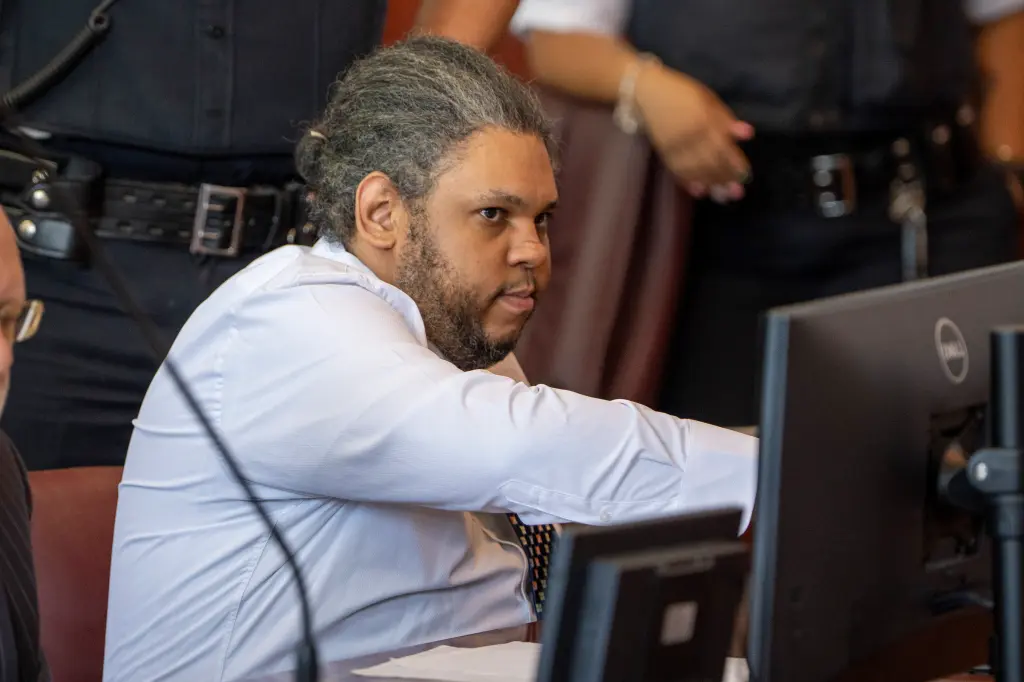
Santos’ documented history of violent, random attacks prior to the killing spree strengthens the prosecution’s argument that he poses ongoing danger requiring permanent incarceration. Law enforcement records indicate a pattern of unprovoked aggression against vulnerable targets, suggesting predatory tendencies rather than isolated psychotic episodes.
The insanity defense faces substantial legal and evidentiary hurdles under New York jurisprudence. Defendants must prove by a preponderance of evidence—more likely than not—that mental disease or defect rendered them incapable of knowing or appreciating either the nature and consequences of their conduct or that such conduct was wrong. Schizophrenia diagnosis alone does not automatically satisfy this standard; the defense must demonstrate the specific psychotic symptoms at the moment of each crime prevented rational judgment.
Prosecutors will likely challenge whether auditory hallucinations, even if genuine, necessarily eliminate criminal responsibility. Many individuals with schizophrenia experience command hallucinations yet retain sufficient reality testing to resist violent urges. The question becomes whether Santos possessed residual capacity to choose lawful behavior despite his mental illness.
The defendant’s ability to identify vulnerable victims in isolated locations, return to crime scenes to verify results, and attempt disposing of evidence by throwing a victim into the Hudson River all suggest preserved cognitive functioning and goal-directed behavior. These actions demonstrate planning, evaluation and adaptation—mental processes that contradict claims of complete psychotic dissociation.
Defense psychiatrists will presumably testify regarding Santos’ mental state during psychiatric examinations and their professional opinions about his capacity for criminal intent on October 5, 2019. Prosecution mental health experts will offer competing assessments, likely arguing that schizophrenia does not preclude the specific intent required for first-degree murder convictions.
Santos currently remains held without bail at Bellevue Hospital, receiving psychiatric treatment while awaiting trial’s conclusion. Defense attorney Arnold Levine declined to provide comment beyond courtroom arguments.
Manhattan District Attorney Cyrus Vance Jr. issued a statement emphasizing the particular vulnerability of the victims. “There is perhaps no population more vulnerable to violence than the growing number of unsheltered New Yorkers who lack a safe place to sleep,” Vance said. “I offer my heartfelt condolences to the victims’ loved ones as our community begins to heal.”
The statement acknowledges broader societal failures that leave homeless individuals exposed to violence while sleeping in public spaces. The 2019 murders spotlighted urgent needs for both expanded mental health services and safe shelter options that could prevent similar tragedies.
The trial’s outcome carries implications extending beyond Santos’ individual case. A successful insanity defense could establish precedent for future cases involving defendants with severe mental illness, potentially influencing how courts balance public safety concerns against recognition of psychiatric impairment. Conversely, conviction despite acknowledged schizophrenia would reinforce that mental illness does not automatically excuse criminal responsibility when defendants retain sufficient capacity to form criminal intent.
Jurors face the challenging task of reconstructing Santos’ subjective mental experience during the attacks based on competing expert testimony, behavioral evidence and their own evaluation of the defendant’s credibility. They must determine whether the voices Santos claims to have heard constituted genuine psychotic symptoms that overwhelmed his volitional control or whether he retained sufficient rational faculties to be held accountable for choosing to kill.
The families of Nazario Vasquez Villegas, Chuen Kwok, Anthony Manson and Florencio Moran Camano await justice nearly seven years after losing their loved ones to brutal violence. The extended delay between crime and trial—though partly attributable to Santos’ psychiatric hospitalizations and legal complexities—has prolonged their suffering and uncertainty.
As testimony proceeds over the coming weeks, the fundamental question remains whether Santos’ schizophrenia genuinely prevented him from understanding his actions’ wrongfulness or whether he committed calculated murders despite his mental illness. The answer will determine whether he spends life imprisoned as a convicted murderer or committed to a psychiatric facility as a patient requiring treatment rather than punishment.




