

CHICAGO — The Rev. Jesse L. Jackson, who emerged from the segregated South to become America’s most prominent civil rights leader after the assassination of the Rev. Martin Luther King Jr., sustained the movement’s moral force across more than five decades of protest, politics, and international diplomacy before dying Tuesday at his Chicago home. He was 84.
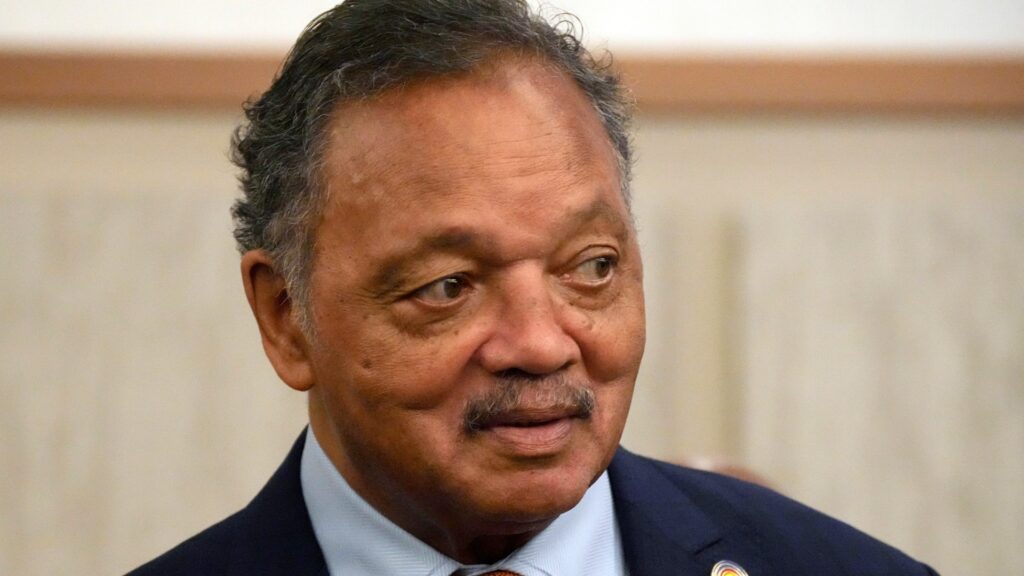
His daughter Santita Jackson confirmed that her father, who suffered from a rare and debilitating neurological disorder, passed away surrounded by family members at his home, ending a life of extraordinary public consequence that transformed American politics, corporate America, and the global understanding of racial justice.
“Our father was a servant leader — not only to our family, but to the oppressed, the voiceless, and the overlooked around the world,” the Jackson family said in a statement. “We shared him with the world, and in return, the world became part of our extended family.”
The Rev. Al Sharpton, whom Jackson mentored across decades of activism, captured the magnitude of the loss with characteristic directness. “He was not simply a civil rights leader; he was a movement unto himself,” Sharpton wrote. “He taught me that protest must have purpose, that faith must have feet, and that justice is not seasonal, it is daily work.”
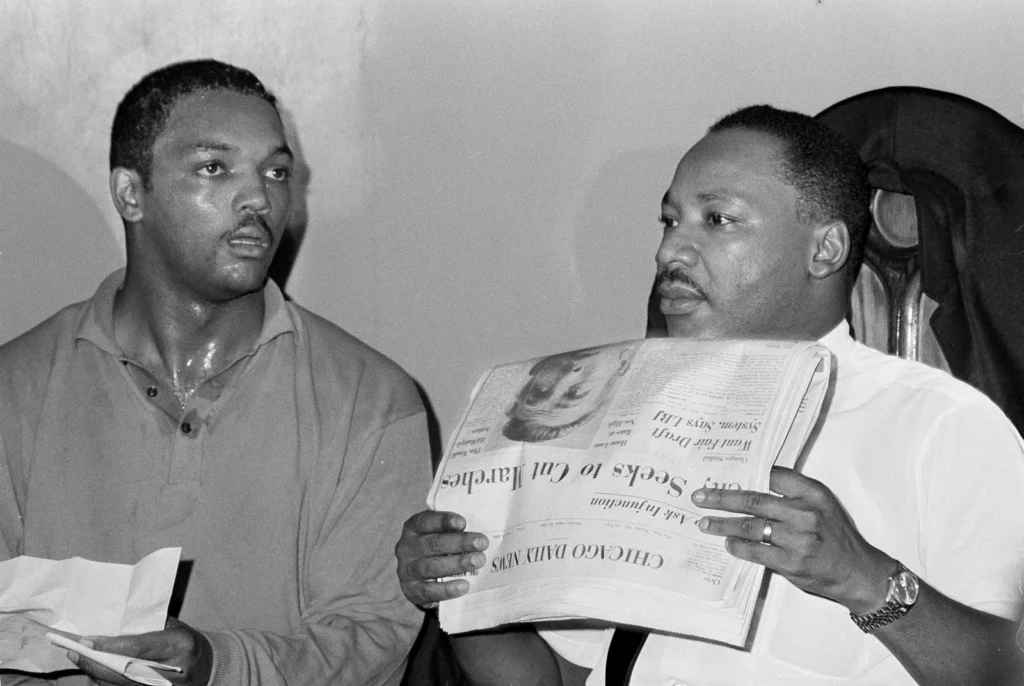
Jackson’s death closes a direct living connection to the civil rights era’s most transformative chapter. He was present at the Lorraine Motel in Memphis, Tennessee, on April 4, 1968, when King was assassinated, and afterward publicly positioned himself as the slain leader’s spiritual and organizational successor—a claim that defined both his towering achievements and the controversies that followed him throughout his remarkable life.
Jesse Louis Jackson was born October 8, 1941, in Greenville, South Carolina, the son of high school student Helen Burns and Noah Louis Robinson, a married neighbor. He was later adopted by Charles Henry Jackson, who married his mother. His origins in the segregated South gave visceral authenticity to his lifelong advocacy for those excluded from American opportunity.
A gifted athlete, Jackson excelled as quarterback on the football team at Sterling High School in Greenville, earning a scholarship from the University of Illinois. However, after reportedly being informed that Black athletes could not play quarterback, he transferred to North Carolina A&T in Greensboro, where he flourished as starting quarterback, honor student in sociology and economics, and student body president—demonstrating the determination to excel despite discriminatory barriers that would characterize his entire career.
His arrival at the historically Black campus in 1960 coincided with students there launching sit-ins at whites-only lunch counters, immersing him in the blossoming Civil Rights Movement at a formative moment. By 1965, he had joined the landmark voting rights march King led from Selma to Montgomery, Alabama, cementing his place within the movement’s core leadership.
King dispatched the young Jackson to Chicago to launch Operation Breadbasket, a Southern Christian Leadership Conference initiative pressuring corporations to hire Black workers—an assignment that showcased both his organizational talent and his ability to translate moral arguments into tangible economic outcomes. Jackson later described his years working directly under King as “a phenomenal four years of work.”
The circumstances of King’s assassination produced one of the most contested episodes in Jackson’s biography. He maintained that King died in his arms and wore a turtleneck he claimed was soaked with King’s blood for two days following the murder, including at a Chicago City Council memorial service. “I come here with a heavy heart because on my chest is the stain of blood from Dr. King’s head,” Jackson declared at that gathering. Several King aides questioned whether Jackson could have gotten blood on his clothing, and no photographs from immediately after the shooting show Jackson in the position he described.
In 1971, Jackson parted ways with the SCLC to establish Operation PUSH—People United to Save Humanity—on Chicago’s South Side. The organization pursued an ambitious agenda spanning workforce diversification, voter registration, and educational reform. Through lawsuits and threatened boycotts, Jackson compelled major corporations to commit millions of dollars and public pledges to hire more diverse employees, channeling the civil rights movement’s moral energy into corporate accountability in ways that fundamentally changed American business practices.
He later merged Operation PUSH with his National Rainbow Coalition to form the Rainbow/PUSH Coalition, which became the institutional home for his ongoing advocacy. Through this platform, Jackson pressured executives in corporate boardrooms, declared that Black pride and self-determination were non-negotiable demands, and channeled the aspirations of marginalized communities into tangible institutional change.
His signature proclamation—”I am Somebody”—distilled his philosophy into a defiant declaration of human dignity. “I may be poor, but I am Somebody; I may be young; but I am Somebody; I may be on welfare, but I am Somebody,” Jackson intoned at rallies across the country, reaching audiences of all backgrounds with a message simultaneously personal and universal.
Jackson’s resonant voice, shaped by the stirring cadences of the Black church, commanded attention wherever he spoke. His deployment of rhyme and memorable slogans—”Hope not dope,” “Keep hope alive,” and “If my mind can conceive it and my heart can believe it, then I can achieve it”—gave his political philosophy a musical quality that made complex arguments accessible and memorable across diverse audiences.
His two campaigns for the Democratic presidential nomination represented watershed moments in American political history. Jackson had once told a Black audience he would not seek the presidency “because white people are incapable of appreciating me,” yet his first campaign in 1984 demonstrated substantial support that his second campaign in 1988 dramatically expanded, winning 13 primaries and caucuses—more than any Black politician had achieved before Barack Obama’s historic 2008 victory.
“I was able to run for the presidency twice and redefine what was possible; it raised the lid for women and other people of color,” Jackson told the Associated Press. “Part of my job was to sow seeds of the possibilities.”
The late Representative John Lewis, himself a civil rights icon, observed during a 1988 C-SPAN interview that Jackson’s presidential campaigns “opened some doors that some minority person will be able to walk through and become president”—a prophecy fulfilled two decades later when Obama won the White House.
When Obama was elected, Jackson stood in Chicago’s Grant Park with tears streaming down his face. “I wish for a moment that Dr. King or Medgar Evers could’ve just been there for 30 seconds to see the fruits of their labor,” he later told the Associated Press. “I became overwhelmed. It was the joy and the journey.”
Jackson also pushed for cultural transformation beyond electoral politics, joining NAACP members and other movement leaders in the late 1980s to promote identifying Black Americans as African Americans. “To be called African Americans has cultural integrity — it puts us in our proper historical context,” he explained. “Every ethnic group in this country has a reference to some base, some historical cultural base. African Americans have hit that level of cultural maturity.”
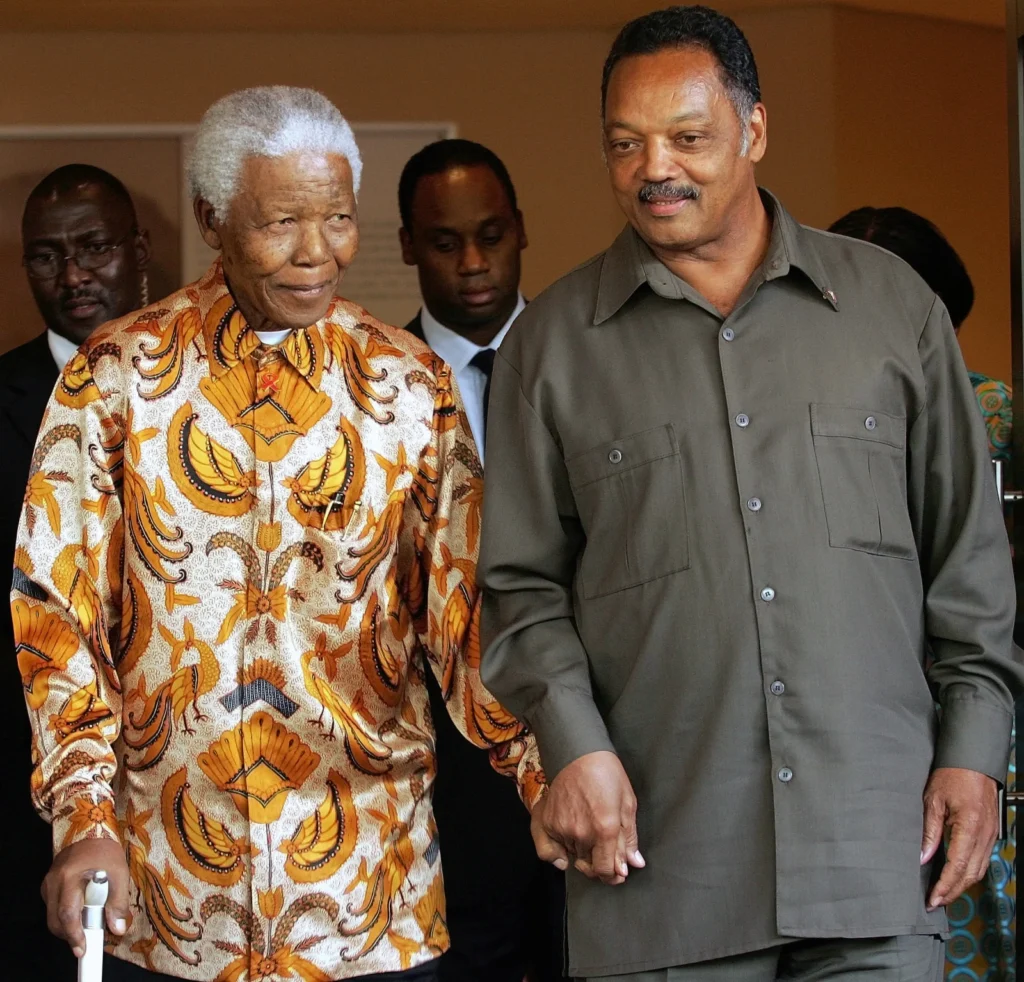
His influence extended powerfully beyond American borders. Jackson secured the 1984 release of Navy Lt. Robert Goodman from Syrian custody through direct negotiations with President Hafez al-Assad, demonstrating that private citizens with moral authority could accomplish what formal diplomacy sometimes could not. In 1990, he obtained freedom for more than 700 foreign women and children held after Iraq’s invasion of Kuwait, and in 1999 he won the release of three Americans imprisoned by Yugoslav President Slobodan Milosevic.
President Bill Clinton awarded Jackson the Presidential Medal of Freedom in 2000—the nation’s highest civilian honor—in recognition of his decades of service to human dignity and democratic values.
“Citizens have the right to do something or do nothing,” Jackson said before departing for one of his diplomatic missions. “We choose to do something.” That phrase encapsulated the activist philosophy he embodied throughout his public life.
Jackson’s career was not without significant controversy. In 1984, he apologized for private remarks to a reporter in which he called New York City “Hymietown,” a derogatory reference to its substantial Jewish population that generated lasting damage to his standing within Jewish communities and raised questions about his commitment to fighting all forms of bigotry. In 2008, an open microphone captured him complaining that Obama was “talking down to Black people” during a television taping break—comments that complicated his relationship with the man whose election he would later celebrate with tears.
He also acknowledged fathering a daughter, Ashley Jackson, with a Rainbow/PUSH employee, Karen L. Stanford. Jackson, who had been ordained as a Baptist minister in 1968 and earned a master’s of divinity degree in 2000, stated he understood what it meant to be born out of wedlock and supported his daughter emotionally and financially.
Critics throughout his career accused Jackson of grandstanding and seeking media attention at the expense of substantive work. Jackson addressed such assessments with characteristic directness, telling the Associated Press in 2011 that decades of effort had produced measurable results. “A part of our life’s work was to tear down walls and build bridges, and in a half century of work, we’ve basically torn down walls,” he said. “Sometimes when you tear down walls, you’re scarred by falling debris, but your mission is to open up holes so others behind you can run through.”
His constant campaigns created enormous demands that fell heavily on his wife, Jacqueline Lavinia Brown, the college sweetheart he married in 1963. She bore primary responsibility for raising their five children: Santita Jackson, Yusef DuBois Jackson, Jacqueline Lavinia Jackson Jr., and two future members of Congress, Representative Jonathan Luther Jackson and Jesse L. Jackson Jr., who resigned from Congress in 2012 and is currently seeking reelection in the 2026 midterms.
Despite escalating health challenges, Jackson refused to retreat from public engagement. He disclosed a Parkinson’s diagnosis in 2017 but continued appearing at demonstrations and public events even as the disease increasingly impaired his speech and mobility. Doctors subsequently confirmed a diagnosis of progressive supranuclear palsy, a life-threatening neurological disorder more severe than Parkinson’s that ultimately robbed him of the powerful voice that had moved millions.
In his final months, requiring around-the-clock care and unable to speak, Jackson communicated through touch—holding visitors’ hands and conveying understanding through gentle pressure. His son Jesse Jackson Jr. told the Associated Press in October that he found the silence profoundly affecting. “I get very emotional knowing that these speeches belong to the ages now,” the younger Jackson said.
Even as his physical capabilities diminished, Jackson’s moral commitments remained undiminished. In 2021, he joined the parents of Ahmaud Arbery in the Georgia courtroom where three white men were convicted of murdering the young Black jogger. In 2022, he hand-delivered a letter to the U.S. Attorney’s Office in Chicago demanding federal charges against former Chicago police officer Jason Van Dyke in the 2014 killing of Black teenager Laquan McDonald. In 2024, despite his deteriorating condition, he appeared at the Democratic National Convention in Chicago and at a City Council meeting supporting a ceasefire resolution in the Israel-Hamas war.
Jackson stepped down as Rainbow/PUSH president in July 2023, closing his formal organizational leadership role while retaining his status as a moral authority and historical witness. During the coronavirus pandemic, he and his wife survived hospitalizations with COVID-19 before he became an early vaccination advocate, specifically urging Black Americans to seek protection given their statistically higher risks for severe outcomes.
His final public reflections revealed a man who understood both what his generation had accomplished and what remained undone. “It’s America’s unfinished business — we’re free, but not equal,” Jackson told the Associated Press. “There’s a reality check that has been brought by the coronavirus, that exposes the weakness and the opportunity.”
That assessment—acknowledging progress while insisting on continued struggle—reflects the essential tension that animated Jackson’s entire public life. Born into a system designed to deny his humanity, he spent 84 years dismantling barriers, registering voters, challenging corporations, running for president, negotiating with dictators, and reminding Americans of the gap between their nation’s ideals and its realities.
Jesse Jackson’s passing leaves an irreplaceable void in American public life and closes a living chapter of the civil rights movement’s history. His legacy endures in the corporations that diversified their workforces under pressure from his campaigns, the voters whose registration he facilitated, the prisoners whose freedom he negotiated, and the political possibilities he expanded for every American of color who came after him.
“Keep hope alive”—the slogan he carried across decades of struggle—now becomes an instruction to those who continue the work he began alongside Martin Luther King Jr. more than sixty years ago on the streets of Greensboro, Selma, Memphis, and Chicago.



