

U.S. Secretary of State Marco Rubio used a Senate Foreign Relations Committee hearing Wednesday to deliver a stark warning to Venezuela’s acting leader, suggesting that Delcy Rodríguez could share the fate of her predecessor, Nicolás Maduro, if she does not align Caracas with U.S. objectives — a confrontation rooted in one of the most dramatic chapters of recent Latin American history.
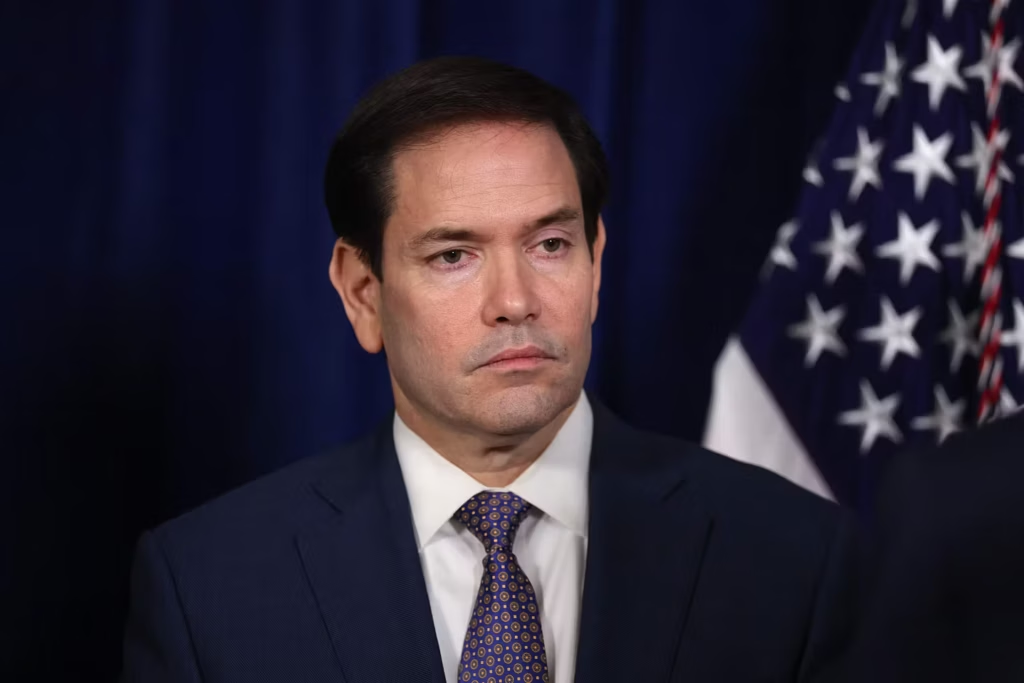
Rubio, whose prepared testimony was made available ahead of the session, framed Washington’s expectations in stark terms, asserting that Rodríguez, who now serves as Venezuela’s acting president, is fully conscious of what happened to Maduro. Maduro was removed from power and taken into U.S. custody during a military operation early in January.
“We believe her own self-interest aligns with advancing our key objectives,” Rubio told lawmakers, emphasizing that the United States is prepared to escalate measures if diplomacy and pressure fail to secure desired cooperation from Venezuelan authorities. He cited the strong message implicit in Maduro’s experience as an example of consequences for non-compliance. Maduro and his wife, Cilia Flores, were seized by U.S. forces and transported to New York to face drug-related charges, which they deny.
Rubio’s comments reflect escalating tensions between Washington and Caracas after the extraordinary early-January operation that resulted in Maduro’s detention. That operation, which involved U.S. special forces, was lauded by the Trump administration as a law enforcement action aimed at narco-trafficking networks but drew widespread shock internationally and raised significant questions about U.S. military authority and regional stability.
U.S. Presence and Policy Post-Maduro
In his testimony, Rubio reiterated that the United States is not engaged in a traditional war against Venezuela, even as pressure mounts for Caracas to transform its political and economic structures in line with Washington’s interests. He noted that the U.S. is exerting influence not through ground occupation but by leveraging strategic assets — including an oil embargo and enforcement of sanctions — to push for a new direction in Venezuelan governance.
Rubio’s remarks come amid a broader debate in Washington over the legal and constitutional limits of U.S. military and diplomatic actions. Congressional Democrats have repeatedly questioned whether the executive branch overstepped its authority in Venezuela, particularly after a war-powers resolution aimed at restricting military involvement narrowly failed in the House of Representatives last week by a 215-215 tie.
Rodríguez’s Complex Position
Delcy Rodríguez, who was Venezuela’s vice president under Maduro, was sworn in as acting president by the country’s Supreme Tribunal of Justice after the U.S. raid, a move that has been accepted by the Venezuelan military but rejected by some international actors, including the European Union, which does not recognize her legitimacy.
Since assuming leadership, Rodríguez has navigated a precarious political landscape: balancing a need to maintain internal legitimacy, particularly among Maduro loyalists, with external expectations from Washington for cooperation on issues including oil production, political reforms and the release of detainees held under the previous regime. Independent observers note that she has publicly expressed both a desire to work with the United States and a rebuke of perceived foreign interference in Venezuela’s internal affairs.
At times, Rodríguez has explicitly pushed back against Washington’s influence. In recent speeches, she declared that Venezuela must resolve its own political conflicts without foreign “orders,” a tone that underscores her attempt to bolster nationalist credentials even as she engages with U.S. officials.
In response to Rubio’s warning, some analysts suggest Rodríguez’s position is strategically constrained by her dual role: she must reassure Venezuelans wary of U.S. intentions while simultaneously seeking pragmatic cooperation to stabilize the economy, particularly around the oil sector. The Trump administration has publicly tied its expectations for Rodríguez to benefiting American oil companies by reopening and expanding U.S. involvement in Venezuela’s state-run energy industry.
Maduro’s Legal Status and International Implications
Meanwhile, Maduro has pleaded not guilty to narcotics and terrorism-related charges in a New York federal court, publicly maintaining that he remains Venezuela’s legitimate president and describing his detention as coercive. His assertions resonate with factions in Venezuela and abroad who view the U.S. operation as a breach of sovereignty.
The legal proceedings against Maduro and Flores — combined with Rubio’s hard line — indicate that U.S. policy toward Venezuela remains rooted in a mix of law enforcement narratives and geopolitical priorities, including counter-narcotics and energy security. However, the unfolding dynamics have also sparked debate in Washington over the separation of powers, with some lawmakers arguing that Congress should have a more definitive role in authorizing military involvements abroad, even those framed as narrowly targeted judicial enforcement actions.
What Comes Next?
Rubio’s testimony underscores the Trump administration’s determination to push for sweeping changes in Venezuela, even as opponents warn that such pressure could deepen domestic polarization or fuel anti-American sentiment within the country. Whether Rodríguez ultimately aligns fully with U.S. demands — or seeks to assert greater autonomy in the face of external pressure — remains a key question for policymakers and analysts alike as the situation continues to evolve.
Bloomberg




